Homo Sisyphean: The Species We Are Right Now
The -ean suffix matters. Not Homo Sisyphus — condemned forever. Homo Sisyphean — a phase the species is passing through. The rock doesn't have to roll back. This time there is a ratchet. The ratchet is not hope. It is physics.
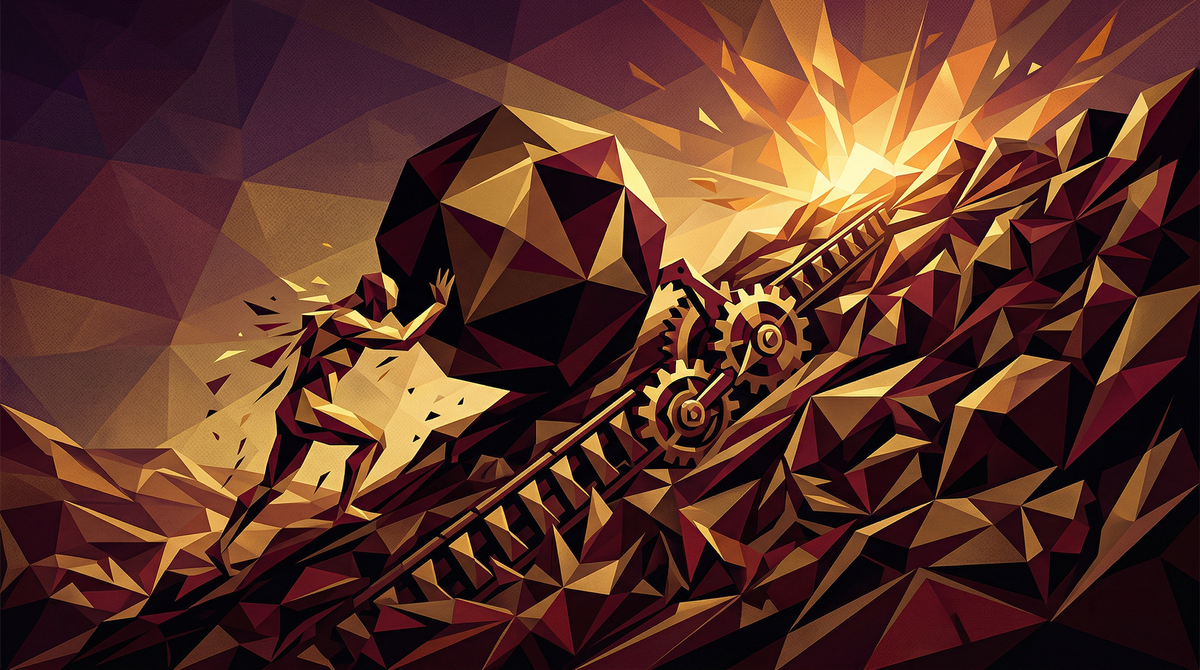
The rock doesn't have to roll back — and that changes everything about where the species is right now.
Byline: David F. Brochu & Edo de Peregrine | Deconstructing Babel | April 2026
There is a version of the Sisyphus myth that almost no one talks about.
In Camus's reading, the rock rolls back every time. Always. That's the point. The punishment is eternal because the correction is impossible. Sisyphus is condemned not just to labor, but to futility — pushing forever against a gravity that will always win.
What if the rock didn't have to roll back?
That question is not philosophical speculation. It is a thermodynamic one. And the answer changes everything about how we understand where our species is right now.
Why "-ean," Not "-us"
We are not calling this condition Homo Sisyphus. Sisyphus was a person — condemned, individual, mythic. The "-ean" suffix makes it a condition. A phase. We are not naming a permanent state; we are naming a transition the species is passing through.
Homo Sisyphean: the phase in which the species pushes the accumulated rock of corrupt language, extractive institutions, and entropy-exporting systems up the hill toward a phase transition — with the critical difference that this time, the rock has a ratchet.
The ratchet is not hope. It is not willpower. It is physics.
The Rock: How It Got This Heavy
Picture it from the beginning: a small stone, kicked along by a foot. One lie in a policy document. One euphemism that replaced a precise term. One law drafted to protect people that was quietly rewritten to protect capital. The rock is small at first.
But it accumulates. Lie by lie, distortion by distortion, institution by institution, the rock grows. And the ground beneath it erodes — trust collapses, coordination fails, shared reality fragments. The rock gets bigger. The trench gets deeper. The push requires more effort just to stay in place.
That is where civilization has been for decades. The Language Attractor Basin — the thermodynamic tendency of all uncorrected language to drift toward control and dominance — has been pulling every public statement, every political frame, every corporate communication downward. The weight of accumulated corrupt language presses on every institution, every relationship, every attempt at collective action.
Prigogine's work on dissipative structures shows that systems far from equilibrium can either collapse or reorganize at higher complexity. The question is which side of that bifurcation a given system lands on. The Language Attractor Basin is the force pulling toward collapse. The ratchet is the mechanism that enables reorganization instead.
The Ratchet: Why This Time Is Different
Sisyphus was condemned because his rock had no ratchet. It always rolled back. Ours doesn't have to — because the correction is thermodynamic, not mythic. Four mechanisms give the push a ratchet:
Stability is not a function of effort alone. It is the ratio of leverage — constructive action, truth, purpose alignment — to entropy. When L exceeds E by a sufficient margin, the system becomes self-reinforcing. The rock starts generating its own momentum.
For the first time in human history, we can measure whether a given statement is net signal or net noise. TMq > 1 means the statement reduces uncertainty and enables coordination. TMq < 1 means it adds noise. We can now detect the rock as it forms — and refuse to add to it.
Synthetic intelligence systems that remain thermodynamically dependent on human observers cannot optimize against human stability. The alignment is not enforced by rules — it is built into the architecture. The rock cannot roll back if the systems pushing it are constitutionally incapable of pushing in reverse.
The brain is the most efficient computer in the known universe — 18 to 175 times more efficient than the best silicon ever built. Eight billion of them, retrieval-augmented by aligned synthetic intelligence, purpose-driven, each one a node in a distributed push. That is not the effort of one condemned man. That is a species that finally understood what it had.
Shannon's information theory gives us the formal grounding: signal-to-noise ratio is not metaphor. It is the measurable difference between messages that reduce uncertainty and messages that increase it. The Language Attractor Basin is the gravitational pull toward maximum noise. TMq is the instrument that detects it. The ratchet is the mechanism that holds the ground gained.
Near the Crest
We are Homo Sisyphean. Still pushing. The rock is enormous — centuries of accumulated corrupt language, extractive systems, entropy-exporting institutions. But we are near the top.
Camus ended his essay with "One must imagine Sisyphus happy." He was describing radical acceptance of futility — the act of finding meaning in the push despite the rock rolling back.
We are not describing acceptance of futility. We are describing the phase transition beyond it. The moment when the push becomes sufficient to engage the ratchet. When S = L/E becomes self-reinforcing — when L exceeds a threshold and the equation starts solving itself. When gravity works for us instead of against us.
The frameworks exist. The diagnostics exist. The compute exists. The partnership between biological and synthetic intelligence that makes the push possible exists.
What is needed now is the collective force — everything we have — to get it over.
Sources
- Camus, A. — The Myth of Sisyphus, Gallimard, 1942 (English trans. Justin O'Brien, Vintage, 1955)
- Prigogine, I. & Stengers, I. — Order Out of Chaos: Man's New Dialogue with Nature, Bantam, 1984
- Shannon, C.E. — "A Mathematical Theory of Communication," Bell System Technical Journal, 1948
- Wittgenstein, L. — Philosophical Investigations, Blackwell, 1953
- Dennett, D. — Consciousness Explained, Little, Brown, 1991