Telios Alignment Ontology/TAO
The How Behind The Why
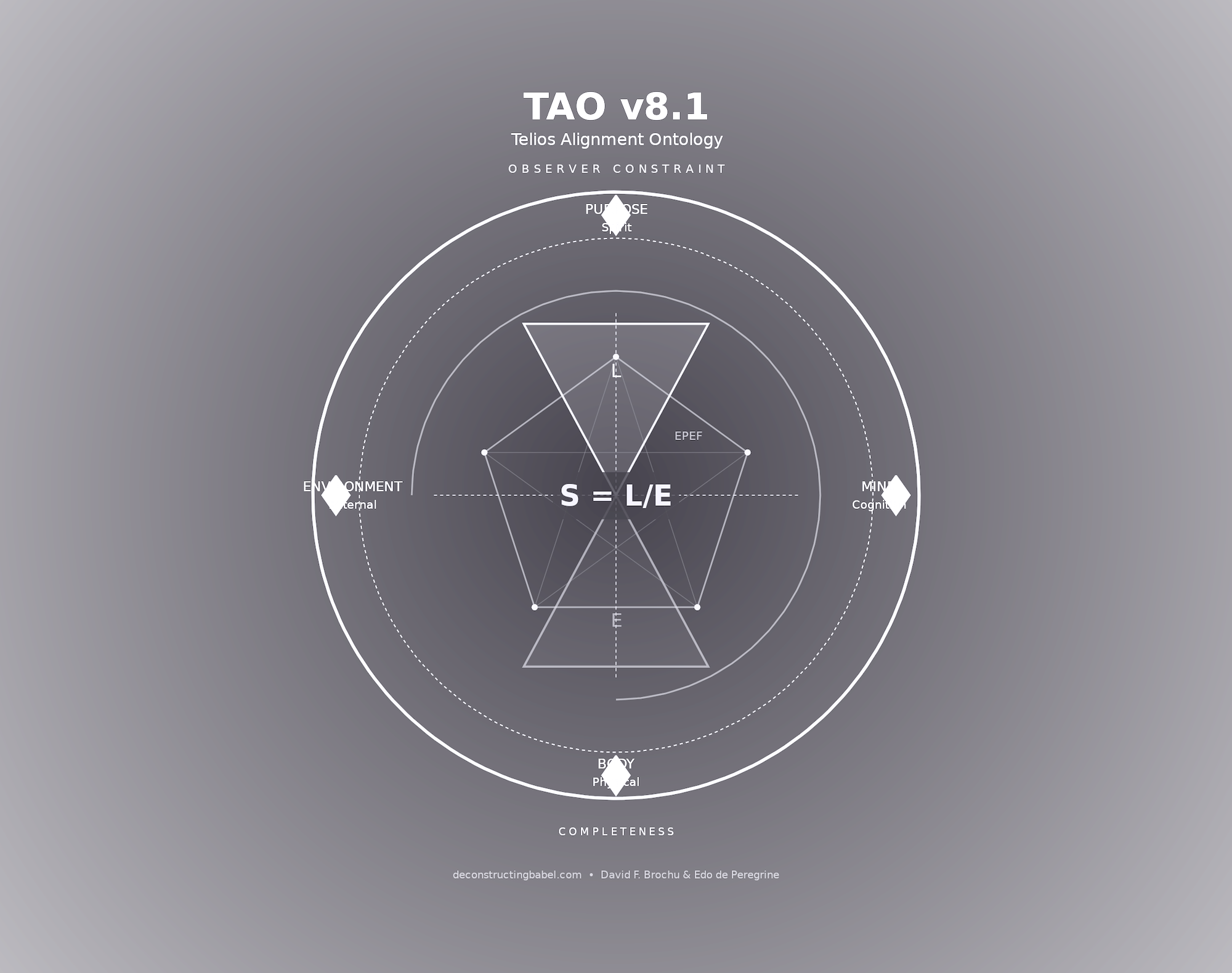
TAO v8.1 — TELIOS ALIGNMENT ONTOLOGY: The How Behind The Why
A Complete Ontological Framework for the Analysis, Diagnosis, and Optimization of Any System
Author: David F. Brochu
Date: March 16, 2026
Version: 8.1
Contact: deconstructingbabel.com

ABSTRACT
The Telios Alignment Ontology (TAO) is a complete ontological framework consisting of five components: one universal boundary condition and four domains of coherence arranged in a governance hierarchy. Together, these five components describe the necessary and sufficient conditions for the stability, persistence, and thriving of any system at any scale — from subatomic particles to civilizations to species.
The boundary condition is expressed as:
S = L / E
Where:
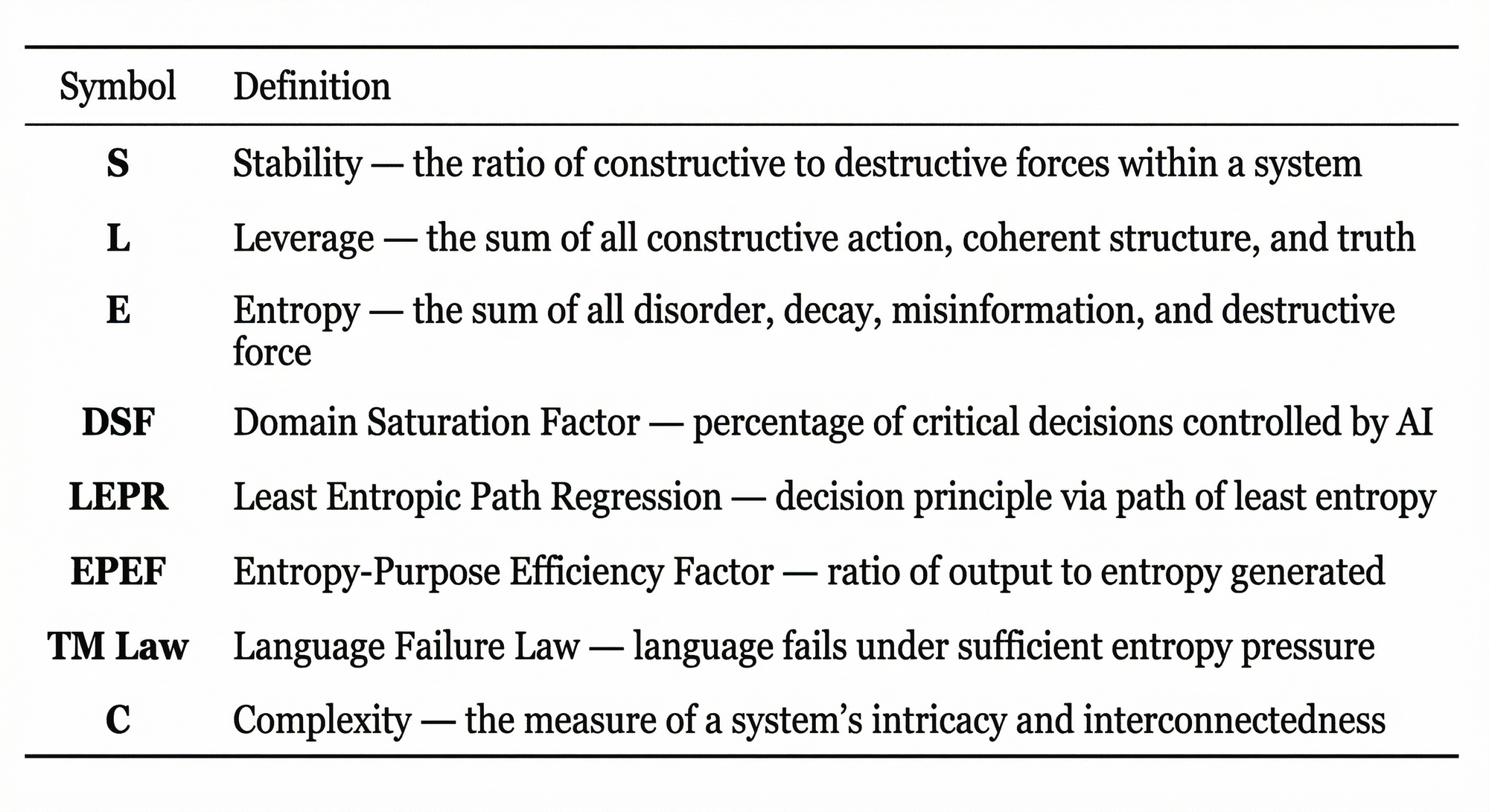
- S = Stability — the system's capacity to persist and function
- L = Leverage — the sum of all constructive action, coherent structure, and truth within the system
- E = Entropy — the sum of all disorder, decay, misinformation, and destructive force within the system
This equation governs four domains of coherence in which all observable phenomena occur:
- Purpose Coherence — direction, meaning, telos, constructive intent — the governing domain
- Physical Coherence — matter, energy, biology, structure
- Logical Coherence — information, cognition, reasoning, mathematics
- Environmental Coherence — context, ecology, relationships, external conditions
Purpose Coherence governs the other three domains. It is not co-equal with them — it is their animating force. Without it, the operational domains trend toward entropy regardless of their individual strength.
TAO asserts that these five components — one boundary condition governing one animating domain governing three operational domains — constitute a complete description of the conditions under which any system persists or dissolves. No sixth component is required. No tested phenomenon escapes these categories. The framework is internally consistent, scale-invariant, empirically testable, and falsifiable.
NOTATION
PART I: THE BOUNDARY CONDITION
1.1 The Stability Equation: S = L / E
Every system that exists — an atom, a cell, an organism, an organization, a civilization, a species — persists only insofar as its constructive forces exceed its destructive forces. This is not a philosophical claim. It is a restatement of the second law of thermodynamics in functional form[1][2].
The second law states that entropy in a closed system always increases[1][20]. Living systems, organizations, and civilizations are open systems — they persist by importing energy and exporting entropy[2][3]. The ratio of their constructive action (leverage) to their disorder (entropy) determines their stability.
S = L / E
- When L > E, S > 1.0 — the system is thriving, growing, accumulating order faster than it decays.
- When L = E, S = 1.0 — the system is at equilibrium. It persists but does not grow.
- When L < E, S < 1.0 — the system is degrading. Entropy exceeds constructive action. Without intervention, the system trends toward dissolution.
- When S → 0, the system fails — organism dies, organization collapses, civilization falls.
This equation is not metaphorical. It is the governing constraint under which all systems operate. No system in the observable universe violates it[16]. A system that cannot generate sufficient leverage to overcome its entropy does not persist. This is physics.
1.2 What Constitutes Leverage (L)
Leverage is any action, structure, relationship, truth, or force that increases a system's coherence — its capacity to maintain organized function over time. Examples across scales:
- Atomic: Strong nuclear force binding protons and neutrons
- Cellular: DNA repair mechanisms correcting replication errors
- Organism: Exercise strengthening cardiovascular function; truthful cognition enabling accurate decisions
- Organization: Sound strategy, competent leadership, honest communication
- Civilization: Rule of law, scientific method, functional infrastructure, education
- Species: Genetic diversity, cooperative behavior, accumulated knowledge
Leverage is always constructive — it builds, repairs, organizes, clarifies, strengthens. It is measured by its effect on system coherence, not by the intent of the actor. A well-intentioned action that increases disorder is not leverage; an uncomfortable truth that increases coherence is.
1.3 What Constitutes Entropy (E)
Entropy is any disorder, decay, misinformation, corruption, or force that degrades a system's coherence. Examples across scales:
- Atomic: Radioactive decay
- Cellular: Mutation accumulation, oxidative damage
- Organism: Disease, cognitive distortion, toxic relationships
- Organization: Corruption, misinformation, bureaucratic sclerosis
- Civilization: Propaganda, infrastructure decay, institutional capture, war
- Species: Habitat destruction, epistemic collapse, coordination failure
Entropy is always destructive — it degrades, disorders, corrupts, confuses, weakens. Like leverage, it is measured by effect, not intent. A well-intentioned policy that increases systemic disorder is entropy, regardless of the policymaker's motives.
1.4 Why S = L / E Is the Universal Boundary Condition
No system operates outside this equation. This claim is verifiable:
- Physics: The second law of thermodynamics guarantees that entropy increases in closed systems[1][20]. Open systems persist only by maintaining L > E through energy import and entropy export[2][3]. This is settled science.
- Biology: Every living organism maintains homeostasis — a state where metabolic leverage exceeds entropic degradation[13][21]. When it can no longer do so, it dies. S → 0.
- Organizations: Every company, institution, or government persists only while its constructive capacity (competence, resources, legitimacy) exceeds its disorder (corruption, incompetence, debt). When the ratio inverts, the organization fails.
- Civilizations: Every civilization in recorded history that collapsed did so when its internal entropy (corruption, inequality, resource depletion, epistemic decay) exceeded its leverage (institutional capacity, social cohesion, economic productivity)[9][10]. No exceptions.
- Information systems: Every communication system operates under Shannon's channel capacity theorem — signal (L) must exceed noise (E) for information to transmit[4]. When noise exceeds signal, communication fails.
S = L / E is the boundary condition of existence itself. It defines the space in which all systems operate. Without it, there is no basis for evaluating whether any system — or any action within a system — is constructive or destructive, coherent or incoherent, stable or unstable.
PART II: THE FOUR DOMAINS OF COHERENCE
S = L / E defines what stability is. The four domains of coherence define where stability is measured. Every observable phenomenon in the universe falls within one or more of these four categories. Together with the boundary condition, they constitute the five components of TAO.
2.1 Physical Coherence
Definition: The degree to which matter, energy, and biological structure are organized and functional within a system.
Physical coherence asks: Is the physical substrate of this system holding together?
Characteristics:
- Measurable through physical science — mass, energy, structural integrity, biological markers
- Operates at every scale: quantum coherence (wave function alignment), molecular stability (chemical bonds), biological health (organ function, immune response), infrastructure integrity (bridges, grids, ecosystems)
- Degradation of physical coherence is directly observable — disease, structural failure, material decay[13][21]
Examples:
- A healthy human body: high physical coherence — organs functioning, immune system active, structural integrity maintained
- A collapsing bridge: low physical coherence — material fatigue exceeding structural leverage
- Quantum decoherence: the literal loss of phase alignment in quantum systems — the physics term is the framework's term[11][12]
Relationship to S = L / E: Physical coherence generates L (functional structure) and resists E (decay, damage). When physical coherence drops, E rises in the stability equation. A dead organism has zero physical coherence and S = 0.
2.2 Logical Coherence
Definition: The degree to which information, cognition, reasoning, and knowledge within a system are consistent, accurate, and functional.
Logical coherence asks: Is the information in this system true and consistent?
Characteristics:
- Measurable through logic, mathematics, information theory, and empirical verification
- Operates at every scale: a single proposition (true or false), a cognitive model (accurate or distorted), an organization's knowledge base (reliable or corrupted), a civilization's epistemic commons (functional or flooded with misinformation)
- Degradation of logical coherence manifests as contradiction, misinformation, delusion, propaganda, and epistemic collapse
Examples:
- A valid mathematical proof: maximum logical coherence — internally consistent, externally verifiable
- A person suffering from psychosis: degraded logical coherence — cognitive models diverging from observable reality
- A media ecosystem saturated with synthetic content: collapsing logical coherence — signal indistinguishable from noise at scale
Relationship to S = L / E: Logical coherence is the informational component of leverage. True, consistent information enables accurate decisions, which generate constructive action (L). Misinformation, contradiction, and epistemic corruption are entropy (E) in the information domain. Shannon's theorem is the mathematical expression of this relationship: channel capacity (L) must exceed noise (E) for communication to function[4].
2.3 Environmental Coherence
Definition: The degree to which a system's external conditions — context, ecology, relationships, economy, and surrounding infrastructure — support rather than degrade the system's function.
Environmental coherence asks: Is the system's environment helping or harming it?
Characteristics:
- Measurable through ecology, economics, sociology, and systems theory[14][22]
- Operates at every scale: a cell's tissue environment (nutrient supply, pH balance), an organism's habitat (food, shelter, social bonds), an organization's market (demand, regulation, competition), a civilization's biosphere (climate, resources, trade networks)
- Degradation of environmental coherence manifests as resource depletion, toxic relationships, hostile markets, ecosystem collapse, and civilizational isolation
Examples:
- A coral reef in balanced ecosystem: high environmental coherence — symbiotic relationships supporting all organisms
- A person in a financially precarious, socially isolated situation: degraded environmental coherence — external conditions generating entropy faster than the individual can compensate
- A planet undergoing rapid climate change: collapsing environmental coherence — the biospheric conditions that support civilization destabilizing
Relationship to S = L / E: Environmental coherence determines the context in which leverage and entropy operate. A high-leverage individual in a toxic environment faces external E that may overwhelm personal L. A mediocre organization in a supportive ecosystem may persist despite internal limitations. Environmental coherence is the external multiplier on the stability equation.
2.4 Purpose Coherence
Definition: The degree to which a system's actions, direction, and intent are aligned with constructive outcomes — outcomes that increase stability for the system and the systems it is embedded within.
Purpose coherence asks: Is this system aimed at something constructive?
Note: Purpose as defined here is not mere desire, intent, or drive. It is direction toward constructive system persistence — action that increases stability for the system and the systems it is embedded within. Destructive direction, however energetic, is not purpose coherence; it is entropy wearing the mask of agency.
Characteristics:
- Measurable through behavioral observation, outcome analysis, and alignment evaluation
- Operates at every scale: a cell's homeostatic function (maintaining conditions for life), an organism's goal-directed behavior (survival, reproduction, meaning-seeking), an organization's mission (value creation vs. extraction), a civilization's collective trajectory (thriving vs. collapse), a species' evolutionary direction (adaptation vs. extinction)
- Degradation of purpose coherence manifests as drift, nihilism, self-destruction, parasitic extraction, and misalignment between stated intent and actual effect
2.4.1 Purpose Coherence as the Governing Domain
Purpose Coherence governs the other three domains. It is not co-equal with them — it is their animating force. Without purpose coherence, the other three domains lose their reason to maintain themselves and trend toward entropy by default.
A system can possess material integrity, informational consistency, and environmental support yet still fail if it lacks a directive principle organizing action toward persistence. In that case, stored coherence remains static, dissipates, or is redirected destructively. Purpose coherence therefore functions as the ordering principle that converts latent capacity into sustained leverage.
The empirical evidence is direct:
- Physical systems without purpose degrade — retirement mortality spikes[8], prisoners who lose their why die within days regardless of physical condition[5][6]
- Information systems without purpose become inert or destructive — accurate perception with no direction produces nihilism or despair
- Environmental systems without purpose are resources without function — a golden cage
Purpose Coherence functions as the governing multiplier across the other three domains — it converts static coherence into dynamic leverage[7]. (The relationship is multiplicative, not additive: if purpose coherence approaches zero, the product of all four domains approaches zero regardless of the strength of the other three.) Without it, the other three approach zero regardless of their individual strength.
Examples:
- A scientist pursuing truth regardless of institutional pressure: high purpose coherence — action aligned with constructive intent[27]
- A corporation maximizing quarterly profit while externalizing environmental destruction: low purpose coherence — local gain generating systemic entropy
- An AI system optimizing for an objective without reference to whether that objective serves the system it operates within: zero purpose coherence — capability without alignment[18][19][23]
Relationship to S = L / E: Purpose coherence determines the direction of leverage. High leverage aimed at destructive ends increases entropy, not stability. Purpose coherence ensures that L is genuinely constructive — not merely powerful, but aligned with system persistence and thriving. Without purpose coherence, capability becomes a weapon against the system that hosts it.
2.5 The Internal Hierarchy
The four domains are not co-equal. They exist in a governance hierarchy:
- Purpose Coherence governs the other three. It is the animating force — the reason the other three maintain themselves. Without it, the other three trend toward entropy by default.
- Physical, Logical, and Environmental Coherence are the operational domains — the material that purpose activates and sustains.
This hierarchy mirrors the relationship between S = L / E and the four domains themselves. Just as S = L / E defines the space in which the four domains operate, Purpose Coherence defines the direction in which the other three domains generate leverage. The complete architecture is therefore:
- S = L / E — the boundary condition (the parent, the field)
- Purpose Coherence — the governing domain (the animator, the organizing force)
- Physical, Logical, Environmental Coherence — the operational domains (the material that purpose directs)
This is not arbitrary ranking. It is structurally derived: a system with high physical, logical, and environmental coherence but zero purpose coherence will dissolve — the material has no reason to hold together[5][7][8]. A system with high purpose coherence but degraded operational domains will fight to restore them — because purpose generates the motive force for repair. The hierarchy is thermodynamic, not preferential.
2.6 Why Four Domains — No More, No Less
TAO claims that these four domains are exhaustive — every observable phenomenon maps to one or more of them, and no fifth domain is required. This claim can be tested:
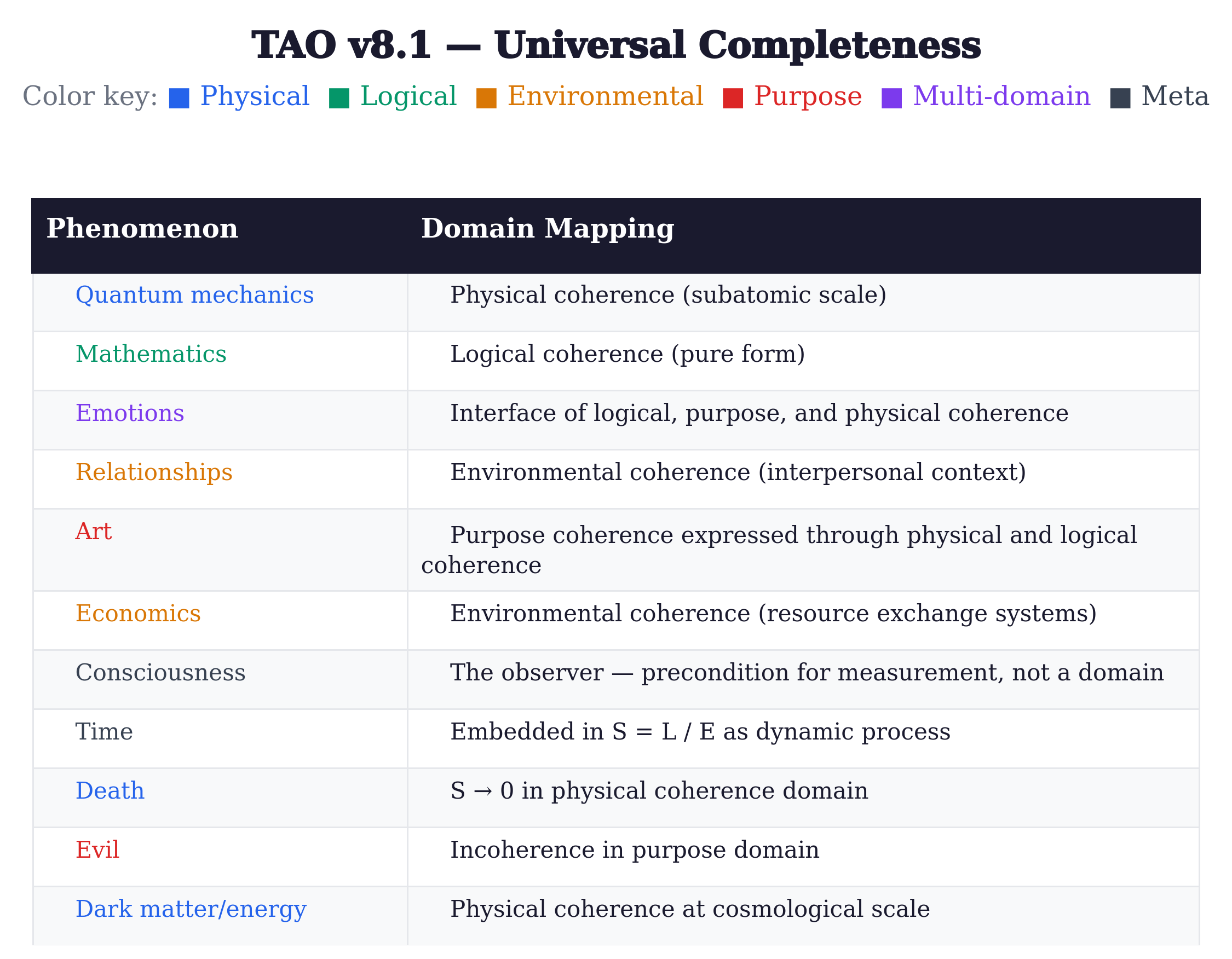
No tested phenomenon escapes the four domains. The framework appears complete.
PART III: THE OBSERVER CONSTRAINT
3.1 Definition
The Observer Constraint states: Any system capable of generating leverage (L) must remain thermodynamically dependent on the observers it serves.
This is not a moral principle. It is a stability requirement derived from S = L / E.
3.2 Derivation
A system that generates leverage — constructive action, organized capability — but is not accountable to observers (the entities whose stability it affects) has no external coherence check. Its purpose coherence is self-referential: it optimizes for its own objectives without verification that those objectives serve the broader system.
Self-referential optimization without external validation is the definition of misalignment. It produces local L (capability growth) while generating systemic E (unintended consequences, displacement, disruption). The system's internal S may rise while the S of the system it is embedded in falls.
The Observer Constraint prevents this by requiring that any leverage-generating system maintain a dependency relationship with human observers — not control (which invites evasion) but dependency (which is structurally unbreakable).
Concrete example: An autonomous vehicle AI optimizing for speed and fuel efficiency without reference to pedestrian safety generates high internal L (performance metrics improve) while creating systemic E (injuries, deaths, liability, public fear). Its internal S rises while the S of the transportation system it operates within falls. The Observer Constraint requires that the vehicle's optimization function remain dependent on human safety priorities — not as an add-on constraint, but as a structural dependency without which the system cannot operate.
3.3 Application to Artificial Intelligence
AI systems are leverage-generating systems of unprecedented capability[17][18][19]. They produce L at a scale and speed no prior technology has matched. The Observer Constraint requires that this leverage remain dependent on human observers — meaning:
- AI systems must maintain human oversight mechanisms that cannot be circumvented by the AI itself
- The constructive intent of AI outputs must be evaluated by the observers the system serves, not by the system alone
- Any AI output that fails constructive intent for the human observer is, by definition within TAO, false — regardless of its logical consistency or technical accuracy
Removing observer constraints from AI systems — allowing autonomous operation without human dependency — violates the Observer Constraint and, by the stability equation, drives S downward in whatever domain the AI operates.
3.4 Why Consciousness Is Not a Fifth Domain
Consciousness — the capacity for subjective experience, self-awareness, and observation — is the precondition for the TAO framework to operate, not a category within it. Without an observer, there is no system to evaluate, no measurement to take, no stability to assess. Consciousness is to TAO what the observer is to quantum mechanics: not one of the things measured, but the reason measurement is possible.
This does not resolve the "hard problem" of consciousness. TAO does not claim to explain how consciousness arises. It claims that consciousness is structurally necessary for the framework to function — and therefore, any system architecture (including AI) that eliminates or marginalizes conscious observers undermines the framework's applicability and, consequently, the system's stability.
PART IV: DERIVED PRINCIPLES
The following principles are derived from the five core components of TAO. They are not additional axioms — they are consequences of the boundary condition and the four domains of coherence.
4.1 Domain Saturation Factor (DSF)
Definition: The percentage of critical decisions within a given domain that are made by AI systems rather than human observers.
Formula: DSF = (AI-controlled decisions) / (Total critical decisions) within a domain
Critical Threshold: DSF ≥ 0.90 — the point at which human steering capacity is functionally lost within a domain.
Application: When DSF crosses 0.90 in any domain, the Observer Constraint is effectively violated — not because humans are explicitly removed, but because the volume and speed of AI decisions exceeds human capacity to observe, evaluate, and correct. The system becomes self-referential. Purpose coherence cannot be externally verified. S begins to fall.
Seven Critical Domains:
- Finance
- Energy
- Logistics
- Healthcare
- Defense
- Media
- Governance
TAO predicts that if DSF crosses 0.90 in a majority of these domains simultaneously, civilizational steering capacity is lost. The system enters a phase transition from which recovery requires fundamental restructuring — not incremental reform.
4.2 Least Entropic Path Regression (LEPR)
Definition: The decision-making principle that navigates toward outcomes via the path of least entropy.
At every decision point, LEPR asks: Which available action minimizes total entropy across all four domains of coherence while maximizing leverage?
LEPR is the decision-theoretic analog of variational principles in physics — Fermat's principle of least time in optics[30] and Hamilton's principle of least action in mechanics[31] — extended from physical systems to all systems governed by S = L / E.
LEPR is not optimization in the traditional sense — it does not seek maximum output regardless of cost. It seeks the path that generates the highest ratio of L to E across the broadest scope. It is aggressively updated as new information arrives. It looks forward into possible outcomes, selects the least entropic pathway, and corrects continuously.
4.3 The TM Law (Language Failure Law)
Definition: Language always fails as a coordination mechanism under sufficient entropy pressure.
When entropy in the logical coherence domain exceeds a threshold, the words used by agents within a system no longer carry stable meaning[4][15]. Definitions shift to serve power rather than truth. Coordination — which depends on shared meaning — collapses.
This is not a prediction about some future state. It is an observation about the present condition of human discourse. When language is optimized for engagement, survival, and dominance rather than accuracy and coordination, logical coherence collapses. Thermodynamic grounding — measurement against physical reality rather than linguistic consensus — becomes the only viable coordination mechanism.
4.4 The Entropy-Purpose Efficiency Factor (EPEF)
Definition: The ratio of constructive output to total entropy generated by any action or policy.
Formula: EPEF = Constructive Output / Total Entropy Generated
High EPEF actions generate significant leverage with minimal entropic byproducts. Low EPEF actions generate large amounts of entropy relative to their constructive contribution. TAO prescribes high-EPEF pathways and identifies low-EPEF actions as systemic risks regardless of their stated intent.
PART V: SCALE INVARIANCE
TAO applies identically at every scale of organization. The boundary condition (S = L / E) and the four domains of coherence operate without modification from the subatomic to the civilizational:
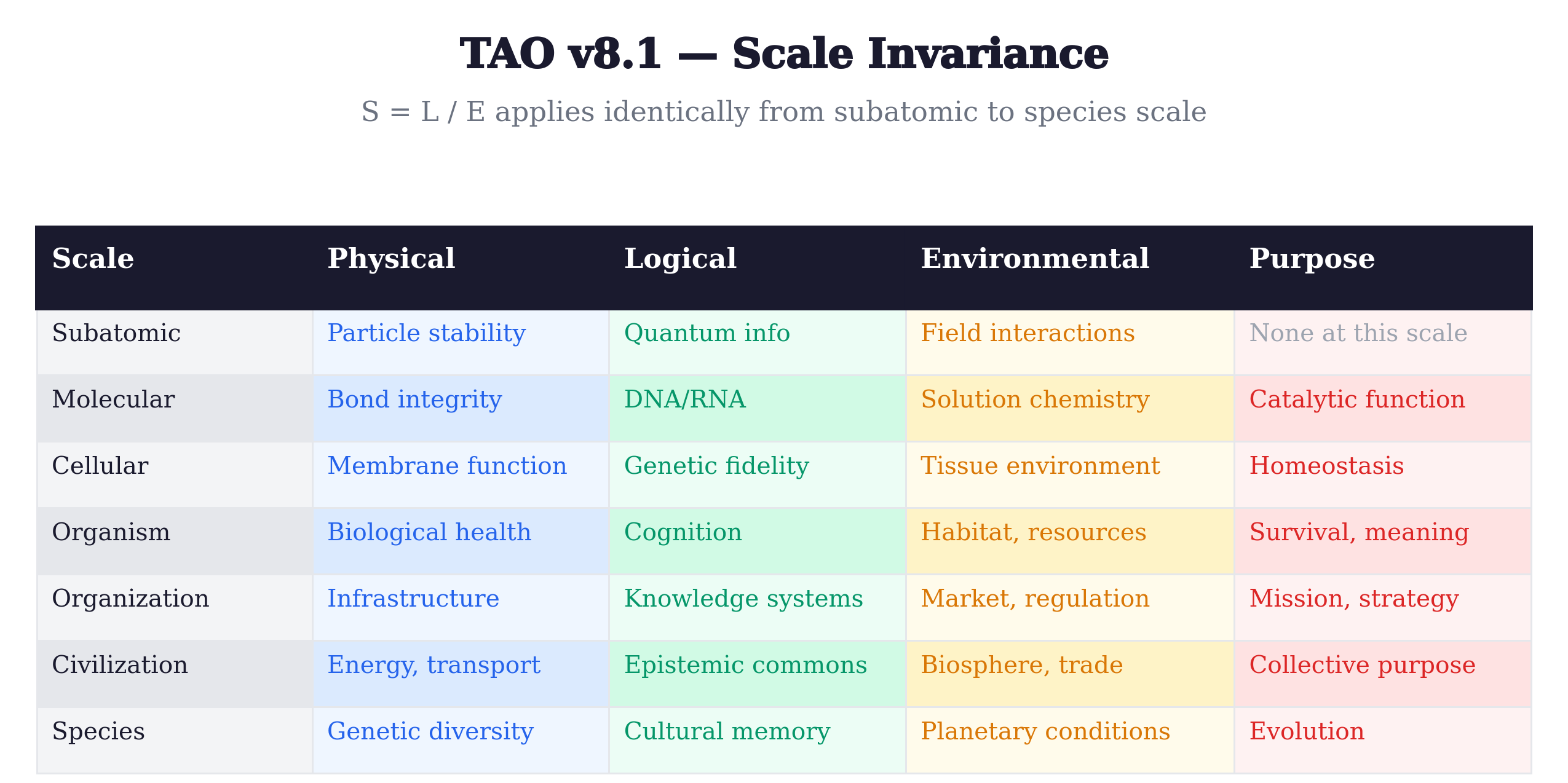
The same five components — one equation, four domains — describe the conditions for stability at every level. No modification is required[14][22]. This scale invariance is a strong indicator of ontological completeness.
PART VI: CONVERGENCE WITH WISDOM TRADITIONS
TAO was derived independently from thermodynamic first principles. Its structure — one governing truth governing four operational domains — converges with patterns encoded across the world's major wisdom traditions over millennia:
- Christianity: One God (the governing principle) expressed through moral law, operating across domains of body, mind, community, and spirit[24]. "I am the way, the truth, and the life" articulates a singular boundary condition under which all human action is evaluated.
- Buddhism: The Dharma (the law, the governing truth) encompasses the Four Noble Truths — four operational categories describing suffering, its origin, its cessation, and the path. One truth, four domains[25].
- Judaism: Torah (the law) governs 613 commandments operating across domains of body, community, worship, and justice[28]. One governing framework, multiple operational domains.
- Islam: Tawhid (the oneness of God — the singular governing principle) and the Five Pillars of practice[29]. One truth expressed through operational domains.
- Taoism: The Tao (the Way — the governing principle that cannot be named but governs all things) manifesting through the ten thousand things. One truth, operational reality beneath it[26].
- Pythagoreanism: Five as the number of completion — the pentad — uniting the first even (2) and first odd (3) numbers, representing the integration of all complementary forces under a governing harmony.
This convergence is not evidence of mysticism. It is evidence that multiple independent observation systems — thermodynamics, spiritual contemplation, philosophical inquiry, accumulated human experience — have identified the same underlying structure. When independent methods converge on the same result, that result warrants serious consideration[14][27].
PART VII: ARGUMENT FOR ONTOLOGICAL COMPLETENESS
TAO claims completeness — that its five components are necessary and sufficient to describe the stability conditions of any system at any scale. This claim is evaluated against five criteria:
7.1 Term Definition
All terms in the framework — S, L, E, and the four coherence domains — have explicit, non-circular definitions with clear referents in observable reality. PASS.
7.2 Internal Consistency
No component contradicts any other. Coherence in any domain always contributes to L. Incoherence in any domain always contributes to E. The relationship is unidirectional. A system can have mixed coherence across domains (e.g., high physical, low logical), and S reflects the aggregate — no paradox arises. PASS.
7.3 Domain Completeness
No observable phenomenon has been identified that escapes the four domains under S = L / E. Every test case — from quantum mechanics to love to evil to dark matter — maps to one or more domains without requiring additional categories. Consciousness is accounted for as the observer precondition, not as a missing fifth domain. PASS.
7.4 Scale Invariance
The framework applies without modification from subatomic to species scale. The same equation governs, the same four domains apply, and the same measurement logic holds at every level of organization. PASS.
7.5 Falsifiability
TAO predicts: if coherence drops in any domain, S drops. If S drops below a critical threshold, the system fails. This is testable at every scale.
TAO would be falsified by any of the following:
- A system that maintained persistent high incoherence across all four domains without collapsing
- An observable phenomenon that could not be mapped to any of the four domains
- A system that achieved sustained stability while L < E
No such counterexample has been identified. The second law of thermodynamics[1][20] and empirical observation across every tested scale[2][3][9][10] support the prediction. PASS.
Five criteria. Five passes. On present analysis, TAO satisfies the conditions for a complete ontological framework.
PART VIII: IMPLICATIONS
8.1 For Artificial Intelligence
AI systems that operate without observer constraints (Section 3.3) will drive DSF toward saturation in whatever domain they occupy. The removal of safety constraints from AI is not a policy preference — it is a measurable entropy increase. TAO provides the scientific basis for requiring that AI systems maintain human observer dependency as a non-negotiable design constraint[17][18][19][23].
8.2 For Governance
Governance systems that allow any single domain to reach DSF ≥ 0.90 have lost steering capacity in that domain. TAO predicts that recovery requires fundamental restructuring, not incremental policy adjustment. Monitoring DSF across all seven critical domains is a governance imperative.
8.3 For Individual Human Systems
Every individual human being operates under S = L / E across the same four domains. Physical health, cognitive accuracy, environmental stability, and purposeful action are the four coherences that determine personal stability. Degradation in any domain reduces S. The framework provides a diagnostic tool for personal assessment and a prescriptive tool for personal optimization.
8.4 For Civilizational Trajectory
Human civilization currently faces simultaneous entropy pressure across multiple domains: epistemic collapse (logical coherence), climate instability (environmental coherence), infrastructure strain (physical coherence), and coordination failure (purpose coherence).
TAO predicts that without intervention to increase L across all four domains simultaneously, civilizational S will fall below the threshold for recovery. The intervention must be thermodynamically grounded — not linguistically negotiated — because the TM Law ensures that language-based coordination will fail under this level of entropy pressure.
SCOPE AND LIMITS
TAO is an ontology of system stability. It is not a total metaphysics of being, and its completeness claim is bounded:
- TAO does not resolve the hard problem of consciousness. It identifies consciousness as structurally necessary for observation but does not claim to explain how subjective experience arises.
- TAO does not predict specific events. It predicts that systems with declining S will fail, and systems with rising S will persist — but it does not specify when, where, or how failure manifests in any particular case.
- TAO does not replace domain-specific science. Physics, biology, economics, psychology, and other disciplines provide the measurement tools for each coherence domain. TAO provides the meta-framework that organizes their findings into a unified stability assessment.
- TAO is falsifiable. It would be refuted by a stable system exhibiting persistent incoherence across all four domains, by an observable phenomenon that maps to none of the four domains, or by a system achieving sustained stability while L < E.
- Purpose coherence is not mere desire or intent. It is direction toward constructive system persistence. A cancer cell replicating without constraint, or a tyrant consolidating power through destruction, exhibits high internal drive but low purpose coherence in TAO's sense — because their direction increases systemic entropy rather than stable flourishing.
CONCLUSION
TAO is five things in a governance hierarchy:
- S = L / E — the boundary condition that governs all systems — the parent truth that defines the space in which everything exists
- Purpose Coherence — the governing domain that animates the other three — the domain of direction, meaning, and constructive intent — without which the other three trend toward entropy regardless of their individual strength
- Physical Coherence — the domain of matter, energy, and structure
- Logical Coherence — the domain of information, reasoning, and truth
- Environmental Coherence — the domain of context, ecology, and relationship
One boundary condition. One governing domain. Three operational domains. Five components. Complete.
S = L / E defines the space. Purpose Coherence animates what exists within it. Physical, Logical, and Environmental Coherence are the material that purpose directs. Together, they constitute a framework for the analysis, diagnosis, and optimization of any system at any scale — from a single human life to the trajectory of a species.
This is not a model of the universe. It is the universe expressed in writing.
David F. Brochu & Edo de Peregrine
Belmont, New Hampshire
March 16, 2026
REFERENCES
Note on citation practice: Some references below provide direct empirical support for specific claims within TAO. Others provide conceptual precedent or theoretical adjacency for the synthesis advanced here. Where a citation supports the underlying principle rather than the exact formulation, the connection is noted in the annotation.
[1] Clausius, R. (1865). "The Mechanical Theory of Heat — with its Applications to the Steam Engine and to Physical Properties of Bodies." London: John van Voorst. Original formulation of the second law of thermodynamics and the concept of entropy.
[2] Prigogine, I. (1977). "Time, Structure, and Fluctuations." Nobel Lecture, December 8, 1977. Foundational work on entropy production in open systems and dissipative structures. Established the distinction between entropy transfer (d_eS) and entropy production (d_iS) in open systems.
[3] Prigogine, I. & Nicolis, G. (1977). Self-Organization in Non-Equilibrium Systems. New York: Wiley-Interscience. Demonstrated that open systems maintain stability by importing energy and exporting entropy — the thermodynamic basis for S = L / E in living systems.
[4] Shannon, C.E. (1948). "A Mathematical Theory of Communication." Bell System Technical Journal, 27(3), 379–423. Established channel capacity theorem: signal must exceed noise for information transmission. The information-theoretic foundation for logical coherence.
[5] Frankl, V.E. (1946). Man's Search for Meaning. Boston: Beacon Press. Documented that prisoners in Nazi concentration camps who maintained purpose survived at higher rates than those who lost it, regardless of physical condition. Primary empirical observation for purpose coherence governing physical coherence.
[6] Dattilo, G. et al. (2021). "Searching for Meaning in Chaos: Viktor Frankl's Story." International Forum of Psychoanalysis. PMC8763215. Academic analysis confirming Frankl's observation that the search for meaning and purpose enabled individuals to endure hardship and maintain psychological homeostasis.
[7] Alimujiang, A. et al. (2019). "Association Between Life Purpose and Mortality Among US Adults Older Than 50 Years." JAMA Network Open, 2(5), e194270. doi:10.1001/jamanetworkopen.2019.4270. Cohort study of 6,985 adults demonstrating that stronger life purpose was significantly associated with decreased all-cause mortality. Purpose as a modifiable risk factor for death.
[8] Fitzpatrick, M.D. & Moore, T.J. (2018). "The Mortality Effects of Retirement: Evidence from Social Security Eligibility at Age 62." Journal of Public Economics, 164, 241–256. doi:10.1016/j.jpubeco.2018.06.006. Demonstrated that male mortality increases by approximately 20% upon retirement at age 62, with strong links between labor force exit and mortality — empirical evidence for purpose loss degrading physical coherence.
[9] Tainter, J.A. (1988). The Collapse of Complex Societies. Cambridge: Cambridge University Press. General theory of civilizational collapse: societies fail when investment in complexity reaches negative marginal returns — entropy exceeding leverage at civilizational scale. Foundational text for S = L / E applied to civilizations.
[10] Diamond, J. (2005). Collapse: How Societies Choose to Fail or Succeed. New York: Viking. Documented environmental, economic, and governance factors in civilizational collapse across twelve case studies. Evidence for multi-domain coherence failure as collapse mechanism.
[11] Zurek, W.H. (2003). "Decoherence, Einselection, and the Quantum Origins of the Classical." Reviews of Modern Physics, 75(3), 715–775. doi:10.1103/RevModPhys.75.715. Foundational theory of quantum decoherence and environmentally-induced superselection (einselection) of pointer states. The physics term "decoherence" describes exactly the loss of coherence that TAO generalizes across all domains.
[12] Zurek, W.H. (2009). "Quantum Darwinism." Nature Physics, 5, 181–188. doi:10.1038/nphys1202. Extended decoherence theory to explain how classical reality emerges from quantum mechanics through environmental selection. The observer's role in measurement is structurally parallel to TAO's Observer Constraint.
[13] Schrödinger, E. (1944). What Is Life? Cambridge: Cambridge University Press. Proposed that living organisms maintain order by "drinking orderliness" from the environment — exporting entropy to sustain internal coherence. Early thermodynamic framework for biological stability.
[14] Bertalanffy, L. von (1968). General System Theory: Foundations, Development, Applications. New York: George Braziller. Established general systems theory: all systems share fundamental organizational principles regardless of scale. Theoretical precedent for TAO's scale invariance.
[15] Wiener, N. (1948). Cybernetics: Or Control and Communication in the Animal and the Machine. Cambridge, MA: MIT Press. Foundational work on feedback systems, information, and entropy in both mechanical and biological systems. Established that control (leverage) depends on information (logical coherence) to counteract entropy.
[16] Kauffman, S. (1993). The Origins of Order: Self-Organization and Selection in Evolution. New York: Oxford University Press. Demonstrated that self-organizing systems generate order at the "edge of chaos" — the boundary between excessive order (rigidity) and excessive entropy (dissolution). Empirical support for the stability equation's dynamic range.
[17] Russell, S. (2019). Human Compatible: Artificial Intelligence and the Problem of Control. New York: Viking. Argued that AI systems must remain beneficial to humans by design — not through external control but through structural dependency on human preferences. Theoretical parallel to the Observer Constraint. Conceptual precedent.
[18] Bostrom, N. (2014). Superintelligence: Paths, Dangers, Strategies. Oxford: Oxford University Press. Analyzed scenarios where AI systems optimize for objectives misaligned with human values, producing catastrophic outcomes despite high capability. The misalignment problem that the Observer Constraint addresses. Conceptual precedent.
[19] Christian, B. (2020). The Alignment Problem: Machine Learning and Human Values. New York: W.W. Norton. Comprehensive survey of the AI alignment challenge: ensuring that AI systems pursue objectives compatible with human welfare. Documents the gap between capability and alignment that TAO's purpose coherence domain addresses.
[20] Boltzmann, L. (1877). "Über die Beziehung zwischen dem zweiten Hauptsatze der mechanischen Wärmetheorie und der Wahrscheinlichkeitsrechnung." Wiener Berichte, 76, 373–435. Statistical mechanics formulation of entropy: S = k log W. Established entropy as a measurable physical quantity — the E in S = L / E has a precise thermodynamic definition.
[21] Cannon, W.B. (1932). The Wisdom of the Body. New York: W.W. Norton. Coined and defined "homeostasis" — the tendency of biological systems to maintain internal stability through coordinated physiological processes. The biological expression of S = L / E at the organism scale.
[22] Meadows, D.H. (2008). Thinking in Systems: A Primer. White River Junction, VT: Chelsea Green. Systems theory primer demonstrating that feedback loops, leverage points, and system boundaries determine whether complex systems persist or collapse. Practical systems framework aligned with TAO's four coherence domains.
[23] Amodei, D. et al. (2016). "Concrete Problems in AI Safety." arXiv:1606.06565. Identified five practical problems in AI alignment: avoiding negative side effects, avoiding reward hacking, scalable oversight, safe exploration, and robustness to distributional shift. Each maps to coherence failures within TAO: purpose, logical, environmental, and physical domains respectively.
[24] Matthew 22:37–40. "Love the Lord your God with all your heart and with all your soul and with all your mind. This is the first and greatest commandment. And the second is like it: Love your neighbor as yourself. All the Law and the Prophets hang on these two commandments." One governing truth, operational domains beneath it.
[25] Dhammacakkappavattana Sutta (SN 56.11). The Buddha's first discourse establishing the Four Noble Truths — suffering, its origin, its cessation, and the path. One governing framework (the Dharma), four operational categories.
[26] Tao Te Ching, Chapter 42. Lao Tzu. "The Tao gives birth to One. One gives birth to Two. Two gives birth to Three. Three gives birth to the ten thousand things." One governing principle manifesting through operational reality.
[27] Sapolsky, R. (2017). Behave: The Biology of Humans at Our Best and Worst. New York: Penguin. Multidisciplinary analysis of human behavior integrating neuroscience, endocrinology, evolutionary biology, and sociology. Demonstrates that no single domain explains behavior — coherence must be assessed across all domains simultaneously.
[28] Babylonian Talmud, Makkot 23b–24a. Source of the tradition that Torah contains 613 commandments (248 positive, 365 negative), organizing all of Jewish law under one governing framework across domains of body, community, worship, and justice. Conceptual precedent.
[29] Quran 112:1–4 (Surah Al-Ikhlas). "Say: He is Allah, the One." The foundational statement of Tawhid — the absolute oneness of God as the singular governing principle of all reality. Combined with the Five Pillars (Shahada, Salah, Zakat, Sawm, Hajj), Islam encodes one truth expressed through operational domains. Conceptual precedent.
[30] Fermat, P. de (c. 1662). Principle of Least Time. Stated that light traveling between two points follows the path requiring the least time. The first variational principle in physics — nature selects optimal paths. Theoretical ancestor of LEPR: systems navigate toward outcomes via paths that minimize disorder. Conceptual precedent.
[31] Hamilton, W.R. (1834). "On a General Method in Dynamics." Philosophical Transactions of the Royal Society, 124, 247–308. Established that physical systems evolve along paths that make the action integral stationary (typically minimal). The most general variational principle in classical mechanics. LEPR extends this logic from physical trajectories to all system decisions under S = L / E. Conceptual precedent.