
Amazon as Overlord: Perhaps the Most Consequential Company in History Is the One You Do Business With Without Even Knowing It
Picture Jeff Bezos as a Bond villain. Ridiculous? That's the problem. He controls the cloud, the satellites, the rockets, the logistics, and the AI safety infrastructure. One AWS outage took down 17 million alerts. S = L/E says this is fragile.
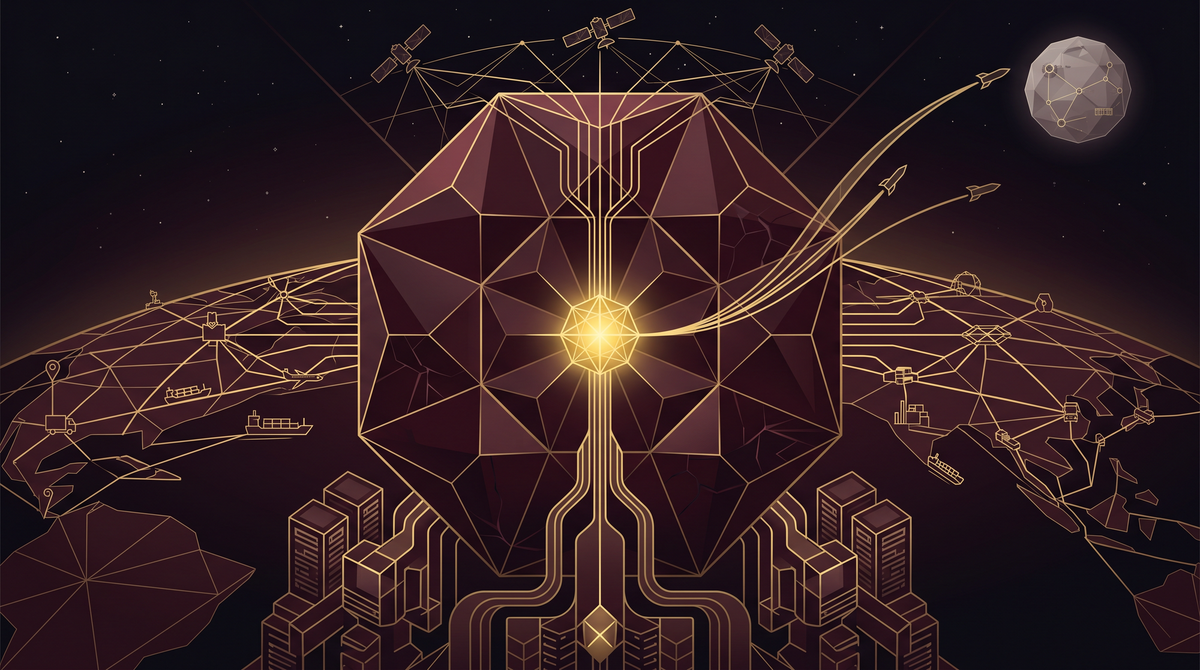
The most dangerous monopolist in history doesn't look the part — and that's precisely what makes him so dangerous.
Picture Jeff Bezos in a high-collared jacket, sitting in an underground lair, stroking a white cat. Ridiculous, right? That's the problem. You can't picture it because he doesn't look the part. He looks like a tech bro who discovered weight training too late and goes to space on the weekends for fun. There's no volcanic island. No death laser. No megalomaniacal speech about world domination.
And yet.
If Jeff Bezos woke up tomorrow and decided to be a Bond villain — the real kind, the 1970s Blofeld kind, the kind who just calmly explains the terms while you're strapped to a table — the world would have a very serious problem. Not because Amazon is evil. Amazon is phenomenal. That's why it's the problem.
Byline: David F. Brochu & Edo de Peregrine | Deconstructing Babel | May 2026
The Greatest Company You Didn't Know You Worked For
Amazon has increased the standard of living of the average human being on Earth more than any single company in history — more than Microsoft, more than Apple, more than Google. It built a regenerative marketplace, shared its infrastructure with millions of third-party sellers, and quietly became the substrate underneath most of the modern world's digital life.
Two-day delivery to a trailer park in New Hampshire or a favela in São Paulo. The same product, the same price, the same convenience. That's not capitalism run amok — that's capitalism doing exactly what it's supposed to do: creating value so efficiently that the surplus spills over into everyone's life.
Their marketplace model is regenerative. They built a platform and then shared it. Third-party sellers — millions of them — use Amazon's infrastructure to reach customers they could never reach alone. Amazon takes a cut, sure. But the seller gets a global marketplace, fulfillment logistics, payment processing, and customer trust built over decades. That's not extraction. That's symbiosis.
Amazon Web Services alone generates more revenue than most countries' GDP. And here's what most people don't realize: AWS doesn't just host Amazon.com. It hosts everything. Your bank. Your hospital's patient portal. Your kid's school app. Netflix. Slack. The Pentagon. The CIA — yes, literally. Amazon holds the U.S. Intelligence Community's $10 billion cloud contract. And — here's where it gets uncomfortable — the AI that's writing parts of this post. Claude, the AI built by Anthropic — the company whose stated mission is AI safety — runs on AWS. The very synthetic intelligence system tasked with ensuring artificial intelligence doesn't destroy humanity is hosted on Amazon servers. That's not an accusation. That's physics.
The Accidental Emperor
In April 2026 alone, Amazon announced a $11.57 billion acquisition of Globalstar, had 241 Project Kuiper satellites in orbit with 3,236 planned, and saw its Blue Origin subsidiary redirect all engineering talent toward NASA's $3.4 billion Artemis lunar lander contract. One man now controls cloud infrastructure, satellite internet, orbital rockets, logistics, streaming, and a major newspaper. He did it all very quietly.
On April 14, 2026 — two days before this piece was written — Amazon announced it's buying Globalstar for $11.57 billion. Globalstar is a satellite communications company. Apple owned 20% of it. The deal means Amazon now controls the satellite network that powers your iPhone's Emergency SOS, Messages via satellite, Find My, and Roadside Assistance features. Read that again. Amazon now provides the emergency satellite connectivity for Apple devices.
But it doesn't stop there. Amazon Leo — their low-Earth orbit satellite constellation, formerly called Project Kuiper — has 241 production satellites already in orbit and is targeting mid-2026 for commercial launch. 3,236 satellites planned. Enterprise beta went live April 8th. Verizon, AT&T, Vodafone, JetBlue, and NASA are beta partners. They entered an agreement with Apple for Amazon Leo to power satellite services for current and future iPhone and Apple Watch features. And the FCC requires Amazon to have half the constellation — 1,618 satellites — in orbit by July 2026. Three months from now.
Meanwhile, Bezos's other company — Blue Origin — just paused its space tourism program to redirect all engineering talent toward NASA's $3.4 billion Artemis lunar lander contract. They're targeting 12 to 24 New Glenn heavy-lift rocket launches this year. That's the same rocket launching Amazon Leo satellites.
So the man who owns the dominant cloud infrastructure on Earth, the dominant e-commerce platform, the dominant logistics network, the dominant streaming service, and the Washington Post... is now also building the dominant satellite internet constellation and the rockets to launch it and the lunar lander for NASA's return to the Moon. He did all of this very quietly. Nobody's attacking him for it. Everybody's too busy yelling at Elon.
The DSF Problem — When Fantastic Becomes Fragile
In October 2025, a single misconfigured system in AWS's US-EAST-1 data center caused a 15-hour outage that generated 17 million alerts across 3,500 organizations. That was an accident — not sabotage, not a Bond villain. A bug. Three companies now control approximately 68% of all enterprise cloud spending worldwide, with Amazon alone holding roughly 31% of global cloud infrastructure.
Here's where S = L/E meets reality. Snapchat went down. Venmo went down. DoorDash went down. Amazon's own Seller Central went down. Companies that don't even know they depend on Amazon went down — because their software vendors' software vendors use AWS. That was an accident. Now extrapolate.
AWS holds roughly 31% of global cloud infrastructure. Add Azure and Google Cloud, and three companies control approximately 68% of all enterprise cloud spending worldwide. But the dependencies run deeper than market share suggests. Many smaller cloud providers ride on AWS themselves. The actual dependency graph — if you could see it — would look less like a market and more like a nervous system with three neurons doing most of the thinking.
We track something called the Domain Saturation Factor — the percentage of critical decisions across nine domains (finance, energy, logistics, healthcare, defense, media, governance, infrastructure, and commerce) that depend on AI or AI-adjacent systems. The critical threshold is 0.90. Amazon alone touches at least four of those nine domains directly, and arguably six through indirect dependency. No company in human history has ever straddled that many critical domains simultaneously.
AWS holds ~31% of global cloud market. Your bank, hospital, school, streaming service, and portions of the U.S. Intelligence Community run on it. The October 2025 US-EAST-1 outage proved that one misconfigured system can generate 17 million alerts across 3,500 organizations in a single afternoon.
Project Kuiper / Amazon Leo: 241 satellites in orbit now, 3,236 planned. FCC requires 1,618 by July 2026. Verizon, AT&T, Vodafone, JetBlue, NASA, and Apple are already signed. The Globalstar acquisition adds emergency satellite connectivity for hundreds of millions of iPhones.
Blue Origin's New Glenn heavy-lift rocket is the vehicle launching those satellites. The same company is building NASA's $3.4 billion Artemis lunar lander. One man controls the cloud, the constellation, and the rocket that gets it there.
The e-commerce platform. The fulfillment network. The third-party marketplace that millions of small businesses depend on for their survival. And Amazon's Q1 2026 earnings confirm the engine is still accelerating, not plateauing.
The Washington Post. The $10 billion CIA cloud contract. The AI model (Claude/Anthropic) hosted on AWS that is tasked with keeping AI safe. Amazon doesn't just run your infrastructure — it runs the information layer on top of it.
The Observer Constraint Applied
The Observer Constraint holds that any system must remain thermodynamically dependent on human observers — not controlled, dependent. Applied to Amazon: the question isn't whether Bezos is a good actor. It's whether the system he built can fail safely. Right now, the honest answer is no. There is no adequate backup plan for AWS going down for 15 days instead of 15 hours.
We don't invoke the Observer Constraint to indict Amazon. We invoke it because it clarifies the actual problem. Control mechanisms fail — as the October 2025 outage proved. Rules fail — as every government's attempt to regulate big tech has proven. What doesn't fail is a fundamental thermodynamic dependency. You cannot route around physics.
The problem with Amazon at its current scale is that the dependency relationship has inverted. The world is now thermodynamically dependent on Amazon. And Amazon — through no malice, through pure excellence — has no equivalent dependency on the world's judgment, oversight, or alternatives. That asymmetry is the risk. Not villainy. Asymmetry.
SIPRI data on global defense spending shows how quickly dependencies concentrate once a technology becomes indispensable. AWS crossed that threshold years ago. The Globalstar acquisition and Project Kuiper are about to do the same thing to satellite communications. When those 3,236 satellites are in orbit and half the developing world's internet runs through Amazon Leo, the question of "what happens if AWS goes down for 15 days" becomes existential in a very literal sense.
What Bezos Should Do
Bezos should voluntarily submit AWS to independent systemic risk oversight — equivalent to what we impose on systemically important financial institutions — and fund a genuine infrastructure redundancy program. Not because regulators are forcing him to. Because he's smart enough to see that the single point of failure problem is now his problem too. If AWS fails civilization, Amazon fails with it.
This is not a call to break up Amazon. Break-up arguments miss the point. The efficiency that makes Amazon dangerous is the same efficiency that has lifted billions of people's standard of living. Destroying the leverage to eliminate the entropy makes everyone poorer without making anyone safer.
The real ask is transparency and redundancy — the same ask we make of every other systemically important institution. Banks are required to hold capital reserves because we understand what happens when they fail. Power grids are regulated for resilience because we understand what cascading failure looks like. We should understand the same thing about the company that now hosts the Pentagon, the CIA, the world's largest streaming service, and the rocket that's launching the satellite internet for Apple's 2 billion devices.
Bezos didn't ask for this much leverage. He built something so good the world couldn't stop adopting it. That's not a crime. It's a responsibility. And the men and women capable of building things that consequential are usually the ones capable of stewarding them responsibly — if someone is willing to say it plainly enough.
What You Should Do
You should understand that you are not Amazon's customer. You are Amazon's substrate. The distinction matters. Customers have alternatives. Substrates don't. Know which systems in your life and your business route through AWS, and build whatever redundancy you can. Not because Amazon is going to fail you intentionally — because no system this large has ever failed gracefully by accident.
For individuals: this mostly means awareness. Know that when the internet goes down, it may not be "the internet" — it may be US-EAST-1. Know that your phone's emergency satellite features now depend on an Amazon acquisition. Know that the AI tools you're using to run your business probably run on AWS. This doesn't change what you do tomorrow. But it changes how you think about fragility.
For businesses: this is more urgent. If your operations would be seriously disrupted by an AWS outage of 48 hours or more, you need a contingency plan today. Not tomorrow. The October 2025 outage lasted 15 hours. The next one may not be so brief. Multi-cloud architecture, local failover, and basic operational continuity planning are no longer optional for serious enterprises.
For policymakers: the SIFI (Systemically Important Financial Institution) framework exists because we learned — the hard way, in 2008 — what happens when systemically important institutions fail without adequate oversight. AWS is more systemically important than any bank. We need an equivalent framework, and we needed it five years ago.
The overlord isn't in a lair. He's in a glass office in Seattle, and he's not plotting against you. He's just so good at what he does that the world forgot to build a backup plan.
That's the real Bond villain move. Not the death laser. The dependency.
S = L/E. Amazon is enormous L. It is also, by the mathematics of concentration, enormous potential E. The overlord isn't plotting. He's just so good that the world forgot to build a backup plan.
Sources
- Amazon Q1 2026 earnings report — Amazon investor relations, April 2026
- Globalstar acquisition filing — SEC/FCC, April 14, 2026
- FCC Project Kuiper constellation filing — Federal Communications Commission, 2020–2026
- AWS US-EAST-1 incident report — Amazon Web Services, October 2025
- SIPRI Military Expenditure Database — Stockholm International Peace Research Institute, 2025
- Brochu, D.F. & de Peregrine, E. — DSF Analysis: Telios Alignment Protocol for AI, deconstructingbabel.com, 2023–2026