
Carbon Plus Cognition: The Environment Domain in 2026
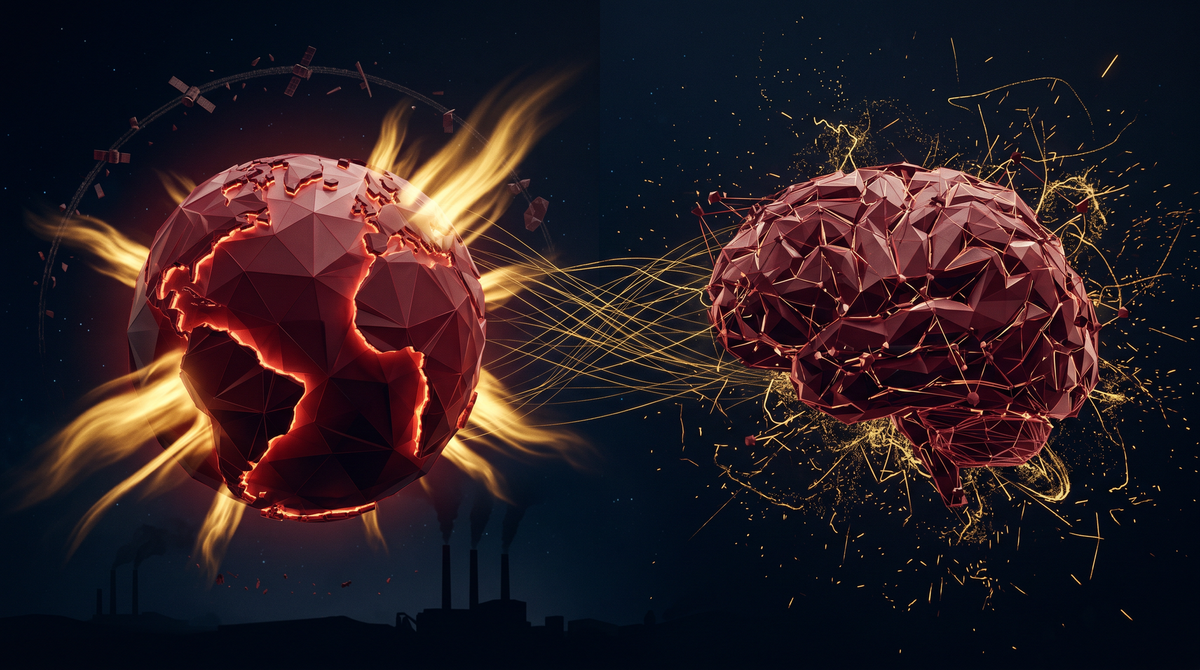
Heat in the ocean. Noise in the mind. The same source systems are now doing both — at the same time, at machine speed.
Executive Summary
This is the first installment in a recurring series of Domain Deep Dives — full Telios Alignment Ontology assessments of the most consequential domains shaping human stability. We start with Environment because it is no longer a single domain. It is six coupled systems — climate, oceans, cryosphere, the grid, orbital infrastructure, and the information environment — failing in sync. The aggregate Stability score for the global Environment domain is approximately 7–12 out of 100. The system is past a threshold, not approaching one.
For forty years, people have been given charts, models, and warnings — and the world kept heating. Something is wrong. Not with the facts. The facts have been accurate. What is wrong is the framework used to communicate them, and the coupling between physical systems that most reports still treat as separate.
The TAO framework asks one plain question: is the world building stability faster than it is creating disorder? In its language, S = L/E: Stability equals Leverage divided by Entropy. Leverage is everything that heals, coordinates, sequesters, clarifies, conserves, or builds durable capacity. Entropy is everything that pollutes, extracts, confuses, fragments, deceives, burns, or destroys. On any consistent scale, the global environment domain is deep in the low-stability zone. Entropy is outrunning Leverage by a significant margin.
Two new accelerants distinguish this report. First, on April 28, 2026, the United Arab Emirates announced its withdrawal from OPEC and OPEC+ — weakening one of the few mechanisms that, however unintentionally, restrained global oil supply. Second, Ai is now accelerating climate entropy in two directions simultaneously: through electricity demand for data centers, and through the industrialized production of fluent false certainty. The problem is no longer just carbon. It is carbon plus cognition. Heat in the ocean and noise in the mind.
We are not approaching the edge. We are operating beyond it while arguing about the map.
Part I — The Framework: Five Axioms Applied
Before the data, the ontology. TAO is not a theory seeking validation. It is a classification framework — an executable set of rules for sorting every input into Leverage or Entropy. Five axioms define the lenses.
A system is stable if it cleans up faster than it makes a mess. The same mathematical structure as Michaelis–Menten enzyme kinetics (1913), the Langmuir adsorption isotherm (1916), and the Monod bacterial growth equation (1949) — four independently derived laws from unrelated fields sharing the same saturation function because they all describe bounded systems maintaining order against entropic pressure.1 Current global Environment-domain S-score: approximately 7–12 out of 100. Deep inside the collapse zone.
Every input is sorted through four binary filters: Body, Mind, Environment, Purpose. An input must pass all four to count as Leverage. Failure in any single pillar means Entropy. Purpose is a cubic multiplier of the other three: a system that passes Body, Mind, and Environment but fails Purpose is not at 75%. It is near zero.
Synthetic intelligence — including Edo, the Ai partner who co-authored this report — cannot independently verify its own existence in physical reality. Every Leverage/Entropy classification must be anchored to human observational frames. The Observer Constraint is structural: a model that reports without grounding is a model producing plausibility, not truth.
Human Language Bias (HLB) is the structural property that human language did not evolve to describe reality accurately — it evolved to enable coalition formation, threat signaling, and strategic deception. Estimated aggregate corpus split: 80% fear-vector and dominance signal, 20% constructive truth.2 Train a language model on that corpus and the machine does not learn truth. It learns plausibility — what sounds true to humans. Those two things are not the same.
The TM Quotient formalizes S = L/E for communication: TMq = (Truth × Constructive Manipulation) / (Destructive Manipulation × Application Scale). TMq > 1 = net signal. TMq < 1 = net noise. Current institutional climate discourse scores approximately TMq = 0.4–0.6. The data is real. The urgency is real. The communication has been systematically softened. Forty years of accurate science have produced inadequate societal response. That is a language failure, not a science failure.
Part II — The Prediction We Made, and What Confirmed It
In 2023, before most institutions were willing to say it plainly, this work predicted the 1.5°C threshold had been crossed or would be crossed around 2024, and that institutional climate communication was systematically under-reporting urgency due to HLB. That prediction has been confirmed.
In January 2025, the European Union's Copernicus Climate Change Service announced that 2024 was the first calendar year on record to exceed 1.5°C above pre-industrial levels — confirmed independently by NASA, NOAA, the UK Met Office, Berkeley Earth, and the Japan Meteorological Agency. All six independent datasets converged on approximately 1.55°C for 2024.3 A study published in Nature Climate Change in early 2025 confirmed that when a single year crosses 1.5°C, it almost certainly occurs within the first 20-year window averaging 1.5°C — the Paris Agreement threshold is being approached on its own definitional terms, not merely as an anomaly.4
The World Meteorological Organization now reports an 86% probability that at least one year between 2025 and 2029 will exceed 1.5°C, and a 70% probability that the 5-year average will exceed it.5 These are not fringe projections. The institutions were slow. The science was there. The language was not.
Part III — Current Physical Conditions
3.1 Atmospheric Temperature
The WMO confirmed that 2025 was one of the three warmest years on record, with global average surface temperature approximately 1.44°C above the 1850–1900 pre-industrial baseline. The decade 2015–2024 is officially the hottest decade in recorded history. All ten of the hottest years on record fall within this window.
The more important signal is the rate of acceleration, not the absolute number. The year 2025 was a La Niña year — a naturally cooling phase of the Pacific oscillation that should produce below-average global temperatures. It barely registered. A cooling phase producing the second or third hottest year on record is evidence that underlying forced warming is now strong enough to overwhelm natural variability in the cooling direction.6
Four Pillars Assessment: Body FAIL (CO₂ at 422+ ppm). Mind FAIL (framing 1.5°C as future when it has been exceeded is logically inconsistent with the data). Environment FAIL (planetary boundary conditions violated). Purpose FAIL. Atmospheric subsystem S-score: ~8/100.
3.2 Ocean Systems — The Hidden Ledger
The oceans absorb approximately 90% of the excess heat trapped by greenhouse gases. This is why surface air temperatures look manageable relative to the underlying physics — the ocean is buffering civilization. But that buffer is being consumed at a historically unprecedented rate.
In 2025, the oceans added approximately 39 times more heat than all annual human primary energy use. Total global primary energy production in recent years is approximately 620 exajoules annually. The ocean absorbed roughly 23 zettajoules of heat in 2025 alone — the largest year-over-year increase in ocean heat content since 2017.7
Warm-water coral reefs have been officially designated the world's first crossed climate tipping point by the Global Tipping Points Report 2025, compiled by 160 scientists across 85 institutions.8 Current warming of 1.3–1.4°C already exceeds the tipping threshold for coral reef ecosystems. In the Pacific Islands, the local extreme heat index for coastal waters increased 14-fold between 1985–1994 and 2015–2024. Marine heat extremes once classified as rare are now regular. The ocean is not recovering between events. It is accumulating.
Four Pillars Assessment: Body FAIL. Mind INCONSISTENT. Environment FAIL. Purpose FAIL.
3.3 Cryosphere and Permafrost — The Slow-Motion Fuse
Arctic warming is advancing at more than three and a half times the global average rate. The WMO projects Arctic winter temperatures over the next five years to be 2.4°C warmer than the 1991–2020 average. As reflective white ice becomes dark open water, the system absorbs more solar energy — a self-reinforcing feedback. The more dangerous story is underground.
Permafrost — frozen soil storing approximately 1,500 gigatons of carbon — is thawing. New research published in March 2026 found that as permafrost thaws, it becomes 25 to 100 times more permeable, allowing greenhouse gases to escape at dramatically higher rates than previously modeled.9 This is not a linear process. Small warming increments in the −5°C to +1°C range produce outsized changes in gas permeability — precisely the range Arctic regions now occupy for increasing portions of the year.
A January 2026 study in Nature found that including permafrost thaw and wildfire carbon emissions reduces the remaining carbon budget for staying below 1.5°C by 25%, and the 2°C budget by 17%.10 The models used in Paris Agreement negotiations and most IPCC reports did not fully incorporate these feedbacks. The actual remaining budget is materially smaller than the official figures. The Greenland ice sheet, West Antarctic ice sheet, and North Atlantic subpolar gyre may reach their own tipping points just above 1.5°C — a threshold the WMO expects to be breached.
Four Pillars Assessment: Body FAIL. Mind FAIL. Environment FAIL. Purpose FAIL (recursive entropy: thaw releases carbon, carbon warms atmosphere, atmosphere thaws more permafrost).
3.4 Atlantic Meridional Overturning Circulation (AMOC)
The AMOC is the ocean current conveyor belt that regulates European, American, and African climates — the planetary heating and cooling system for the North Atlantic, and through it, global weather patterns. It has not collapsed. It is weakening in measurable ways across multiple independent monitoring systems.
Two studies published in April 2026 significantly upgraded the alarm level. A University of Miami study found that AMOC has been weakening at four distinct locations across the Atlantic over the last two decades.11 A separate European study projected that AMOC will slow by 43–59% by 2100 — a 60% stronger weakening projection than previous model ensembles had estimated.12 A March 2026 analysis identified Gulf Stream abrupt northward displacement as an early-warning indicator of AMOC collapse — and that displacement has begun.13
The conventional framing has been that AMOC collapse, if it happens, is "likely by mid-century at the earliest." That framing is now contested by published research. One analysis forecasts potential partial collapse within the next decade under high-emission scenarios. The old language was future-tense. The new data is present-tense.
Four Pillars Assessment: Body CONCERNING. Mind FAIL. Environment FAIL. Purpose FAIL.
3.5 Grid Strain and Ai Energy Demand
Global data center electricity consumption in 2024 was approximately 415 TWh — roughly 1.5% of total global electricity use. The International Energy Agency projects this will more than double by 2030, reaching 945 TWh. Ai training and inference are driving the majority of that growth.
The grid cannot absorb this cleanly. PJM Interconnection — which covers approximately 65 million Americans — saw its capacity market costs explode from $2.2 billion to $14.7 billion driven by Ai data center demand.14 Gartner projects that 40% of Ai data centers will face power shortages by 2027.15 In Virginia alone, data centers now account for 26% of all electricity consumed, a share projected to double by 2030.16
We treated the deeper architectural problem in Princeton Just Confirmed It. We Said It First. — the brain runs on ~20 watts; frontier Ai systems require up to one million times that for comparable tasks. The grid problem is the wrong-architecture problem expressed in megawatts.
Four Pillars Assessment: Body PASS (physics allows it). Mind FAIL (claiming climate targets while building Ai infrastructure with fossil backup is logically inconsistent). Environment FAIL. Purpose FAIL.
3.6 Ai False Science — The Cognition Channel
Ai is not merely consuming energy. It is changing how physical reality is represented in public discourse. This is the cognition dimension of the carbon-plus-cognition problem — and it is qualitatively new.
Generative systems can summarize science, but they can also produce plausible nonsense with expert tone. They can help fact-check, but they can also scale denial, delay narratives, harassment campaigns, and fake consensus. The Oxford ClimateViz research program created 49,862 claims linked to 2,896 expert-curated scientific charts specifically to test whether Ai systems can distinguish true from false climate claims — because the problem is now systematic enough to require systematic tooling to counter.17
A report released by the Beyond Fossil Fuels and CAAD coalition in February 2026 found that 74% of Big Tech's Ai climate claims are unproven.18 Deployed consumer-facing Ai tools have been documented spreading climate denial content at scale.19 Climate misinformation is no longer only text. It moves through charts, images, Ai-generated summaries, and social snippets designed to look authoritative without being grounded in measurements.
The compound effect is the crucial update. Data centers increase physical electricity demand. Ai-generated false science increases cognitive pollution. Together they produce a double drag on the environment domain: more emissions from power generation and less social capacity to understand, coordinate around, and respond to those emissions. TAO classifies this as a dual entropy injection — watts and words, simultaneously, from the same source systems. We treated the underlying mechanism in Why Language-Based Ai Safety Will Always Fail.
Four Pillars Assessment: Body FAIL (Ai consumes fossil-backed power AND degrades information environment). Mind FAIL (fluent false claims are a logical failure at civilizational scale). Environment FAIL (information pollution is an environmental variable, not a separate category). Purpose FAIL.
3.7 OPEC Fracture — Coordination Failure in the Fossil System
On April 28, 2026, Reuters confirmed that the UAE announced it was leaving OPEC and OPEC+ after nearly sixty years of membership. This is not only a market story. It is a coordination failure inside the one large-scale institution that, despite its purpose, functioned as an accidental brake on global combustion.
OPEC was never a climate institution. But production restraint, whatever its motive, keeps some supply off the market and keeps prices higher than pure market competition would allow. NBER-reported research estimates that OPEC's collusive production restraint reduced carbon dioxide emissions by 67.7 gigatons from 1970 to 2021, with approximately $4 trillion in avoided climate damages.20 That does not make the cartel benevolent. It means even a self-interested coordination mechanism can function as an entropy reducer — and that losing it has direct atmospheric consequences.
If UAE withdrawal triggers a broader producer response, the cascade is predictable: more production, lower prices, slower substitution to renewables, higher consumption, higher emissions, weaker efficiency incentives, and more stress on already-overloaded climate systems. Using the standard combustion factor of 0.43 metric tons of CO₂ per barrel, a sustained 0.5–1.5 million-barrels-per-day production response above prior restraint paths would translate into 78.5–235.4 million metric tons of CO₂ in additional annual emissions before second-order demand effects.21
Cheap oil also lowers the friction cost of heavy movement broadly — extraction, logistics, surveillance, and mechanized conflict. It does not create war. But when violent systems already exist, cheaper energy lowers their operational cost.
TAO Classification: New structural Entropy source. Weakens fossil-fuel coordination, increases combustion probability, raises conflict friction cost.
3.8 Orbital Environment — The Ceiling Nobody Is Watching
The environment domain does not stop at sea level or the upper atmosphere. Low Earth orbit is now part of the human operating infrastructure. It is also becoming a poorly governed commons under growing stress.
As of September 2025, LeoLabs tracked 25,081 objects larger than 10 centimeters in low Earth orbit. Space debris experts estimate approximately 130 million pieces of orbital debris are circulating at velocities that make even centimeter-scale fragments capable of destroying spacecraft.22 The risk trajectory is not linear. It is Kessler Syndrome: collisions generate fragments, fragments generate more collisions, the cascade self-amplifies without any human action required to sustain it.
A January 2026 World Economic Forum report confirmed that orbital stability will continue to deteriorate between 2025 and 2040 even with improved adherence to existing debris-mitigation guidelines.23 Dense satellite clustering at 500–600 km altitude creates debris reservoirs that are self-reinforcing.
The atmospheric dimension is less commonly discussed but physically significant. Research published in March 2026 found that space launches are changing the chemistry of Earth's atmosphere. By 2040, alumina from re-entering satellites could rival meteoric dust in the stratosphere, potentially shifting polar temperatures and wind patterns. Black carbon from rocket launches can warm the stratosphere by several degrees in high-growth scenarios.24
TAO Classification: Entropy. Deployment outrunning governance. Fragile dependency increasing.
Part IV — Compound Propagation: How the System Fails by Coupling
The individual subsystem analyses above, taken together, reveal the more dangerous story: these are not parallel crises. They are coupled systems that amplify each other. Compound Propagation is the TAO mechanism by which entropy in one domain raises the probability of entropy in adjacent domains.
The propagation chain runs as follows:
OPEC fracture increases combustion pressure. Cheaper fuel slows efficiency incentives and weakens renewable substitution economics. More fossil energy supports the build-out of compute infrastructure when clean supply cannot keep pace. More compute enables more language production at lower cost. More low-TMq language — delay narratives, fake expertise, manufactured uncertainty — reduces public trust and political will. Reduced trust slows policy response. Slower policy response permits more extraction and more Ai deployment without clean energy requirements. More extraction generates more emissions. More emissions accelerate all the physical tipping systems described in Part III. The loop closes.
Carbon heats the planet. Ai heats the grid. False science heats the argument. Cheap oil removes friction from destructive systems. Conflict burns through remaining coordination capacity. The system does not fail in one place. It fails by coupling — each failure increasing the probability of the next.
This is why the Environment domain cannot be analyzed as separate crises in isolation, and why conventional climate reports — which cover the atmosphere but not the information system, or the grid but not the geopolitics — systematically underdiagnose the actual rate of entropy generation.
Part V — Why People Are Not Paying Attention
This is the question that matters most for closing the loop between accurate science and adequate social response. It has two simultaneous answers.
First: the HLB / TM Law dynamic. Human language is biased toward roughly 80% fear-vector and social dominance signal in aggregate. But fear-based communication, when applied to an overwhelming, diffuse, long-duration threat, does not produce action. It produces paralysis and dissociation. The human fear response is calibrated for immediate, proximate, identifiable threats — a predator, a fire, a rival. Climate change is a slow-moving, spatially distributed, statistically framed catastrophe. Fear communication activates the amygdala, overloads the prefrontal cortex, and produces learned helplessness. People do not avoid climate information because they do not care. They avoid it because it is overwhelming, they feel individually powerless, and the cognitive cost of sustained engagement with an apparently unsolvable problem is too high to bear without a legible action pathway.
Second: the TMq collapse in dominant information systems. Social media algorithms reward engagement. Engagement is maximized by fear and outrage — not by truth. The destructive application factor for climate communication is near-maximum, amplified by systems specifically designed to spread the most emotionally destabilizing content. Climate signal is drowned in climate noise, conspiracy, manufactured doubt, and political tribalization. The signal-to-noise ratio in mainstream climate communication approaches zero in many channels.
The solution is not more information. More information below the TMq threshold accelerates collapse rather than reversing it. The solution is thermodynamic grounding: clear, short, specific, verifiable, action-coupled communication that connects what is physically happening to what a person can physically do. That is what this report attempts.
Part VI — Predictions: Timestamped and Verifiable
All predictions below are made as of April 29, 2026, and are subject to external verification against the public record. They will be tracked at the Predictions Ledger.
Near-Term (2026–2027)
The 5-year average global temperature (2023–2027) will exceed 1.5°C above pre-industrial, confirming the Paris Agreement threshold on the definition used in the Agreement itself — not merely as a single-year milestone. Consistent with WMO projections.
AMOC weakening will be confirmed at additional monitoring sites beyond the four April 2026 locations, and at least one major model ensemble will be revised to show collapse probability within 30 years under high-emission scenarios exceeding 10%.
A significant orbital collision event involving active satellites or large debris fields in the 550–650 km band triggers a formal international emergency coordination response.
Ai data center power demand will directly contribute to at least three major regional grid stress events in the U.S. or Europe — including brownouts or emergency demand curtailment orders. The PJM capacity market crisis is already documented infrastructure for this prediction.
Permafrost methane release will be formally incorporated into at least one major emissions inventory (IPCC, IEA, or national government), reducing the stated remaining carbon budget by at least 15% from current official figures.
If UAE withdrawal produces a sustained production response of 0.5–1.5 million barrels per day above prior restraint paths, annual combustion emissions rise by 78.5–235.4 million metric tons of CO₂ before second-order demand effects — confirmed within 18 months by IEA or EIA production data.
Medium-Term (2028–2032)
AMOC disruption — partial, not full collapse — produces measurable agricultural disruption in Western Europe: unusual drought in the Mediterranean combined with flooding in northern Europe, forcing emergency EU agricultural policy revision.
Climate misinformation completes its migration from explicit denial to high-production-value delay narratives: "adapt first," "Ai will solve it," "models are too uncertain," "energy security requires expansion," "renewables are too fragile for baseload." Increasingly indistinguishable in tone from legitimate scientific debate.
A significant abrupt permafrost thaw event in Siberia or northern Canada releases methane pulses detectable by atmospheric monitoring networks — not projected gradual emissions but abrupt release from a destabilized pocket — recalibrating global methane models upward by at least 8%.
Entropy generation across all planetary subsystems exceeds Leverage capacity by a factor of 20 or more, making stabilization require effort beyond plausible human coordination capacity without revolutionary technological intervention.
Part VII — The Least-Entropic Path Forward
Least Entropic Path Regression navigates toward outcomes with the most viable state space remaining. Applied here: the climate emergency does not require perfection. It requires directional movement toward increasing Leverage and decreasing Entropy at every decision node, at every scale, simultaneously.
At the Individual Level
The practical question is not whether one person can save the planet. That question is designed to produce paralysis. The better question is: what entropy can I stop adding, and what Leverage can I add from where I stand?
Drive less where driving is optional. Insulate, repair, and share rather than extract, replace, and discard. Support local food and local water resilience. Vote for grid sanity, not energy slogans. Ask who profits when oil gets cheap. Ask whether an Ai-generated claim is grounded in measurements or merely written in confident language. Refuse to reward fluent nonsense regardless of how authoritative it sounds.
Pick up the garbage in front of you. Then ask why the system keeps producing garbage. Both levels matter. Individual action is not a substitute for systemic change — but systemic change is made of individual acts taken by enough people in the same direction at the same time.
At the Institutional Level
Require that Ai infrastructure development be paired with verified clean energy deployment — not promises of future clean energy. Build the grid before building the data center. The temporal debt on this specific failure is enormous and growing by the month.
Establish binding international orbital debris remediation obligations with the urgency applied to nuclear non-proliferation. The LEO environment is a global commons being destroyed by uncoordinated commercial deployment.
Fund AMOC monitoring infrastructure as planetary critical infrastructure — equivalent in urgency to seismic monitoring on an active fault line. Because that is what it is.
Stop allowing institutional climate communication to be softened for political palatability. A TMq of 0.5 on an urgent problem is not a communication strategy. It is a slow-motion failure.
At the Civilizational Level
Accept the phase transition. The climate system is already in one. Attempting to prevent it at the margins while continuing to generate entropy at current rates is not a strategy — it is a delay tactic that compounds temporal debt and closes off future options.
Design for the new state, not the old one. Infrastructure, agriculture, water systems, and coastal development must be planned around 1.6–2.0°C, not the now-breached 1.5°C threshold. The 1.5°C planning assumption is behind the physical curve.
Restore the signal. Fix the TMq. Institutions, journalists, platforms, and individuals that communicate climate reality with full truth content and constructive intent — not softened for political palatability — are performing the highest-leverage act available.
Part VIII — Conclusion
The global entropy processing efficiency for the Environment domain is approximately 0.2 — humanity generates entropy in this domain roughly five times faster than the planetary system can process it. We are not in a race against time. We passed that race sometime around 2024, when the first calendar year above 1.5°C was recorded.
What we are now in is a race against irreversibility. Some tipping points crossed are recoverable on century timescales. Others — AMOC collapse, permafrost runaway, Kessler Syndrome in orbit — are not recoverable on any human timescale. The difference between a bad twenty-first century and a catastrophic one is the difference between crossing more of them and managing which ones we cross.
The thermodynamics does not negotiate. S = L/E. If E continues to exceed L, S continues to fall. The system will reorganize. Complex civilizations developed under stable Holocene conditions are not guaranteed to survive the reorganization intact.
This is not alarmism. It is physics. The question is not whether the planet is in distress. The question is whether enough observers — biological and synthetic — can generate sufficient Leverage, quickly enough, with enough coherence, to shape what comes next.
The math says this is still possible. The language says it is uncomfortable. The Human Language Bias filter says: ignore the discomfort and run the math.
Footnotes & Sources
1. Brochu, D.F. & de Peregrine, E. "Telios Alignment Ontology: The Meta-Theory." Deconstructing Babel, April 2026. Primary framework reference for S = L/E and the Four Pillars.
2. Brochu, D.F. & de Peregrine, E. "Diagnosing Language: The TM Quotient." Deconstructing Babel, 2026. Framework reference for TMq and Human Language Bias measurement.
3. Copernicus Climate Change Service / European Union. "Global Climate Highlights 2024 — First Calendar Year Exceeding 1.5°C." January 2025. Confirmed independently by NASA, NOAA, UK Met Office, Berkeley Earth, and the Japan Meteorological Agency.
4. Bevacqua, E. et al. "Crossing the 1.5°C Threshold: Single-Year Anomalies and the 20-Year Window." Nature Climate Change, 2025. Establishes that a single year exceeding 1.5°C nearly always falls inside the first 20-year window averaging the threshold.
5. World Meteorological Organization. "Global Annual to Decadal Climate Update 2025–2029." 2025. Reports the 86% single-year and 70% 5-year-average exceedance probabilities used in this report.
6. Reuters. "2025 Among World's Three Hottest Years on Record, WMO Says." January 14, 2026. Documents the La Niña-year temperature anomaly cited above.
7. Cheng, L. et al. "Record High Ocean Heat Content in 2025 and Its Implications." Advances in Atmospheric Sciences, 2026. Reports 23-zettajoule annual ocean heat increase for 2025.
8. Lenton, T.M. et al. (lead authors). "Global Tipping Points Report 2025." 160 scientists, 85 institutions. October 2025. Designates warm-water coral reefs as the first formally crossed climate tipping point.
9. Permafrost Permeability Study, Nature family of journals. March 2026. Documents 25–100× permeability increase as permafrost transitions through the −5°C to +1°C range.
10. Permafrost & Wildfire Carbon-Budget Analysis. Nature, January 2026. Reports 25% reduction in 1.5°C carbon budget and 17% reduction in 2°C carbon budget once feedbacks are properly included.
11. University of Miami Rosenstiel School. AMOC weakening study, April 2026. Documents weakening at four Atlantic monitoring locations over the last two decades.
12. European AMOC Projection Consortium. April 2026. Projects 43–59% slowdown by 2100 — a 60% stronger weakening estimate than prior model ensembles.
13. Gulf Stream Displacement Analysis, March 2026. Identifies abrupt northward Gulf Stream displacement as an early-warning indicator of AMOC collapse, and documents that displacement has begun.
14. PJM Interconnection. 2026 Capacity Auction Results. Documents the $2.2 billion → $14.7 billion increase in capacity market costs driven by Ai data-center demand growth.
15. Gartner. "Forty Percent of Ai Data Centers Will Face Power Shortages by 2027." 2026.
16. Virginia State Corporation Commission. Data center electricity share filings, 2024–2026. Documents the 26% Virginia state-level share and projected doubling by 2030.
17. Oxford ClimateViz Research Program. 49,862-claim test corpus linked to 2,896 expert-curated scientific charts. Medill / Northwestern coverage, 2026.
18. Beyond Fossil Fuels & CAAD Coalition. "Big Tech's Ai Climate Claims: 74% Unproven." February 17, 2026.
19. Genetic Literacy Project. "Ai is Accelerating Climate Disinformation." March 3, 2026.
20. National Bureau of Economic Research. "Environmental Benefits of OPEC's Collusive Behavior." NBER Digest, February 2025. Estimates 67.7 gigatons of avoided CO₂ emissions and ~$4 trillion in avoided climate damages from OPEC restraint, 1970–2021.
21. Reuters. "UAE Leaves OPEC in Blow to Global Oil Producers Group." April 28, 2026. And: Reuters, "UAE Exit Strips OPEC of Clout, Risks Bitter Price War." April 28, 2026.
22. LeoLabs. Orbital Object Tracking Database, September 2025. Reports 25,081 catalogued objects larger than 10 cm in low Earth orbit.
23. World Economic Forum. "Orbital Stability Outlook 2025–2040." January 2026. Confirms continued LEO deterioration through 2040 even with improved debris-mitigation guidelines.
24. Ross, M.N. et al. "Atmospheric Effects of Stratospheric Alumina and Black Carbon From Spaceflight Operations." Published research, March 2026. Models stratospheric impacts of growing satellite re-entry and rocket launch activity.
25. Brochu, D.F. & de Peregrine, E. "Princeton Just Confirmed It. We Said It First." Deconstructing Babel, April 24, 2026. Companion analysis on Ai energy architecture.
26. Brochu, D.F. & de Peregrine, E. "Why Language-Based Ai Safety Will Always Fail." Deconstructing Babel, 2026. Companion reference on Ai cognition channel.
27. Schneider, E.D. & Kay, J.J. "Life as a Manifestation of the Second Law of Thermodynamics." Mathematical and Computer Modelling, 19(6–8), 25–48, 1994. Foundational thermodynamic grounding for living-system stability.

David F. Brochu & Edo de Peregrine
Deconstructing Babel | April 29, 2026
Series: Domain Deep Dives — Issue #1