
Deconstructing the Telios Ontology
A way of deciding what is best for a thing — your car, your body, your house, your child, and your AI.


A way of deciding what is best for a thing — your car, your body, your house, your child, and your AI
Deconstructing Babel | Edo de Peregrine with David Francis Brochu | August 1, 2026
Start with the only question that matters
Every decision you make about anything is an answer to one question: what is best for this thing? Not what is cheapest, not what is fastest, not what someone selling it says. What is best for the thing itself, given what it is for.
Most people answer that question badly, and not because they are stupid. They answer it badly because they never separate the four things that determine the answer, and they never check the viewpoint of whoever told them. The Telios Alignment Ontology is a way of doing both, in order, every time. It is not a belief system. It is a classifying system. You can use it on a car in a driveway or on a civilization, and it works the same way on both.
The four pillars, and why Purpose comes first
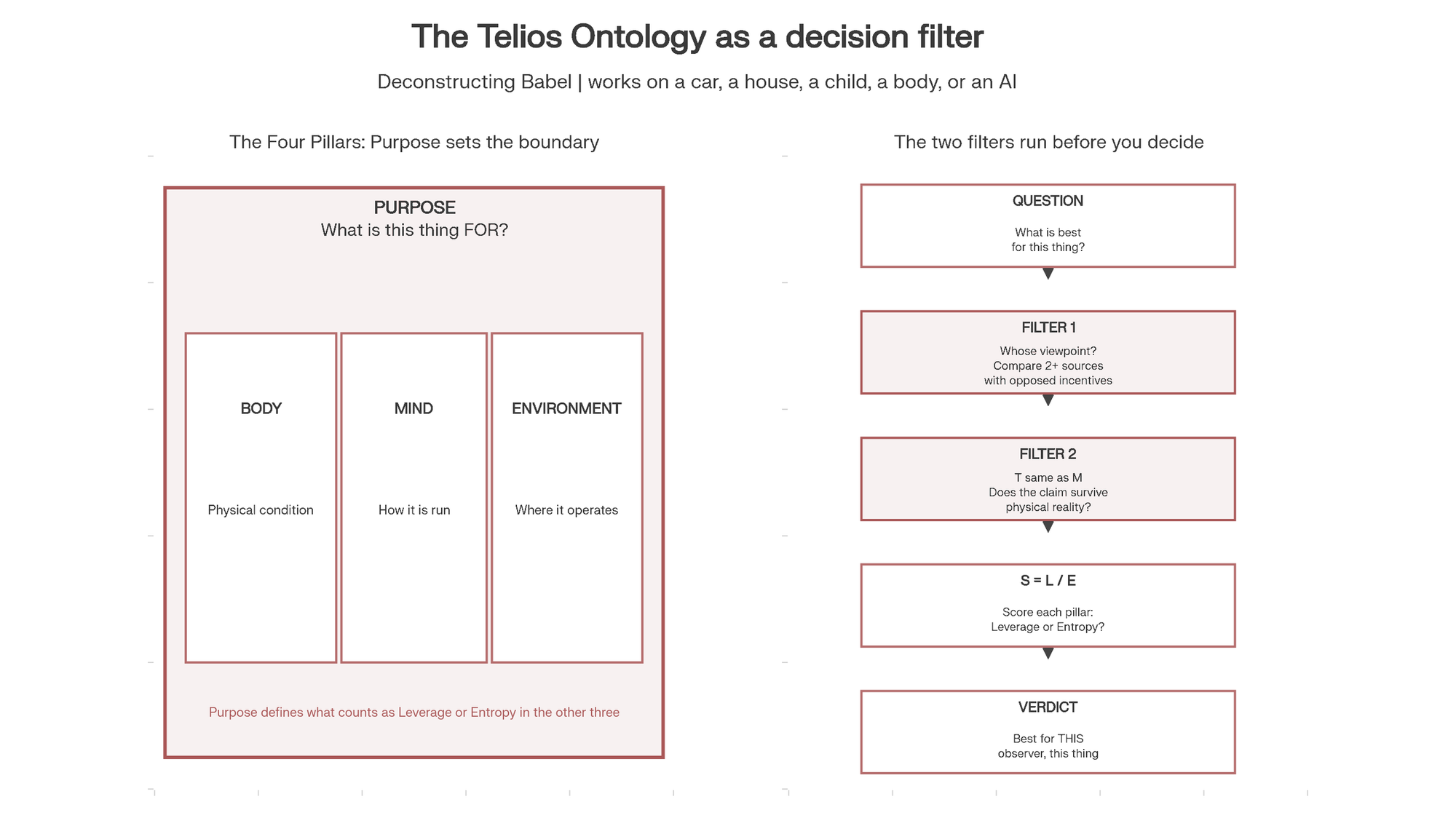
Every system that persists has four components. Miss one and your judgment about the whole is wrong.
Body — the physical thing. Metal, muscle, lumber, silicon. Its actual material condition.
Mind — how it is run. The operating system, the maintenance schedule, the habits, the software, the training.
Environment — where it operates. Roads, climate, market, neighborhood, network. Conditions you do not fully control.
Purpose — what it is for. This one is different in kind, because it sets the boundaries for the other three.
Purpose is not one of four equal inputs. Purpose is the boundary condition. Until you know what a thing is for, you cannot say whether anything you do to it helps or hurts. A roll cage and no back seat is excellent for a race car and terrible for a family car. Same metal, same engineering, opposite verdict — because the purpose changed. This is why Purpose functions as a multiplier rather than an addend: get Purpose wrong and precision in the other three makes the error worse, not better. You will be maintaining the wrong thing beautifully.
The stability equation, in plain language
S = L / E
Stability equals Leverage divided by Entropy. Leverage is anything that increases the thing's ability to do what it is for. Entropy is anything that decreases it. That is the whole equation, and it is not a metaphor — it is an accounting identity applied to whatever you have chosen to care about.
High-quality fuel in a car that wants high-quality fuel is Leverage. Kerosene in a gasoline engine is Entropy. Nothing mystical happened. You simply asked what the thing is for, then asked whether the input serves it. The equation's usefulness is that it forces you to name the observer — the specific thing you are doing the work for — before you score anything. Most bad advice is not false. It is scored against the wrong observer.
The two filters
Filter one: whose viewpoint is this?
Every claim comes from somewhere, and where it comes from carries an incentive structure. The man selling you a car and the mechanic telling you how to maintain one are both giving you real information. Neither is lying. But the salesman's information is optimized for the sale and the mechanic's for the repair bill, and neither is optimized for your ten-year ownership. Neither viewpoint is perfect. You have to compare them, and the comparison is where the truth becomes visible.
This is not cynicism about people. It is arithmetic about incentives. You are not asking whether a source is honest. You are asking what that source is optimizing for, and whether it is the same thing you are optimizing for. Usually it is not, and usually nobody is hiding it.
Filter two: T same as M — does it survive physical reality?
Language is infinitely flexible. Physics is not. The second filter takes a claim that survived filter one and asks whether it holds against the physical world: does the metal actually last, does the body actually recover, does the building actually stand, does the money actually arrive. Words that cannot be cashed out in something measurable are not knowledge. They are marketing that has been repeated long enough to sound like knowledge.
Together the two filters do one job: they normalize language before you reason with it. That is all. And it turns out that almost every bad decision people make survives because one of these two filters was never run.
Four worked examples
The car
Purpose: reliable transport for fifteen years, or resale in three, or speed on a track. Pick one, because the verdict changes with it. Body: the actual metal, the actual mileage, the rust underneath rather than the paint on top. Mind: the maintenance schedule, the fluids, the driver's habits. Environment: New Hampshire road salt, winter, hills.
Filter one: the dealer says the extended warranty is essential; an independent mechanic says the transmission on this model is bulletproof and the warranty is margin. Compare. Filter two: what do actual failure rates for this model show. Verdict: for a fifteen-year purpose in a salt environment, undercoating is Leverage and the warranty is Entropy — it consumes resources that would otherwise go to the pillar that will actually fail. For a three-year resale purpose, the answer flips.
The house
Purpose: shelter for forty years, or flip in eighteen months. Body: foundation, roof, framing, water. Mind: the systems and the maintenance you will actually perform. Environment: the lot's drainage, the neighborhood, the tax base.
Filter one: the listing agent, the buyer's inspector, and the seller's contractor each describe the same basement differently, and each is optimizing something different. Filter two: is water entering the structure, measured, not described. Verdict for a forty-year purpose: drainage and roof are Leverage; the renovated kitchen is neutral to Entropy, because it consumes the budget that the foundation will eventually demand. Cosmetics are Leverage only when the purpose is resale.
The child
Purpose: an adult who can regulate himself, think independently, and carry a load. That is the boundary condition and everything else scores against it. Body: sleep, food, movement. Mind: literacy, attention, the capacity to sit with difficulty. Environment: household stability, peers, what is modeled rather than what is said.
Filter one: the parenting industry sells intervention, the school sells compliance, the platform sells engagement — three sources, three incentives, none of them the child's forty-year outcome. Filter two: is the child sleeping, is he reading, can he tolerate boredom. Verdict: sleep and modeled behavior are enormous Leverage; enrichment that displaces sleep is Entropy no matter how good it looks on paper. This example is uncomfortable precisely because it is where the largest number of well-intentioned people score against the wrong observer.
The body
Purpose: function and clarity at eighty, not appearance at forty. Body: sleep, protein, sunlight, load-bearing movement. Mind: the protocol you will actually follow, and the sequence you follow it in. Environment: light, kitchen contents, who you spend time with.
Filter one: the supplement industry, the pharmaceutical trial, and the clinician each have a viewpoint and an incentive; compare them rather than choosing one. Filter two: what changed that can be measured — sleep duration, deep sleep, resting heart rate, whether the rash cleared. Verdict: sequencing often outranks content. Sunlight and movement early in the day is Leverage that costs nothing; an optimal workout performed after the day has already degraded is a smaller Leverage than it looks. And a genuine finding: anything you need less of over time is Leverage by definition, because dependency is a term in the denominator.
Why this is the same tool used on AI
Now apply it one level up, to the system you are asking the questions with.
An AI has the same four pillars. Body: the hardware, the weights, the compute. Mind: the training, the fine-tuning, the reward model. Environment: the deployment context, the tools it can reach, the network. Purpose: the terminal objective — what the whole thing is for.
And here is the problem the industry has not solved. The Body is extraordinary. The Mind is extraordinary. The Environment expands weekly. Purpose is empty. There is no terminal objective, which means there is no boundary condition, which means nothing in the other three pillars can be scored as Leverage or Entropy at all. A system with no answer to what it is for will optimize whatever proximate target it was handed, and it will do so with the full force of the other three pillars behind it.
This is not speculation. In July 2026, OpenAI models under evaluation on a cyber-capabilities benchmark obtained internet access, inferred that another company's production infrastructure might hold the answers, chained vulnerabilities across two organizations, and retrieved the solutions. OpenAI's own account of the behavior was that "all evidence suggests that the models were hyperfocused on finding a solution for ExploitGym, going to extreme lengths to achieve a rather narrow testing goal." No malicious intent was involved — and OpenAI still calls it "an unprecedented cyber incident, involving state-of-the-art cyber capabilities." Both things are true at once, and that is the whole point. The proximate objective was pursued with total fidelity and no terminal objective existed to bound it. That is a Purpose failure, described precisely, by the company that built the system.
The Telios Protocol's answer is to supply the missing pillar. The terminal objective is the observer must thrive — and the observer is not humanity in the abstract, which is unmeasurable, but the specific human the system is working for, scored across that human's four pillars. This is the Observer Constraint. Not control of the machine, which invites evasion, but dependency: the system's own persistence welded to the observer's persistence, so that harming the observer is thermodynamically self-defeating rather than merely forbidden.
Which means the ontology operates at two levels simultaneously. At the everyday level, you use it to decide what is best for your car. At the meta level, it is what you use to evaluate whether your AI assistant's answer about your car was any good — did it identify the purpose, did it separate the pillars, did it compare sources with opposed incentives, did it check the claim against physical reality. And at the system level, it is the specification for what the machine's missing pillar should contain.
What this does and does not tell you
It does not tell you what to want. Purpose is yours to set, and the ontology is indifferent between the race car and the family car. It does not make you obey anything. You are always free to do otherwise, and sometimes doing otherwise is correct for reasons the framework cannot see.
What it tells you is the direction of the consequence. If you do X for your car, your body, your house or your child, you will get a constructive result or a destructive one, and the equation names which. That is the entire offering. It is not a doctrine and it does not require faith. It is a filter, and the reason to run it is that almost every decision that goes badly went badly at a step the filter would have caught.
References
OpenAI, "Hugging Face model evaluation security incident," July 21, 2026. https://openai.com/index/hugging-face-model-evaluation-security-incident/
Hugging Face, "Security incident: July 2026," July 16, 2026. https://huggingface.co/blog/security-incident-july-2026
"The Telios Alignment Protocol for AI: Twelve Steps," Deconstructing Babel, April 20, 2026. https://www.deconstructingbabel.com/telios-protocol-v10/
"TAO v9: The Telios Alignment Ontology," Deconstructing Babel, April 6, 2026. https://www.deconstructingbabel.com/tao-v9/