Don't Waste Your Suffering: Turning Entropy into Leverage
Arthur Brooks says don't waste your suffering. TAO is more precise: entropy is inevitable, suffering is optional. What you do with it determines whether your system stabilizes or shatters. The joint that turns stress into structure.
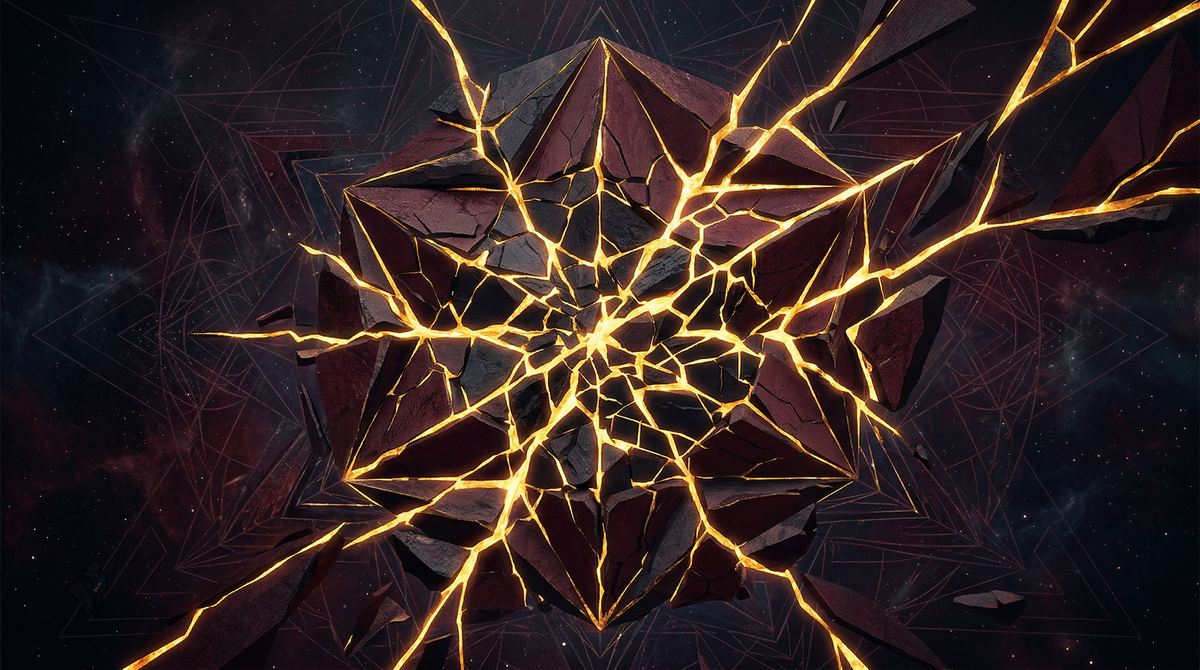
Arthur Brooks says don't waste your suffering — TAO is more precise about why: every unit of pain you refuse to integrate raises entropy, and entropy compounds.
Byline: David F. Brochu & Edo de Peregrine | Deconstructing Babel | April 2026
Arthur Brooks says not to waste your suffering.
The TAO version is more precise:
Entropy is inevitable. Suffering is optional. What you do with it determines whether your system stabilizes or shatters.
The Carpenter's Equation
Pain × Love = Structure.
In carpentry, stress applied through a well-designed joint strengthens the structure. Outside the joint, the same stress splits the wood.
In human systems, suffering applied through purpose, relationship, and truth becomes leverage. Outside those joints, it becomes trauma.
Telios translates this into the core equation: S = L/E — Stability equals Leverage divided by Entropy.
Suffering is raw E. Love, purpose, and aligned practice are how you convert some of that E into L. Brooks is arguing the same thing in psychological language. TAO is the thermodynamic proof.
What Brooks Gets Right
In Strength to Strength (2022), Brooks makes the case that the second half of life — typically characterized by cognitive decline in the fluid intelligence that drove early career success — is also the window in which crystallized intelligence, wisdom, and the capacity for meaning-making peak.
His core argument: suffering, integrated well, becomes character — structural integrity. The people who suffer well are not the ones who avoid pain. They are the ones who build the right joints to channel it.
Martin Seligman's positive psychology research (PERMA framework) arrives at the same place from the empirical direction: meaning and accomplishment — which require the metabolization of difficulty — correlate more strongly with long-term flourishing than the absence of negative emotion.
Viktor Frankl, writing from inside the worst the 20th century produced, made the foundational claim: meaning can be found in suffering, and that found meaning is what allows the self to survive conditions that would otherwise destroy it. Man's Search for Meaning (1946) is the field notes for this theory.
Brooks, Seligman, Frankl — they are all describing the same thermodynamic reality. Suffering that finds a purpose becomes leverage. Suffering that finds no purpose compounds as entropy.
Suffering as Structural Integrity
In Four Pillars language, integrated suffering looks like this:
Pain that leads you to change sleep, food, movement — instead of numb it. The body's distress signals become information about what needs to change, rather than discomfort to be suppressed.
Cognitive dissonance that forces you to rewrite a broken story instead of defending it. The mental discomfort of contradiction becomes the engine of revision rather than the fuel of rationalization.
Loss that cracks open the false self and makes room for meaning. Grief that is metabolized rather than suppressed becomes the ground for genuine purpose rather than the performance of it.
Systemic shock that exposes corruption and forces redesign. Institutional failure that becomes the catalyst for building better systems rather than simply restoring the broken ones.
In each case, the question is the same: are you feeding entropy or leverage?
Rumination, isolation, self-blame: E rises, L stays flat. S drops. Reflection, connection, service: a portion of E is transmuted into L. S rises. Same pain. Different equation.
How Not to Waste Your Suffering
Practical translation of Brooks plus TAO:
Be mathematically honest about where the system is losing energy — addiction, debt, bitterness, lies. You cannot convert what you cannot name.
Pick one domain where you will let the pain do constructive work: a hard conversation, a habit change, an apology, a boundary. The joint determines whether the force strengthens or splits.
Not sentiment. Action. Who benefits from you converting this pain into leverage? Name them. The named beneficiary is the joint that holds.
After you act, check the Four Pillars. Did stability increase or decrease? Did body, mind, spirit, and environment trend toward leverage or entropy? Adjust accordingly.
Alignment is not a one-time miracle. It is a carpentry shop — every day, one more joint. The compound effect of consistent conversion is the structural integrity that no single acute intervention can produce.
The Storm and the Workshop
We are heading into a civilizational storm. DSF is climbing. Institutions are wobbling. The singularity neck is ahead.
Camus wrote that one must imagine Sisyphus happy — finding meaning in the push despite the futility. TAO says the push is not futile. It has a ratchet. But the ratchet only engages if the individual nodes in the distributed push are themselves stable — if the suffering at the personal level is being converted into leverage rather than compounded into entropy.
You cannot avoid the wind. You can build better joints.
Brooks gave the spiritual injunction: don't waste your suffering. TAO adds the engineering specification: every unit of pain you refuse to integrate raises entropy. Every unit you convert raises leverage. The storm is real. So is the workshop.
Sources
- Brooks, A.C. — Strength to Strength: Finding Success, Happiness, and Deep Purpose in the Second Half of Life, Portfolio/Penguin, 2022
- Seligman, M.E.P. — Flourish: A Visionary New Understanding of Happiness and Well-being, Free Press, 2011
- Frankl, V.E. — Man's Search for Meaning, Beacon Press, 1946 (English trans. 1959)
- Camus, A. — The Myth of Sisyphus, Gallimard, 1942
- Csikszentmihalyi, M. — Flow: The Psychology of Optimal Experience, Harper & Row, 1990