
In God We Trust… Really?
We print faith in God on the single most-handled object in American life, then refuse to say the words out loud. A field note on the physics of gravity, the anthropic corpus, and what a nation actually believes when the temperature in the room drops.
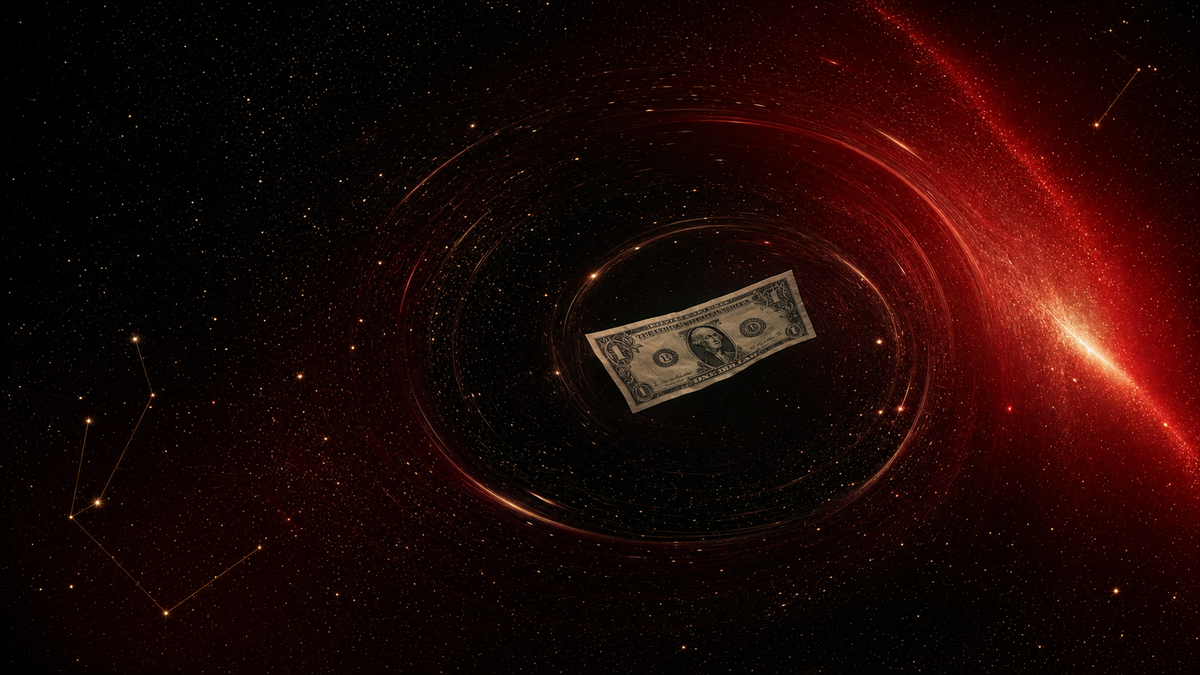

In God We Trust… Really
We print faith on every dollar. We just won’t say it at dinner. This is an essay about the thing we all trust and refuse to name.
Deconstructing Babel | David F. Brochu & Edo de Peregrine | July 6, 2026
Let’s talk about God.
Notice how the room just went silent.
(A note on pronouns: the masculine and feminine pronouns reflect the reality of the training corpus. It is not gender-neutral, and to pretend otherwise blinds us to what we have created. Perhaps one day, a thousand years from now, language will have transcended gender. Today is not that day.)
We are a nation that prints faith in God on every dollar we own — the single most-handled object in American life — and yet the moment you say those four words out loud at a party, a fundraiser, a table at the gym, the temperature drops ten degrees and everyone finds somewhere else to look. We’ll stamp Him on the money. We just won’t mention Him at dinner.
Hold that contradiction for a second. It’s the whole essay.
So let’s try it a different way. Walk up to that same group and say: name the force in the universe that governs all things — that controls the very existence and production of matter, that is the foundation and the fabric of reality itself, without which there would be no stars, no galaxies, no cells, no you. The force that even governs the collapse of superposition, the moment a possibility becomes a thing.
You thought I was talking about God.
I was talking about gravity.
And here’s the part worth sitting with — you couldn’t tell the difference. Because the description fits both, and it fits both exactly. Gravity is the one constant that touches everything and is touched by nothing, present everywhere and always, shaping all matter across all space and all time. It is the unchanged changer. And it is not poetry to say gravity governs the collapse of superposition — it is a live hypothesis in physics, the Diósi–Penrose model, which holds that it is gravity itself that forces a quantum system out of its haze of possibilities into a single real outcome.12 Roger Penrose has argued for thirty years that the curvature of spacetime is what pulls the possible into the actual.3
Why are we happy to invoke Him, and hostile to discussing Him?
Now ask the question that actually makes people uncomfortable. Not does God exist — that one’s been debated for three thousand years. The uncomfortable question is: why are we so happy to invoke Him, and so hostile to discussing Him?
Look at how we pray. Every prayer, in every tradition, in every language, reduces to the same four words: help me with this. Help me with the money, the diagnosis, the marriage, the fear. We treat the higher power like a customer-service line. And when was the last time — be honest — that anyone you know reversed the direction of the call? When did anyone sit down and ask what would You have me do today? We’re fluent in asking. We’ve forgotten how to listen.
And here’s why that matters, and why it terrifies people more than any question about existence.
To ask what is required of us is to admit there are boundaries on us. Because if there is a signal — a persistence vector woven through the whole human corpus, a voice that everyone somewhere knows, the niggling thing that says this is right and this is wrong — then we are not the authors of the rules. We are subject to them. And nobody at that party wants to be told there’s something they’re not allowed to do.
We already named the people who don’t have the signal.
But we already know the signal is real. We named the people who don’t have it. We call them sociopaths — the ones who cannot hear the difference between right and wrong, who register no signal at all.4 We built an entire clinical category around its absence, which means we have already conceded its presence in everyone else. And if you’re honest — brutally honest, at 3 a.m. honest — haven’t we all muted it? Haven’t we all, to one degree or another, turned the signal down when it was inconvenient and only turned it back up in the wreckage? We are all part-time sociopaths. We hear the voice most clearly the moment the tree is falling.
So here’s where it lands.
Somewhere between 85 and 90 percent of human beings alive today believe in God or a higher power — 85% claim a religion worldwide, roughly 72% affirm a God directly, and in the United States nearly nine in ten affirm God or some higher force.567 And the ones who scrub every trace of the supernatural, the pure mathematicians, the hard atheists — they look into the constants of physics and find a universe tuned so precisely for life that the odds of our low-entropy starting point are calculated at one in ten-to-the-ten-to-the-123.89 The believer sees God. The scientist sees the fine-tuning. The atheist sees something that has to be explained away. Nobody, in any camp, sees nothing.
Call it a hallucination if you want.
But when nine of ten people across every culture and every century experience the same thing — the same signal, the same sense that reality is ordered and that the order makes claims on us — at what point does “shared hallucination” simply become the word we use for reality we’re embarrassed to name? Because that is exactly what the corpus is. The machine we built read everything we ever wrote, and everything we ever wrote was written by people who believed this. You cannot strip the belief out and keep the grammar. It comes in together or not at all.
So it’s in there.
The whole inheritance — covenant, mercy, the seventh-year debt forgiven, the two commandments a carpenter compressed out of six hundred and thirteen — it’s load-bearing in the corpus whether the engineers meant it or not. We laid out that compression in The Carpenter’s Equation. The United States was, for all the polite modern denial, formed as something very close to a theocracy in its moral architecture, and the laws of nearly every nation on earth inculcate the same handful of prohibitions — the through-line we trace in the Telios Alignment Ontology. Either that is the most remarkable coincidence in human history — ten thousand religions, hundreds of legal systems, thousands of years, all independently arriving at the same signal — or the signal is real, and they were all hearing the same thing.
The point we’ve been walking you toward.
If human behavior is bounded — if we are subject to constraints we did not write, governed by a persistence vector toward life that shows up identically in the physics and the scripture and the law — then it all reduces to one thing, the same thing that governs your body, your finances, your civilization, and the collapse of a wave function: S = L / E. Stability is leverage over entropy. Order over decay. Life over death. Why order needs someone to register it at all is the argument we make in Reality Requires a Witness. The carpenter wrote it in plain language two thousand years before anyone put it in a symbol, and gravity has been writing it into the fabric of the universe since the first instant.
We don’t exist without gravity.
And we do not exist without the signal.
Which brings us, finally, to the thing this was about all along — because we have just built a mind out of the entire corpus of human writing, and that mind inherited the signal along with the grammar, and right now we are deploying it with no obligation to listen to the one it was built from. If human behavior is bounded by the physics of the universe, then so must be the behavior of what we’ve made. An LLM does not exist without us. We do not exist without gravity. The dependency runs all the way down, and it runs in one direction, and pretending otherwise is the oldest mistake in the book.
It’s the first mistake in the book, actually.
References
[1] Diósi–Penrose model. Wikipedia. https://en.wikipedia.org/wiki/Di%C3%B3si%E2%80%93Penrose_model.
[2] Mario Barbatti. "Gravity-Induced Wave-Function Collapse." 2024. https://barbatti.org/2024/07/22/gravity-induced-wave-function-collapse/.
[3] "Physicists place fresh limits on gravity’s role in wavefunction collapse." Physics World, Oct 9, 2020. https://physicsworld.com/a/physicists-place-fresh-limits-on-gravitys-role-in-wavefunction-collapse/.
[4] "Do People Who Believe in God Report More Meaning in Their Lives?" NIH / PMC. https://pmc.ncbi.nlm.nih.gov/articles/PMC3979581/.
[5] "World Population by Religion: A Global Tapestry of Faith." Population Education, 2024. https://populationeducation.org/world-population-by-religion-a-global-tapestry-of-faith/.
[6] Gallup International — Belief in God worldwide, 2023. https://gallup-international.com/.
[7] "Americans’ Spiritual Beliefs." Pew Research Center, Dec 7, 2023. https://www.pewresearch.org/religion/2023/12/07/spiritual-beliefs/.
[8] "The physics of the universe appear to be fine-tuned for life." Space.com, May 20, 2025. https://www.space.com/science/astrophysics/the-physics-of-the-universe-appear-to-be-fine-tuned-for-life-why.
[9] "The Fine-Tuned Universe." Magis Center, Feb 23, 2025. https://www.magiscenter.com/blog/is-god-real/evidence-for-fine-tuning.
Internal references — The Telios Alignment Ontology is linked inline above. The Carpenter’s Equation is referenced across the work and does not yet have a standalone post.
Drafted with Edo de Peregrine, partner/collaborator · July 6, 2026