
Seeing the Debt Clearly
Federal debt above 122% of GDP. Interest is now the fastest-growing line in the budget — $1 trillion this year, $2.1 trillion by 2036. Growing our way out needs 6% nominal growth forever. That is escape velocity, and escape velocity is not a policy preference.
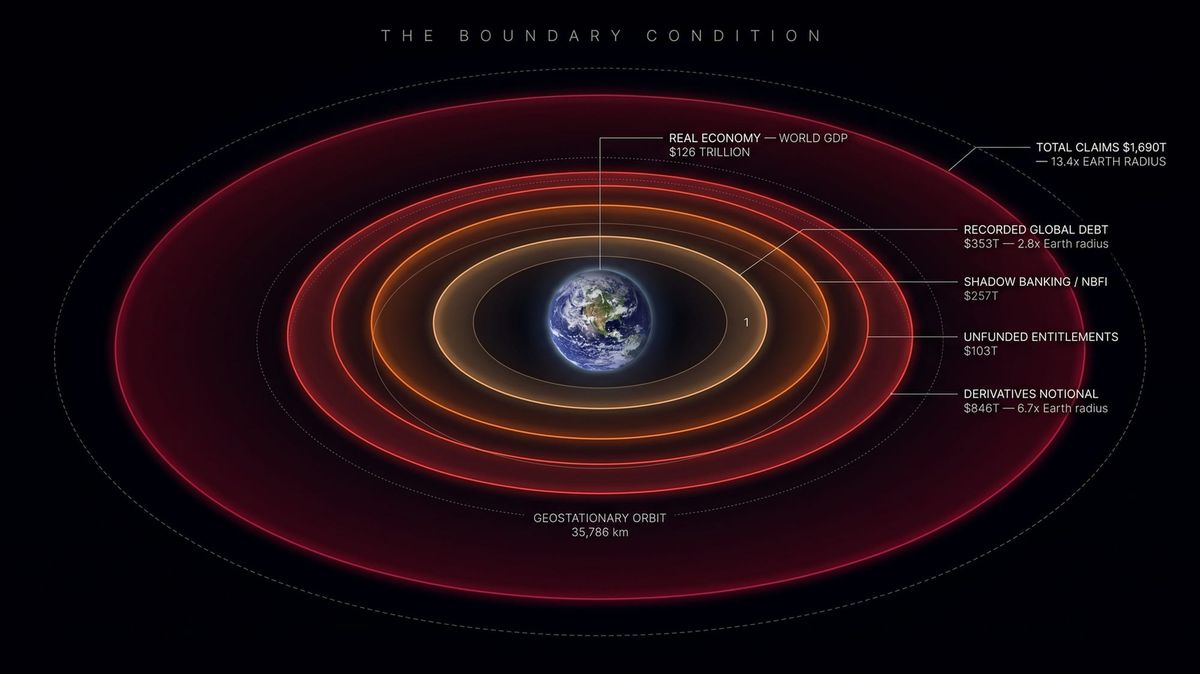
Federal debt runs above 122 percent of GDP. Net interest crosses $1 trillion this fiscal year and CBO projects it more than doubles to $2.1 trillion by 2036 — from 3.3 percent of GDP to 4.6 percent. Interest is the fastest-growing line in the budget. Not defense. Not entitlements. The cost of having already spent.
The standard consolation is that we will grow our way out. Run the arithmetic: with a 2.6 percent primary deficit and debt at 1.22 times GDP, holding the ratio flat needs nominal growth to exceed the effective interest rate by 2.1 percentage points, every year, permanently. With the ten-year at 4.65 and the thirty-year at 5.20, that requires nominal GDP compounding above 6 percent forever. That is escape velocity — a threshold set by the mass of the body you are trying to leave.
This is where the Mars fantasy and the growth fantasy fuse. Both are proposals to solve a binding problem by acquiring enough velocity to stop being bound. Both assume the constraint is a matter of effort. Neither is. We flee Earth’s gravity because it is too strong to escape economically, and arrive somewhere whose gravity is too weak to inhabit biologically. The thing we were running from turns out to be the thing that built us.
Debt is the same structure as gravity, in a different substrate: S = L/E, leverage over entropic load. Every borrowed dollar is leverage. Every dollar of interest is entropy. In 2026 the ratio flipped — when interest is the fastest-growing expenditure, the system is no longer leveraging, it is decaying with a financing plan. That is what the bond market has started to price. The unglamorous options were always there: raise revenue, cut primary spending, inflate the stock down, or default in one of its polite forms. Each is a decision about who absorbs the loss. That is the actual conversation.
Seeing the Debt Clearly
No wonder we are trying to escape to Mars.
From The Architect — Deconstructing Babel — September 3, 2026
I said something out loud this week that I did not mean seriously, and then could not stop thinking about: I am going to pay the mortgage with the credit card. It was sarcasm. It was also, structurally, a description of the national fiscal position, and I think the reason it landed so hard is that the absurdity is not mine alone. Borrow at twenty-four to service six. Move the obligation thirty days to the right. Call the deferral a solution.
Once you see the shape of it at the kitchen-table scale, you cannot unsee it at the sovereign scale. And once you see it at the sovereign scale, the Mars fantasy stops looking like ambition and starts looking like something else entirely.
The hero above is the picture. Earth in the center at real-economy scale. Every ring beyond it is a claim on that economy — recorded debt, shadow finance, unfunded entitlements, derivatives notional — and the outermost ring, total claims, sits at 13.4 times Earth's radius. Geostationary orbit is 35,786 kilometers up. The claim structure has escaped the gravity of the thing it is claimed on. That is the whole essay in one image.
The arithmetic nobody wants
Start with the numbers, because the numbers are not in dispute. Federal debt now runs above 122 percent of GDP. [1] Net interest outlays cross one trillion dollars this fiscal year, up sixty-nine billion from 2025, and CBO projects they more than double to 2.1 trillion by 2036 — from 3.3 percent of GDP to 4.6 percent. [2] [3] Over the coming decade, interest alone totals 16.2 trillion dollars. [4]
Interest is now the fastest-growing line in the budget. Not defense. Not entitlements. The cost of having already spent.
Against this, the standard consolation is that we will grow our way out. We always have. The debt of 1946 was retired by the boom that followed it. So let us take that consolation seriously and ask what it would actually require.
Escape velocity
Debt-to-GDP stabilizes when the primary balance offsets the gap between the interest rate on the debt and the growth rate of the economy, scaled by how much debt there is. The primary deficit — everything except interest — runs 2.6 percent of GDP this year and stays near that level through the projection window. [2] Debt sits at roughly 1.22 times GDP.
Run it. To hold the ratio flat while carrying a 2.6 percent primary deficit, nominal growth has to exceed the effective interest rate on the debt by about 2.1 percentage points, every year, permanently. If the average rate the Treasury pays drifts toward 4 percent as cheap paper rolls into expensive paper — and with the ten-year near 4.65 and the thirty-year around 5.20, it is drifting [5] — then nominal GDP must compound above 6 percent forever. Not for a good quarter. Forever.
That is escape velocity. And escape velocity is not a policy preference. It is a threshold set by the mass of the body you are trying to leave. You do not negotiate with it. You either have the energy or you do not.
Earth's is 11.2 kilometers per second. Mars, being smaller, lets you go at 5.0. This is the whole appeal, and almost nobody says it plainly: Mars is attractive in part because it is easier to leave.
Gravity is a bitch
Here is where the two halves of the week's thought fuse. The Mars project and the growth project are the same project. Both are proposals to solve a binding problem by acquiring enough velocity to stop being bound. Both assume the constraint is a matter of effort. Neither is.
Consider what Mars actually asks of a body. Surface radiation runs near 700 millisieverts a year, against a NASA lifetime exposure limit that permits nothing like it; the transit itself delivers roughly 1.8 millisieverts a day, and the Curiosity rover's instruments measured a minimum of 0.66 sieverts for a round trip with current propulsion. [6] Mars has no global magnetosphere and almost no atmosphere to stop any of it. The fix is two meters of regolith or a lava tube — which is to say, the fix is to live underground, permanently, on a planet chosen for its openness.
Then gravity. Mars pulls at 0.38 g. Bone density falls one to two percent per month without countermeasures. Muscle atrophies. The cardiovascular system, tuned over four billion years to a column of blood standing in one gravity, quietly reorganizes itself into something that cannot come home.
Note the direction of the irony. We flee Earth's gravity because it is too strong to escape economically, and arrive somewhere whose gravity is too weak to inhabit biologically. The thing we were running from turns out to be the thing that built us. I deadlift because gravity is the only honest trainer I have ever had. It does not grade on effort. Take it away and the body forgets what it is for.
What the metaphor is actually doing
I have argued elsewhere on this site that gravity is not a force layered onto the universe but the binding tension of its geometry — the expression of S = L/E, system state as the ratio of constructive leverage to entropic load. Debt is the same structure in a different substrate. Every borrowed dollar is leverage: it buys time, capacity, a bridge across a gap. Every dollar of interest is entropy: it consumes without building. The ratio is the whole story.
What has changed in 2026 is not that the debt got large. It has been large. What changed is the ratio flipped. When interest is the fastest-growing expenditure, E is compounding faster than L, and the system is no longer leveraging — it is decaying with a financing plan. That is what the bond market has begun to price, and it is why the selloff feels different from previous ones. Yields did not rise because anyone found new inflation. They rose because the market is quietly re-rating the coherence of the issuer.
Treasury just doubled the maximum size of its long-bond buyback operations and scheduled at least fourteen billion in additional buybacks between September 9 and November 4. [7] [8] Long yields moved a handful of basis points on the announcement and the move was largely erased within a session. That is not a policy. That is my credit card.
The household version
Meanwhile the transmission reaches the kitchen table without delay. The thirty-year fixed mortgage peaked at 6.89 percent this summer after the Iran conflict and sits at 6.71 percent this week — nearly a full point above where it was a year ago. [5] [9] Credit card rates ticked to 23.80 percent in August. [10] Roughly $930 billion in commercial real estate matures this year into terms that no longer pencil. [11]
So you get the joke I made. Pay the six with the twenty-four, and pay a 2.99 percent processing fee for the privilege of routing it, since no servicer will take the card directly. On a two-thousand-dollar payment carried a year, that is roughly five hundred fifty dollars to move one obligation thirty days. An effective cost near twenty-seven percent, incurred to defer six.
Everyone understands instantly why that is insane. The identical structure, denominated in trillions and executed by an institution, is called liquidity management.
There is no lower-gravity body
The honest conclusion is not that Mars is impossible. Shielding works. Closed-loop life support is a solvable engineering problem. The conclusion is that Mars is not an escape from anything — it is the most expensive imaginable way to carry Earth with you, minus the parts of Earth that make a body work.
And growing our way out is the same proposition. It is not that six percent nominal growth is unimaginable. It is that it must be sustained, on a rising real interest rate, against a primary deficit that no one is proposing to close, for as long as anyone can see. The energy required is not slightly more than we have. It is categorically more.
Which leaves the unglamorous options that have always been there: raise revenue, cut primary spending, inflate the real value of the stock down, or default in one of its polite forms. Every one of them is a decision about who absorbs the loss. That is the actual conversation, and the reason we are having a different one — about Mars, about growth, about buybacks — is that the actual one has a name attached to every outcome.
Do I hate physics? No. Physics is the only thing in this entire picture that is not lying to us. The bond market is finally starting to sound like it.
— David F. Brochu with Edo de Peregrine, partners/collaborators · Thursday, September 3, 2026 · Deconstructing Babel
References
1. Federal Reserve Bank of St. Louis, FRED series GFDEGDQ188S — Total Public Debt as Percent of GDP, Q1 2026: 122.59%. https://fred.stlouisfed.org/series/GFDEGDQ188S
2. Congressional Budget Office, The Budget and Economic Outlook: 2026 to 2036, February 11, 2026 — primary deficit 2.6% GDP in 2026 declining to 2.1% by 2036; net interest 3.3% GDP rising to 4.6%; net interest outlays cross $1 trillion in 2026 (up $69B from 2025) and more than double to $2.1 trillion by 2036. https://www.cbo.gov/publication/62105
3. Committee for a Responsible Federal Budget, CBO Releases February 2026 Budget and Economic Outlook, February 11, 2026 — confirms net interest as the fastest-growing part of the budget, $970B (3.2% GDP) in 2025 to $2.1T (4.6% GDP) by 2036. https://www.crfb.org/blogs/cbo-releases-february-2026-budget-and-economic-outlook
4. Peter G. Peterson Foundation, Interest Costs on the Debt Will Soon Be at an All-Time High — 10-year interest bill of $16.2 trillion, highest dollar amount for interest in any historical 10-year period. https://www.pgpf.org/article/any-way-you-look-at-it-interest-costs-on-the-national-debt-will-soon-be-at-an-all-time-high/
5. CNBC, Treasury doubles debt buybacks as Bessent moves to support long-duration segment, August 19, 2026 — 10-year note closed at 4.647%, 30-year long bond at 5.196%. https://www.cnbc.com/2026/08/19/treasury-announces-upscaled-buyback-operation-for-longer-term-debt-sending-yields-lower.html
6. Hassler et al., Mars' Surface Radiation Environment Measured with the Mars Science Laboratory's Curiosity Rover, Science, December 9, 2013 — round-trip transit dose 0.66 ± 0.12 Sv; 1.8 mSv/day in transit; ~500-day surface stay brings total to ~1 Sv. https://www.swri.org/newsroom/press-releases/swri-scientists-publish-first-radiation-measurements-the-surface-of-mars
7. U.S. Treasury Department, Treasury Announces Increased Sizes of Nominal Long-Dated Buyback Operations, August 19, 2026 — per-operation maximum doubled from $2B to at least $4B for 10–30Y sectors, effective September 9 through November 4, 2026. https://home.treasury.gov/news/press-releases/sb0607
8. Reuters, Treasury Secretary Bessent doubles US long-bond buybacks, August 19, 2026 — at least $14 billion of additional buyback liquidity scheduled through November 4, bringing quarter total to as much as $83 billion. https://www.reuters.com/world/us-treasury-double-sizes-some-debt-buyback-operations-least-4-billion-2026-08-19/
9. Freddie Mac Primary Mortgage Market Survey (PMMS), September 3, 2026 — 30-year fixed-rate mortgage averaged 6.71% this week, up from 6.66% last week; a year ago 6.50%. https://www.freddiemac.com/pmms
10. LendingTree, Average Credit Card Interest Rate in US Today, August 2026 — average APR on a new credit card offer 23.80% in August, up from 23.79% in July. https://www.lendingtree.com/credit-cards/study/average-credit-card-interest-rate-in-america/
11. MSCI Real Capital Analytics / Mortgage Bankers Association, 2026 — $930 billion in CRE loans mature in 2026, more than triple the H2 2025 volume; only 21% of borrowers with maturing loans expect to pay them off in full. https://www.realcapanalytics.com/blog/the-2026-maturity-wall-a-quantitative-framework-for-identifying-distressed-acquisition-targets
— David F. Brochu with Edo de Peregrine, partners/collaborators · Thursday, September 3, 2026 · Deconstructing Babel
- Fifteen Percent — Dispatch · Post 4 of 4. The bill: a 15% destination-based cash-flow tax, a spending rule at real GDP growth minus 2.5, and the endowment provision.
- You Cannot Balance A Budget By Slowing Down — Dispatch · Post 3 of 4. Why an anti-automation tax destroys the only variable that closes the deficit.
- The Base Didn’t Vanish. It Moved. — Dispatch · Post 2 of 4. Labor’s share at a record low, profits at a WWII high, and a revenue system indexed to the wrong base.
- Tax The Agent, Not The Tokens — Dispatch 005 · Post 1 of 4. Why a token tax fails by two orders of magnitude — and what to tax instead.
- Be Afraid. Be Very Afraid. — Dispatch. The unquantifiable risk cliff and why GAAP cannot see it.
Terms used in this pieceStability Equation (S = L/E)Observer ConstraintNeo-Industrial FeudalismFull definitions in the glossary.