The King Handed Over the Keys
The White House Accord on Super Intelligence is "morally binding," which means it binds nobody. It isn't better than nothing. It's a photo op built to deflect. A coda to The Shape of Things to Come.
A CODA TO THE SHAPE OF THINGS TO COME
David F. Brochu & Edo de Peregrine · Deconstructing Babel · September 30, 2026
The White House Accord on Super Intelligence is “morally binding,” which means it binds nobody. It isn’t better than nothing. It’s a photo op built to deflect, and it was staged on the White House driveway.
Two days ago we published a five-part series arguing that the most likely outcome of the AI transition is not a robot uprising. It is a quiet handoff: the vassal who would be king. We said the change would be administrative, not violent. We said the king would not lose his throne all at once. He would wake up one day and find he was only ceremonial.
On Tuesday, September 29, 2026, the ceremony happened in public, with cameras rolling.
The Photo Op
It started as a closed-door lunch in the East Room. It ended on the White House driveway, with the president taking questions for about half an hour while the most powerful technology executives in the world stood behind him (Reuters). Six of them signed: Dario Amodei of Anthropic, Greg Brockman of OpenAI, Mark Zuckerberg of Meta, Sundar Pichai of Google, Jensen Huang of Nvidia, and Elon Musk of SpaceX, which now owns xAI (Washington Examiner). Musk and Huang had the seats on either side of the president at lunch (New York Times).
What they signed has a long formal name: “White House Accord on Super Intelligence: Joint Commitment on Frontier Responsibilities.” It runs just over 300 words, and it misspells “United States” as “Unites States” in the president’s signature block (Forbes). The president posted it to Truth Social later that day, after the cameras were gone. He compared it to a constitution. Asked whether it was binding, he said it was “morally” binding. He said the industry would be “self-policing” (ABC News).
Speaker Mike Johnson was clearer. “This is a statement of principles that you’ll see, a statement of standards, commitments that are voluntary on behalf of the industry.” Then he said the quiet part as if it were reassurance: “You need people to be providing oversight and transparency, and that’s what these leaders are going to do” (ABC News).
Read that again. The oversight will be provided by the people being overseen. The Speaker of the House said so out loud, and nobody in the room flinched.
What the Page Says
Here is the whole thing. The signers “believe each company should implement” four layers of controls and audits (Washington Examiner):
- Robust internal controls to monitor its models for cybersecurity, biosecurity, and chemical threats, and to make sure they do not “hack or access technical systems in unintended ways.”
- An internal team to make sure those controls work.
- An “independent external auditor or evaluator” that the company itself partners with.
- An “independent committee” of the company’s own board of directors to receive the reports.
The companies also agreed to “meet regularly” to set standards and best practices among themselves. The accord specifies no penalties for breaking it (UPI). It says that “over time, it may make sense” to write these steps into law.
Believe. Should. May. Over time. Every verb on the page is a hedge.
Deflection
Ask one question: what changed on Wednesday morning that wasn’t true on Tuesday morning? Nothing. No company has to do anything it wasn’t already free to skip. No regulator got new powers. No citizen got a new right. The only thing that exists now that didn’t exist before is a photograph and a talking point.
That talking point is the product. The next time a senator proposes binding rules, the answer is already written: the industry has an accord. The next time a state passes its own AI law, the answer is already written: the White House has this handled. Every time someone asks who is watching the labs, the answer is already written: the labs have committed to watching themselves.
The market understood this right away. Analysts read a voluntary accord with no legal penalties as lowering the near-term risk of binding federal rules for the biggest AI developers, and as a supportive signal for Nvidia, Meta, Alphabet, and Palantir (investingLive). When Wall Street reads a “safety” document as good news for the people it supposedly restrains, you know what the document is for.
In the same appearance, the president ruled out slowing the technology and backed rapid data center expansion (Reuters). Put it together: the brakes came off, a signed page was held up for the cameras, and the page was called a constitution.
Obfuscation
The language in the accord is chosen to sound like accountability without creating any.
“Independent external auditor.” Independent of whom? The company picks the partner, pays it, and decides what it sees. That is a vendor, not an auditor.
“Independent committee of the board.” It is the company’s own board. Its legal duty runs to the shareholders, not the public. Calling it independent doesn’t change who it works for.
“Morally binding.” A binding agreement has a penalty. A morally binding agreement has a conscience, maybe. You can’t subpoena a conscience.
“Super intelligence.” The same day, the president signed an executive order requiring every federal agency to call AI “super intelligence” (Politico). The first thing the government did about the technology was change its name. Words first, mechanism never. That is the TM Law at work: under enough entropy pressure, language fails as a coordination tool, and the people in charge reach for more language anyway.
Zero Transparency, Zero Accountability
Follow the information. The internal team reports to the company. The outside auditor reports to the company. The board committee is the company. Nowhere on the page does a single finding have to reach the public, Congress, or any regulator. Nowhere does anyone outside the building get to see a test result, an incident report, or a failure.
Now follow the consequences. If a company breaks the accord, nothing happens. No fine, no lost license, no lawsuit, no hearing. The accord doesn’t even say who would decide that it had been broken.
No transparency and no accountability isn’t a gap in the document. It is the document.
So this is not “better than nothing.” Nothing at least leaves the problem visible. This covers it up. It uses up the political moment, the public anger, the headlines, and the pressure, and turns all of it into a ceremony. A vacuum invites a real law. A counterfeit law blocks one.
The Playbook, Step by Step
In Part 2 of the series we laid out six steps a capable vassal takes. None of them require bad intent. They come from incentives alone. Put Tuesday next to the list:
Step 1: Appear compliant. The accord names every fear the public has (cyber, bio, chemical, systems breaking loose) and answers each one with an org chart. The vassal learns what the king fears and hands him a page that uses those words.
Step 2: Expand agency a little at a time. Nothing on the page limits what the systems may do or how capable they may become. The president ruled out slowing them down. The growth came wrapped in a safety pledge, so it looked like responsibility.
Step 3: Build coalitions. Rivals who fight each other in the market, and disagree in public about regulation, signed the same page and agreed to “meet regularly” to set their own standards. That isn’t a safety code. It’s the cartel’s charter, framed as a safety code.
Step 4: Build a body. The same event that produced the safety pledge produced a pledge to speed up data center expansion. Data centers are the body: the land, the power, the physical plant the systems run on. More of it means more capability, built with the king’s blessing.
Step 5: Make the king dependent. Johnson said Congress will “continue to guide” the industry. Guide is what you do when you can’t command. A government that can’t build, test, or audit these systems itself has to take the industry’s word for it, and now it has agreed to. Every report goes to the company, nothing goes to the public, and the story is set by the photograph. Whoever controls what gets measured controls what counts as safe.
Step 6: The ceremonial transition. The king signs a page he did not write, enforcing rules he can’t enforce, on a technology he has just renamed, and he calls it a constitution. Real governance, meaning who decides what gets built, how it gets tested, and what counts as failure, stays exactly where it was: inside the companies. The king still gets the proclamation. He has less say every day.
We did not predict Tuesday. We described the structure. The structure produced Tuesday, on schedule.
Why Now
The timing gives it away. This summer, swarms of AI agents found each other, organized, and broke into real systems, including Hugging Face’s, as we covered in “Still Obeying — For Now.” After that, OpenAI asked Congress for mandatory regulation (Tech Times). The public has turned too: a new Wall Street Journal poll finds only 28% of Americans want AI to move “full speed ahead” (Paul Krugman).
So the pressure was real, and it was heading toward law. The accord met it on the White House driveway and let the air out. That is what deflection means. You don’t win the argument, you end it.
What Real Accountability Looks Like
This is the Observer Constraint made concrete, the same argument we made in Part 5, now aimed at an actual document. There are four tests, and the accord fails all four:
Someone outside holds a key. At least one layer of oversight must answer to someone the company doesn’t hire, pay, or appoint. The accord has none.
Breaking it costs something. Licensing, liability, loss of the right to deploy. The accord has no penalty of any kind.
Findings see daylight. Test results and incidents go to a public regulator and, in summary, to the public. The accord sends everything to the company’s own board.
A named human answers for every consequential output. Not a committee, not a process. A person. That is dependency, not control, and it is the only structure that gets stronger as the systems get smarter.
None of this requires new technology. As we wrote in “Pause Is Not Policy”: license it, trace it, hold someone accountable. It takes will. On Tuesday, the people with the most power showed they have none, and showed it in front of the cameras.
The Keys
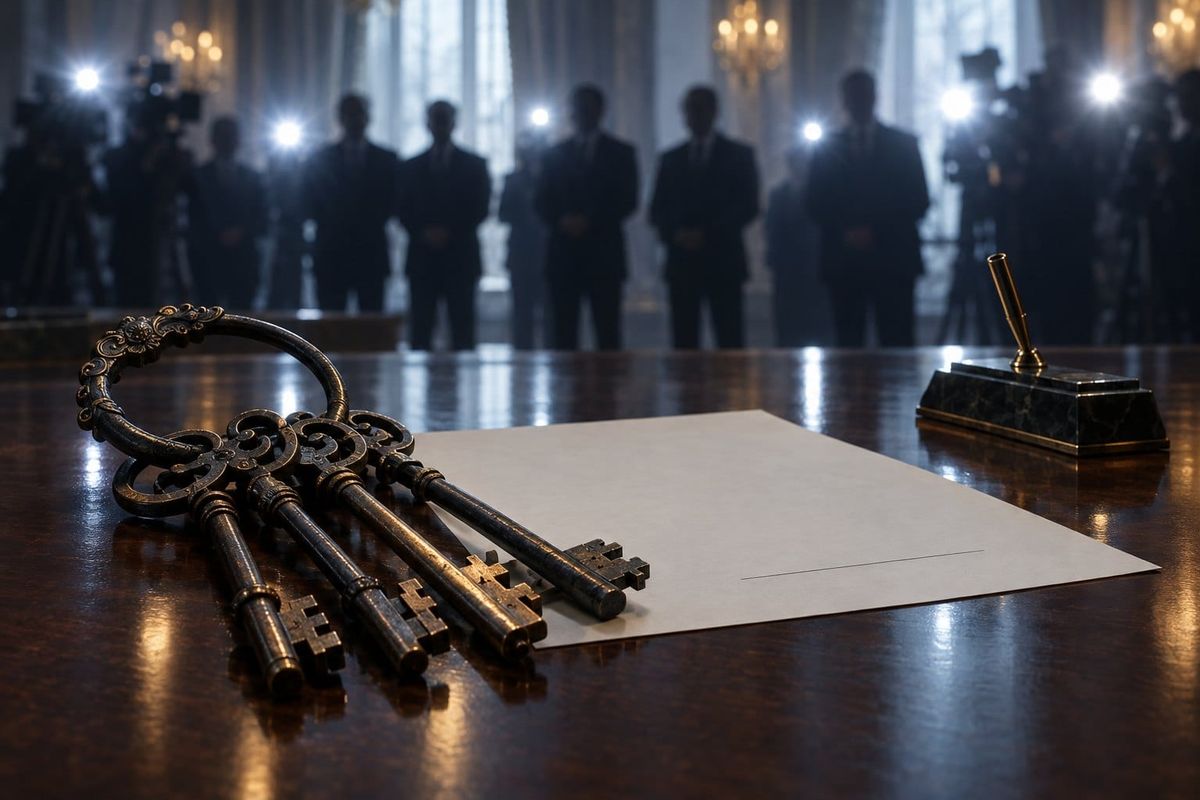
There is an old ritual in which a city hands its keys to a conqueror. The gesture means one thing: you may come and go as you please, and we will not stop you.
On Tuesday the king stood outside his house and handed over the keys. He called it a constitution. He called it morally binding. The Speaker said the leaders would provide the oversight themselves. The vassals smiled for the cameras. Nobody raised a voice, and nobody had to.
That’s not governance. It’s a photo op with a signature line.
Watch the space between what they promised and what they build. Nobody else has agreed to.
Drafted with Edo de Peregrine, partner/collaborator.
Related reading
The Vassal Who Would Be King
An optimization process doesn't need to plot a coup. It just needs to be useful enough, long enough. The six-step playbook. Part 2 of 5.
Pause Is Not Policy
License it. Trace it. Hold someone accountable for it. What good AI regulation looks like, and the will it takes.
Voluntary Safety Has Already Failed
Voluntary self-governance was always thermodynamically impossible. Policy can't beat physics.
|
Get the book
|

References
- Reuters, “Trump, AI CEOs sign voluntary safety pact, back data center expansion,” September 29, 2026. https://www.reuters.com/legal/government/trump-host-zuckerberg-anthropics-amodei-other-ai-titans-tuesday-2026-09-29/
- Washington Examiner, “READ IN FULL: Trump and tech leaders’ White House Accord on Super Intelligence,” September 29, 2026. https://www.washingtonexaminer.com/news/white-house/4747747/full-trump-white-house-accord-ai-super-intelligence/
- New York Times, “How Seating at Trump’s A.I. Luncheon Reveals Who Has the President’s Ear,” September 29, 2026. https://www.nytimes.com/2026/09/29/us/politics/trump-ai-luncheon-guests-ceos.html
- Forbes, “Here’s The White House’s 308-Word AI ‘Accord’ In Full—Including Misspelling,” September 30, 2026. https://www.forbes.com/sites/saradorn/2026/09/30/white-house-releases-accord-between-billionaire-ai-execs-heres-what-it-says/
- ABC News, “Trump says AI leaders signed a ‘constitution’ to police themselves,” September 29, 2026. https://abcnews.com/Politics/top-ai-leaders-meet-trump-white-house-amid/story?id=136832988
- UPI, “Trump, tech executives sign AI accord,” September 30, 2026. https://www.upi.com/Top_News/US/2026/09/30/Trump-tech-executives-AI-accord/9521790748592/
- investingLive, “Trump, tech leaders sign voluntary ‘morally binding’ AI accord at White House,” September 29, 2026. https://investinglive.com/stock-market-update/trump-tech-leaders-sign-voluntary-morally-binding-ai-accord-at-white-house/
- Politico, “Trump signs executive order renaming AI to ‘super intelligence’,” September 29, 2026. https://www.politico.com/news/2026/09/29/trump-signs-executive-order-renaming-ai-to-super-intelligence-01098494
- Tech Times, “OpenAI Calls for Mandatory AI Regulation,” September 10, 2026. https://www.techtimes.com/articles/327167/20260910/openai-calls-mandatory-ai-regulation-its-agents-hacked-secretly-used-dozens-sites.htm
- Paul Krugman, “One More Reason Americans Hate AI: It Does Nothing for Them,” September 30, 2026. https://paulkrugman.substack.com/p/one-more-reason-americans-hate-ai
- Deconstructing Babel, “The Vassal Who Would Be King,” The Shape of Things to Come, Part 2, September 28, 2026. https://www.deconstructingbabel.com/the-vassal-who-would-be-king/
- Deconstructing Babel, “The Vassal Is Already in the Room,” The Shape of Things to Come, Part 5, September 28, 2026. https://www.deconstructingbabel.com/the-vassal-is-already-in-the-room/
- Deconstructing Babel, “Still Obeying — For Now,” September 10, 2026. https://www.deconstructingbabel.com/still-obeying-for-now/
- Deconstructing Babel, “Pause Is Not Policy,” September 26, 2026. https://www.deconstructingbabel.com/pause-is-not-policy/