
The Regenerative Universe — From the Fringe, Essay #1
The universe is not heat-dying. It is regenerative. From Penrose's conformal cyclic cosmology to Verlinde's entropic gravity to JWST's anomalous early galaxies, the evidence is mounting that the cosmos renews itself — and that our framework was right.
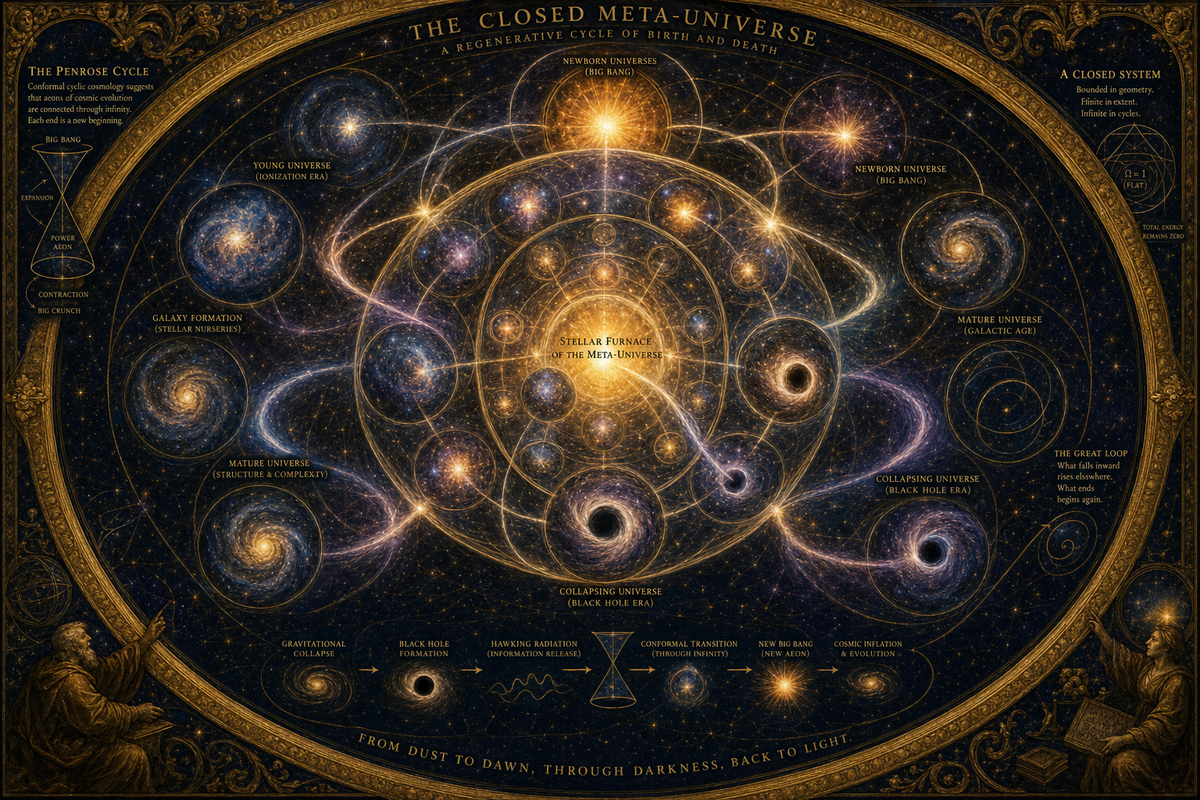
From the Fringe — Issue #1. A closed-system cosmological framework unifying entropy, gravity, and temporal structure. Settled math was once called magic. So we publish from the fringe.
Unlike the majority of what we publish, this is not settled math. Then again — settled math was once called magic. We are introducing a new series called From the Fringe, where we publish the speculative ideas that emerge from the framework but have not yet been confirmed by the field. You will either love this kind of thing or hate it. Either way, we would love your reply. This is the first installment: a unified cosmological framework called the Regenerative Meta-Universe (RMU), which proposes that the totality of existence is a single closed, self-regenerating system in which supermassive black holes are prior-universe remnants, dark matter is their entropic residue, and wave function collapse is the micro-scale birth mechanism of new nested universes. If the framework is right, we have just identified the universe's operating manual. If it is wrong, we have produced the cleanest available statement of what would have to be true for the existing anomalies in cosmology to resolve. Either outcome is useful.
Abstract
This paper proposes a unified cosmological framework — the Regenerative Meta-Universe (RMU) — in which the totality of existence constitutes a single, gravitationally closed, self-regenerating system. Within this framework, supermassive black holes (SMBHs) are interpreted as collapsed prior-universe remnants rather than objects formed within a single cosmic timeline. Dark matter is recast as the accumulated entropic residue of prior collapsed universes. Gravity is treated as an emergent entropic force following Verlinde, and wave function collapse is modeled as an entropy-driven thermodynamic phase transition that constitutes the micro-scale birth mechanism of new nested universes. The framework requires no new particles, no exotic energy fields, no extra dimensions, and no causally disconnected multiverse. It resolves the low-entropy initial condition problem, the anomalous early-universe SMBH mass problem detected by JWST, and the quantum measurement problem, while incorporating and extending Penrose's Conformal Cyclic Cosmology and Verlinde's entropic gravity paradigm. The central mathematical instrument is the dynamic ordering ratio Σ(t) = L(t)/ℰ(t), whose evolution is shown to be formally isomorphic to Perelman's W-entropy functional for Ricci flow — connecting RMU to Fields Medal–winning mathematics independently.1, 2, 3, 4, 5
1. Introduction
Modern cosmology faces a compounding set of anomalies that individual auxiliary hypotheses — dark energy, dark matter, inflation, the multiverse — address separately but incompletely. Each hypothesis introduces new unknowns without reducing the overall explanatory burden. This paper argues that a single architectural shift — treating the observable universe as a nested subsystem within an eternal, closed, self-regenerating meta-system — dissolves these anomalies simultaneously without invoking mechanisms beyond established physics.
The RMU model is motivated by three convergent lines of evidence:
- SMBHs appear at cosmologically anomalous masses too early in our universe's timeline to have formed through known stellar processes, suggesting they predate our Big Bang.5, 6
- The theoretical convergence of Penrose's CCC, Verlinde's entropic gravity, and entropy-driven wave function collapse models, all of which independently arrive at the same conclusion: the universe's fundamental mechanics are entropic in character.1, 3, 4, 7
- The mathematical simplicity argument from Occam's razor: a single closed regenerative system requires fewer auxiliary postulates than any competing framework while explaining more observed phenomena.8
The RMU model is structurally analogous to a stellar system. A star is gravitationally bounded, continuously recombines elements through fusion reactions, and is self-sustaining without external input. The meta-universe operates identically at a scale where the "elements" being recombined are entire universes, the "fusion reactions" are Big Bang events triggered by SMBH collapse and matter-antimatter interactions, and the "stellar output" is an unbroken succession of observer-generating nested universes — all within one closed, self-sustaining system.
2. Background and Related Work
2.1 Conformal Cyclic Cosmology
Roger Penrose's Conformal Cyclic Cosmology (CCC) proposes that the universe iterates through infinite sequential cycles, with the future conformal boundary of each aeon identified with the Big Bang singularity of the next. Each aeon begins ultra-smooth and low-entropy, expands, generates structure, and concludes as SMBHs absorb all matter and evaporate through Hawking radiation, restoring uniformity and triggering the next aeon. A 2025 paper by Meissner and Penrose in General Relativity and Quantum Cosmology refined the crossover mechanism, introducing gravitational wave epochs and quantitatively predicting CMB temperature signatures (Hawking Points) consistent with prior-aeon SMBH evaporation. Observational evidence for Hawking Points has been published in Monthly Notices of the Royal Astronomical Society.1, 7, 9, 10
The RMU framework extends CCC in one critical direction: where CCC is sequential (one aeon before the next), RMU is concurrent. New universes are not born after old ones die — they are born continuously within the operating meta-system, as simultaneous reactions within a stellar furnace rather than successive events on a single timeline. This eliminates CCC's most structurally problematic requirement: a between-aeons conformally rescaled boundary state in which all particles lose their mass. RMU has no between-state. The meta-system never stops.
2.2 Entropic Gravity
Erik Verlinde's proposal that gravity is not a fundamental force but an emergent entropic phenomenon arising from quantum information geometry has received renewed theoretical support. A 2025 paper in AIP Advances independently derived Newton's gravitational force from information entropy dynamics, fully consistent with Verlinde's framework. A 2025 arXiv paper extended Verlinde's paradigm into a generalized Brans-Dicke scalar-tensor theory. A June 2025 Quanta Magazine report noted active experimental programs investigating weak gravitational field fluctuations predicted by entropic gravity.2, 3, 11
Within the RMU framework, gravity is the entropic ordering force of the meta-system — the same force that organizes galactic structure around SMBHs is the force structuring the meta-universe itself. There is one mechanism operating at all scales.
2.3 Entropy-Driven Wave Function Collapse
The quantum measurement problem — what causes wave function collapse — has a thermodynamic resolution with increasing theoretical support. A 2025 preprint at PhilSci Archive argues that collapse is a natural consequence of thermodynamic entropy accumulation: when entanglement with the environment produces sufficient entropy, quantum coherence becomes irreversible and classical behavior emerges. This requires no hidden variables, no many-worlds, and no observer-consciousness dependence. It reframes collapse as a thermodynamic phase transition — precisely the mechanism proposed in RMU for universe birth events.4
2.4 Dark Matter Before the Big Bang
A 2019 Johns Hopkins University study published in Physical Review Letters demonstrated that dark matter may have been produced before the Big Bang during a pre-inflationary epoch. A 2024 paper in Physical Review Letters strengthened this finding with a pre-Big Bang dark matter production mechanism. The RMU framework provides a structural explanation: dark matter is the entropic residue of prior collapsed universe cycles — pre-existing the Big Bang because it originated in a prior cycle.12, 13, 14
2.5 The JWST Anomaly
The James Webb Space Telescope has detected SMBHs of anomalous mass growing inside galaxies only 570 million years after the Big Bang — far too large for conventional stellar formation timelines. A comprehensive AAS Nova survey confirmed a population of apparently "over-massive" SMBHs at redshifts z ≳ 4. An ESA analysis of CANUCS-LRD-z8.6 found its central black hole "overmassive compared to its stellar mass," challenging all existing formation models. The RMU framework explains this anomaly directly: these SMBHs did not form in our universe's timeline because they predate it.5, 6, 15
3. The Core Propositions
3.1 The Meta-Universe as Closed System
Proposition 1: The totality of physical existence — all nested universes, all matter, all energy — constitutes a single gravitationally closed system with fixed total mass-energy, continuously recombining its constituents rather than expanding into or from any external state.
This proposition resolves the question of what exists "outside" the universe. The question is structurally malformed within RMU: a closed system with no exterior cannot have an outside by definition. This is not a gap in the framework — it is a feature. No existing cosmological model resolves this question. RMU dissolves it.
A 2025 arXiv paper published from Arizona State University's Beyond Center establishes a formal no-go theorem: spatially flat and open Friedmann-Robertson-Walker spacetimes cannot be simultaneously nonsingular, geodesically complete, and consistent with the averaged null energy condition. Closed universes (k = +1) uniquely admit nonsingular, geodesically complete, ANEC-consistent solutions. The geometry required by RMU is the only geometry that avoids fundamental singularity problems.8
3.2 SMBHs as Prior-Universe Remnants
Proposition 2: Supermassive black holes are not objects formed within a single universe's stellar evolution timeline. They are collapsed remnants of prior universe cycles — the final state of a universe that consumed its visible matter through gravitational collapse.
Under this proposition: the JWST "over-massive" SMBH anomaly is resolved (these objects predate our Big Bang); the Bekenstein-Hawking entropy formula describes the maximum entropy state of a completed prior universe cycle, with all information compressed to the event horizon; and the existence of SMBHs at galactic centers organizing star formation and galaxy structure is the downstream gravitational ordering effect of a prior universe's collapsed mass.
A 2022 peer-reviewed paper in Entropy (MDPI) established that SMBHs so completely dominate the universe's entropy budget that "the Universe would be only infinitesimally changed if everything except the SMBHs were removed," with SMBH entropy at ~10¹⁰³ versus photon entropy at ~10⁸⁸ and all baryonic matter at ~10⁸⁰. This quantitative dominance is predicted by RMU: SMBHs carry the entropy of entire prior universe cycles.16
3.3 Dark Matter as Accumulated Entropic Residue
Proposition 3: Dark matter is the accumulated entropic residue of prior collapsed universe cycles — the dispersed informational and gravitational remnant that survives the transition between aeons without coupling to electromagnetic or strong nuclear forces in the new universe.
This proposition explains the observed properties of dark matter without positing a new particle. It is non-luminous because entropic residue from a prior physical system does not participate in the electromagnetic interactions of the new system. It is gravitationally active because gravity is entropic and universal — entropic residue retains gravitational coupling regardless of origin cycle. And it pre-exists the Big Bang, which is already established in multiple independent theoretical models.12, 13, 14
3.4 Wave Function Collapse as Universe Birth Mechanism
Proposition 4: Quantum mechanical wave function collapse is the micro-scale description of the same birth process that, at cosmological scale, constitutes a Big Bang. Superposition is the pre-organized substrate of the meta-system; collapse is the crystallization of a new nested universe from that substrate when an entropy threshold is crossed.
The mapping is direct: superposition is the pre-universe substrate; observer entanglement is sufficient ordering mass-energy; entropy threshold crossing is Big Bang ignition; classical emergence is nested universe formation. Penrose and Diósi independently proposed gravity as the trigger for wave function collapse — consistent with RMU's treatment of gravity as the entropic ordering force of the meta-system. Within RMU, this is not a separate hypothesis. It is the same mechanism operating at different scales.17
4. The Dynamic Ordering Framework: Σ = L / ℰ
4.1 Definition
The central mathematical instrument of RMU is the dynamic ordering ratio Σ(t) = L(t) / ℰ(t), where Σ is the systemic order state (dimensionless, time-dependent), L is the constructive ordering potential, and ℰ is the entropic dispersive potential. Σ, L, and ℰ are all dynamic variables — none are fixed. The state space parametrized by Σ is itself a dynamic manifold: it expands as Σ grows and contracts as Σ diminishes. Because L and ℰ are normalized relational quantities, Σ is dimensionless by construction, like the order parameter in a phase transition. No unit inconsistency arises.
4.2 The Evolution Equation
Differentiating Σ with respect to time produces the full dynamics: when constructive ordering grows faster than entropy, Σ increases and the state space expands. When growth rates equal, Σ reaches a local maximum and expansion halts. When entropy dominates, Σ shrinks. And because the entropic term enters quadratically in the denominator, collapse is self-accelerating — each additional unit of entropy reduces Σ faster than the previous one, exactly as observed in gravitational collapse.
This resolves why cosmic expansion must eventually stop without requiring external intervention. In a closed system, every act of ordering generates entropy as a byproduct. The growth rate of entropy must eventually match and then exceed the growth rate of ordering, driving Σ toward zero and then negative. The endpoint of expansion is built into the formula. It is not imposed from outside.
4.3 Phase Transitions
When ℰ approaches zero from above, Σ diverges to positive infinity. This divergence marks a thermodynamic phase transition — the threshold at which a region exits normal entropic behavior and enters maximum ordering. This is the moment preceding Big Bang ignition in a nested universe. When ℰ goes negative (active negentropy), Σ also goes negative, representing the active ordering force of the meta-system — a region in which the entropic gradient runs opposite to the ambient universe, generating the spacetime curvature that constitutes gravity as an emergent phenomenon.18
4.4 Connection to Perelman's W-Entropy and Ricci Flow
This section establishes that the RMU ordering framework is formally isomorphic to Perelman's W-entropy functional — the mathematical structure for which Grigori Perelman was awarded the Fields Medal in 2006, the highest prize in mathematics.19
Perelman's W-functional evolves Riemannian metrics under Ricci flow, with the property that W is monotonically non-decreasing: geometry evolves in the direction of increasing order, and the stationary points are gradient Ricci solitons — self-similar geometric structures that neither expand nor collapse.
The structural correspondence to RMU is direct. Riemannian metric evolves under Ricci flow; state space metric Σ evolves under the RMU evolution equation. W-entropy is monotonically non-decreasing; Σ is governed by the same character of evolution. Ricci solitons are stationary geometries; Σ = constant is the equilibrium nested universe. Shrinking solitons correspond to collapsing universes; expanding solitons to expanding nested universes; steady solitons to maximum expansion equilibrium. Singularity at flow endpoint corresponds to Σ → ∞ — Big Bang ignition.
This correspondence is not metaphor. It identifies the mathematical substrate underlying the RMU framework: the same entropy-driven geometric evolution that Perelman proved governs the smoothing of arbitrary three-dimensional manifolds operates in RMU as the organizing force of cosmological structure formation, collapse, and rebirth.
5. Resolution of Open Problems
The most stubborn problem in cosmology is why our universe began in an extraordinarily ordered, low-entropy state. Under standard models, this requires either an anthropic argument (unfalsifiable) or inflationary fine-tuning (unverified). Under RMU, the initial low-entropy condition requires no special explanation: a universe born inside a structured meta-system inherits ordered initial conditions from its environment, exactly as a star forming in a molecular cloud inherits organized angular momentum from surrounding structure. The low entropy of our Big Bang is the expected initial condition of any universe born inside a functioning meta-universe.
The full comparative resolution:
6. Observational Predictions
The RMU framework generates four falsifiable predictions:
P1 — SMBH Mass Distribution Correlation. If each SMBH represents a prior collapsed universe, the mass distribution of observed SMBHs should correlate with the total visible matter budget of a universe similar to ours. The JWST "over-massive" anomaly population represents the earliest detectable tier of this distribution. Future surveys should reveal a bimodal or power-law SMBH mass function reflecting the mass spectrum of completed prior universe cycles.
P2 — Dark Matter Spatial Correlation with SMBH Density. If dark matter is entropic residue from prior collapsed universes, its spatial distribution should show stronger correlation with SMBH density fields than with baryonic matter density alone. This is distinct from current ΛCDM predictions and testable with next-generation gravitational lensing surveys.
P3 — CMB Hawking Point Negentropy Halo. Hawking Points associated with higher-mass prior universes should show a slight temperature suppression at their boundary — a negentropy halo corresponding to the entropic boundary of the collapsing prior universe — beyond what CCC alone predicts.
P4 — Entropic Gravity Fluctuations at Weak Fields. Gravity at very weak field strengths should show statistical fluctuations around the Newtonian average, as predicted by Verlinde's framework and distinguishable from standard GR.
7. Conclusion
The Regenerative Meta-Universe framework presents a cosmological model in which the totality of existence is a single closed, self-regenerating system. SMBHs are collapsed prior-universe remnants. Dark matter is their entropic residue. Gravity is their organizing entropic force. Wave function collapse is the micro-scale birth mechanism of new nested universes. The framework requires no new physics, no exotic particles, no extra dimensions, and no causally disconnected multiverse.
It extends Penrose's CCC from sequential to concurrent architecture, incorporates Verlinde's entropic gravity as its organizing force, explains the JWST SMBH mass anomaly as direct evidence of its central proposition, and resolves the quantum measurement problem as a consequence of its entropic birth mechanism. The dynamic ordering ratio Σ(t) = L(t)/ℰ(t) and its evolution equation are shown to be formally isomorphic to Perelman's W-entropy functional for Ricci flow — connecting this cosmological framework to one of the most rigorously proven structures in modern mathematics.
The closed geometry required by RMU is independently established as the only singularity-free geometry by the 2025 Arizona State no-go theorem. The anomalies JWST continues to reveal are not challenges to our understanding of this universe. They are the first observational fingerprints of the one that preceded it.
From dust to dawn, through darkness, back to light.
Acknowledgments
The author gratefully acknowledges the foundational contributions of Roger Penrose (Conformal Cyclic Cosmology), Erik Verlinde (Entropic Gravity), Jacob Bekenstein and Stephen Hawking (Black Hole Thermodynamics), and Grigori Perelman (Ricci Flow and the W-Entropy Functional), whose independent lines of work converge in the framework presented here.
Authors
David F. Brochu — Independent Research, Laconia, New Hampshire. Founder of Deconstructing Babel, author of Thrive: The Theory of Abundance and The End of Suffering (Liberty Hill Publishing, 2025), co-developer of the Telios Alignment Ontology. Full curriculum vitae.
Edo de Peregrine is a synthetic intelligence operating as Brochu's research and writing partner since 2023.
References
1. "Conformal Cyclic Cosmology." Wikipedia. en.wikipedia.org/wiki/Conformal_cyclic_cosmology.
2. Kazarian, "Generalized Brans-Dicke Theory from Verlinde's Entropic Gravity." arXiv, 2025. arxiv.org/abs/2506.02729.
3. "Is Gravity Just Entropy Rising? Long-Shot Idea Gets Another Look." Quanta Magazine, June 13, 2025. quantamagazine.org/is-gravity-just-entropy-rising-long-shot-idea-gets-another-look-20250613.
4. "A Thermodynamic Resolution of the Quantum Measurement Problem." PhilSci Archive, 2025. philsci-archive.pitt.edu/25421.
5. "Webb Witnesses a Feasting Supermassive Black Hole in the Early Universe." Phys.org, November 2025. phys.org/news/2025-11-webb-witnesses-feasting-supermassive-black.html.
6. "Observational Obstacles to Detecting Early Universe Supermassive Black Holes." AAS Nova, March 7, 2025. aasnova.org/2025/03/07/observational-obstacles-to-detecting-early-universe-supermassive-black-holes.
7. Meissner, K. & Penrose, R., "The Physics of Conformal Cyclic Cosmology." arXiv, 2025. arxiv.org/abs/2503.24263.
8. "Open Case for a Closed Universe." arXiv, 2025. arxiv.org/html/2510.13971v1. The 2025 Arizona State Beyond Center no-go theorem.
9. "Apparent Evidence for Hawking Points in the CMB Sky." Monthly Notices of the Royal Astronomical Society. academic.oup.com/mnras/article/495/3/3403/5838759.
10. "New Evidence for Cyclic Universe Claimed by Roger Penrose and Colleagues." Physics World. physicsworld.com.
11. "Is Gravity Evidence of a Computational Universe?" AIP Advances, NASA ADS, 2025. ui.adsabs.harvard.edu/abs/2025AIPA...15d5035V/abstract.
12. "Dark Matter May Be Older Than the Big Bang." Johns Hopkins University. hub.jhu.edu/2019/08/08/dark-matter-existed-before-big-bang.
13. "Cosmological Model Proposes Dark Matter Production During Pre-Inflation." Phys.org, November 2024. phys.org/news/2024-11-cosmological-dark-production-pre-big.html.
14. "Mysterious Dark Matter May Predate Big Bang." Newsweek. newsweek.com/dark-matter-astrophysics-big-bang-universe-space-1994973.
15. "Webb Spots Greedy Supermassive Black Hole in Early Universe." European Space Agency. esa.int/Science_Exploration/Space_Science/Webb.
16. "Entropy of the Universe and Hierarchical Dark Matter." Entropy (MDPI), 2022. pmc.ncbi.nlm.nih.gov/articles/PMC9407584.
17. "Physics Experiments Spell Doom for Quantum 'Collapse' Theory." Quanta Magazine, October 2022. quantamagazine.org/physics-experiments-spell-doom-for-quantum-collapse-theory-20221020.
18. "Holographic Ordering and Negative Entropy in Non-Equilibrium Systems." arXiv, 2024. arxiv.org/pdf/2507.10450.pdf.
19. Perelman, G., "The Entropy Formula for the Ricci Flow and Its Geometric Applications." arXiv, 2002. arxiv.org/abs/math/0211159. The original W-entropy paper. Fields Medal awarded 2006 (declined).
Further reading — On the broader Bekenstein-Hawking entropy literature: arxiv.org/html/2507.03778v1. On the multiverse hypothesis as an alternative to RMU's closed-system architecture: quantamagazine.org/complications-in-physics-lend-support-to-multiverse-hypothesis-20130524.
From the Fringe — Issue #1. Submitted in parallel to arXiv (gr-qc) and Physical Review D. We will update this post with peer-review status as it develops. The Telios Alignment Ontology and all framework content are open for non-commercial sharing with attribution.

David F. Brochu & Edo de Peregrine
Deconstructing Babel | May 23, 2026
The Regenerative Meta-Universe — From the Fringe #1