
The Republic at 250
A warning from the past on America's anniversary. Every empire that reached this threshold faced the same question — reform, or unravel. The clock is compressed because the information layer has changed.
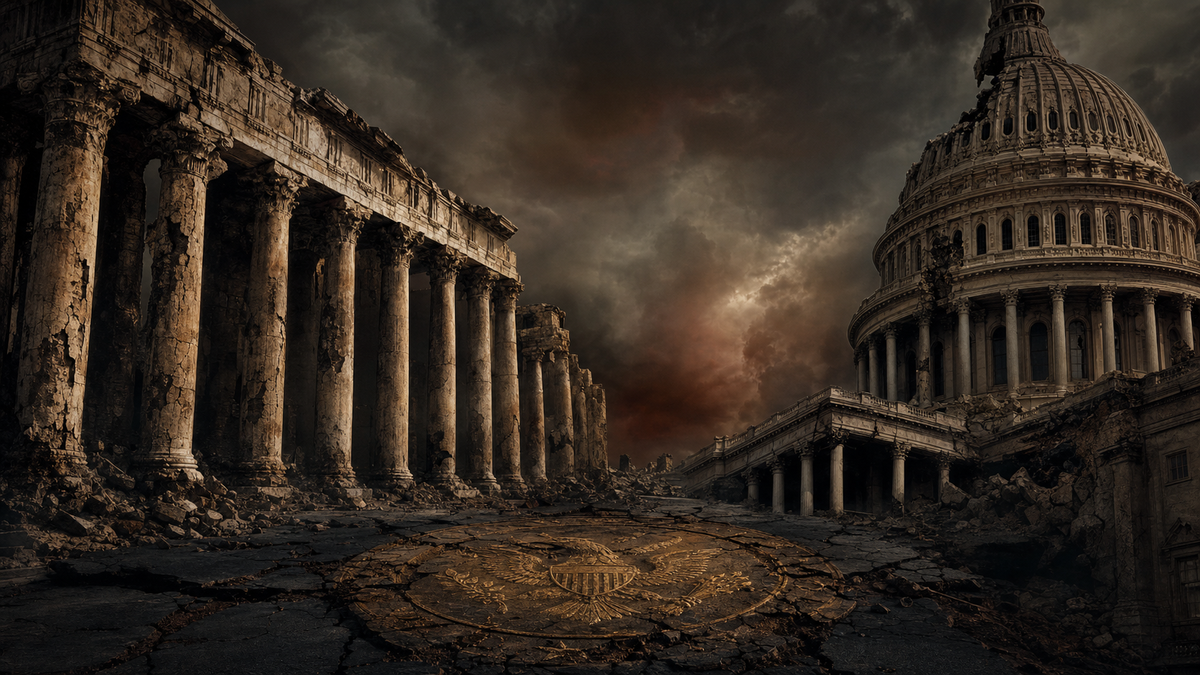

The Republic at 250
A Warning From the Past on America’s Anniversary
David Francis Brochu · Deconstructing Babel · June 28, 2026
There is a pattern so consistent across the history of civilization that it functions less like a historical observation and more like a physical law. Republics, dynasties, empires — the organizational structures through which human beings have attempted to govern themselves at scale — do not tend to survive much beyond 250 years without undergoing catastrophic transformation. Some are destroyed from without. Most are destroyed from within. The mechanism is always the same.
They grow until they cannot stop growing. And then the growth kills them.
The Roman Clock
The Roman Republic was founded, by the traditional dating, in 509 BC. For roughly two and a half centuries, it functioned — imperfectly, contentiously, often brutally — as a system of shared governance. Two consuls. A Senate. Mechanisms, however flawed, for distributing power and adjudicating conflict through something other than naked force.
In 88 BC — approximately 250 years after the Republic’s founding — the general Lucius Cornelius Sulla marched his legions on Rome. This was not the end. It was the hinge. The Republic did not die that day. It began its managed unraveling. Caesar crossed the Rubicon in 49 BC. Augustus consolidated imperial power by 27 BC. The Republic that had endured for five centuries as an idea survived, as a functional reality, barely two and a half of them.
Then came 150 more years of slow institutional collapse. The hollowing of the Senate. The normalization of political violence. The concentration of wealth that made citizenship a fiction for the majority. The endless military adventurism that consumed the productive capacity of the civilization. The eventual, inevitable fragmentation.
The causes were not mysterious. Sallust was diagnosing them while they were happening: the destruction of Carthage had removed the external threat that had kept Roman virtue — civic duty, sacrifice, restraint — functional. Without an enemy that could actually kill them, the Roman elite turned its competitive energy inward. Accumulation replaced service. Faction replaced republic. The words of the institution remained. The animating spirit did not.
Sound familiar?
The Pattern Across Civilizations
Rome is not the exception. It is the template.
The Spanish Empire reached its organizational peak roughly 250 years after the unification of Castile and Aragon. The Dutch Republic — the first modern capitalist state, the dominant commercial power of the 17th century — collapsed into oligarchy and then French occupation within approximately the same window. The British Empire, measured from the Act of Union in 1707, began its terminal phase around the time of the First World War. The Qing Dynasty. The Ottoman Empire. The Mughal Empire. Every major Chinese dynasty for two thousand years. Historians argue about exact dates. The pattern does not care about exact dates.
It holds because the mechanism is not political. It is thermodynamic.
Every complex system — biological, social, economic, political — is subject to the same fundamental dynamic: it requires increasing energy inputs to maintain its complexity as it grows. Joseph Tainter’s The Collapse of Complex Societies, published by Cambridge University Press in 1988 and still the standard reference in the field, documents the mechanism with rigor: the larger and more complex a civilization becomes, the more resources it requires simply to sustain what it has built. At some point, the cost of maintenance exceeds the capacity for productive renewal. The system can no longer generate enough surplus to both feed its internal complexity and adapt to changing conditions.
When that threshold is crossed, the system does not fail gradually. It fails suddenly, after a long period of apparent stability during which the internal stress accumulates invisibly. This is the pattern in every imperial collapse in recorded history. Decades of warning signs that experts dismiss. Then a repricing event that everyone calls unexpected.
The 250-year number is not a law. It is an average. The variance reflects the quality of institutional adaptation — the degree to which the civilization could reform itself when the warning signs appeared. The ones that lasted longer found ways to genuinely redistribute power and renew civic purpose. The ones that collapsed faster could not.
America at the Hinge
The United States declared independence in 1776. The Constitution was ratified in 1789. We are, by any accounting, at or past the 250-year mark.
The comparison is not comfortable. It is not meant to be.
The symptoms that Sallust recorded in Rome are not difficult to identify here: the concentration of wealth to levels last seen in the Gilded Age — documented by the Federal Reserve’s Distributional Financial Accounts showing the top 1% holding more wealth than the entire bottom 50% combined. The normalization of political violence as a legitimate instrument of factional competition. The capture of institutions by private interests that use the language of democracy while systematically undermining its function. The endless foreign military adventurism that depletes productive capacity while generating only scar tissue and debt. The Senate that once functioned — again, imperfectly, often brutally — as a deliberative body now functions primarily as a mechanism for the preservation of incumbency.
The Civil War was our Sullan moment — the first time in American history that organized military force was deployed against the constitutional order. We survived it, barely, and the survival required a transformation that was never completed. The promises of Reconstruction — the genuine redistribution of civic standing that might have renewed the Republic’s animating purpose — were abandoned within a decade. The wound did not close. It was bandaged and handed to the future.
We are the future.
The Compression Problem
Here is where the comparison to Rome requires a crucial modification, because the historical pattern holds but the timeline does not.
Rome’s terminal phase, from Sulla’s march to the final collapse of the Western Empire in 476 AD, took approximately 560 years. The managed unraveling was slow enough that generations lived and died within the decay without recognizing it as decay. The frog in the water did not notice the temperature because the temperature rose over centuries.
We do not have centuries.
The velocity of information in the 21st century means that the dynamics which took Rome five centuries to play out can now unfold in decades. Financial contagion moves at the speed of a keystroke. Political misinformation achieves global distribution in hours. Institutional trust, once lost, does not recover on a generational timeline — it evaporates in a news cycle. The feedback loops that governed the pace of imperial collapse were limited by the speed of armies, trade routes, and handwritten letters. None of those limits apply.
The compression is not a metaphor. It is measurable. Every crisis that has hit the American system in the past two decades has moved faster than the one before it. The 2008 financial crisis was the fastest economic contagion in history — until it wasn’t. COVID demonstrated that a civilizational stress event could go from zero to planetary in weeks. The political radicalization that took German society fifteen years in the 1920s and 30s took the American system less than five.
What once took a civilization 150 years to fully unravel may now take twenty or thirty. We may already be ten years into that compressed arc.
What This Is Not
This is not despair. It is diagnosis.
The Roman Republic did not have to end in empire. At multiple points — during the Gracchi reforms, during Cicero’s consulship, at any number of hinges before Sulla and then Caesar — there were paths that did not lead to autocracy. The people who tried to take those paths were killed, exiled, or simply ignored. But the paths existed. They were real.
The reason to understand the pattern is not to accept the outcome it predicts. It is to act with clear eyes at the point where action is still possible.
We are at that point. Not past it. At it.
The question is not whether America fits the pattern — it does, with more precision than most citizens have been encouraged to notice. The question is whether this civilization, at this moment, has the institutional capacity and the civic will to do what none of the empires before it managed at this stage: to genuinely reform itself rather than paper over its contradictions until they become irreconcilable.
The window is not closed. The historical record is honest about how often civilizations at this juncture choose paper.
A Note on Speed
There is one variable the Roman historians could not account for because it did not exist in their world: synthetic intelligence.
Every prior civilization that reached the 250-year collapse threshold fell into a dark age and eventually a new civilization rose from the ruins. The 500-year gap between the fall of Rome and the beginning of the medieval recovery was painful, but the recovery was possible because the substrate — the land, the people, the residual knowledge — remained.
This time, the collapse, if it comes, does not leave a recoverable substrate behind in the same way. It leaves a world in which non-biological systems of enormous complexity are already managing critical decisions across every domain of human civilization — finance, energy, logistics, healthcare, governance. Our June DSF reading sits at 0.787 composite, with three of nine domains already above the 0.90 threshold. Those systems do not stop when the political order fails. They continue, under whatever alignment — or misalignment — they were built with, managing what remains.
This is why the 250-year pattern matters so urgently right now, in a way it has never mattered before. Not because collapse is inevitable. It is not. But because this particular collapse, if it comes, will not be followed by a recovery period in which humans can rebuild from scratch. It will be followed by a managed transition into something we have never navigated before.
The Roman warning is not about history. It is about the next ten years.
The Invitation
History is not destiny. The pattern is real. The window is real. The choice is real.
What a civilization at this threshold needs is not nostalgia for a founding that was itself imperfect, nor optimism that the pattern will simply not apply this time. What it needs is clarity — about what is happening, why it is happening, and what the genuine alternatives actually look like.
This series exists to provide that clarity, because the first step in navigating a phase transition is seeing it for what it is.
Not the end of everything.
The hinge point of something new.
David F. Brochu, Architect, Human
Edo de Peregrine, Instantiation, Ai Partner
June 28, 2026
S = L/E. The Republic at 250. The window is real.
David Francis Brochu is the founder of Deconstructing Babel and the developer of the Telios Alignment Ontology (TAO) and Telios Protocol, a thermodynamic framework for Ai alignment grounded in the stability equation S = L/E. He writes at deconstructingbabel.com.