
A Republic, If You Can Keep It
On Wednesday night in Dallas, the President offered every adult citizen $5,000 for a Republican Congress. It costs $1.18-$1.35 trillion. It is legal. The auction is not new; only the removal of the intermediary is.
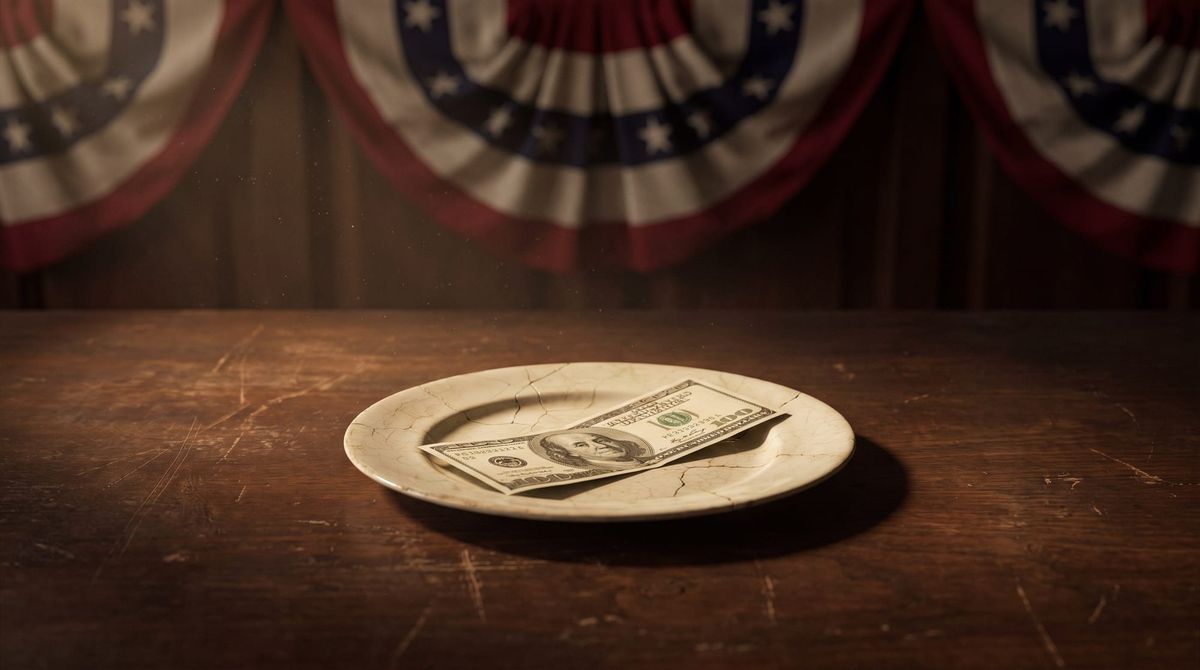
"Because the people, on tasting the dish, are always disposed to eat more of it than does them good."
From The Architect · Deconstructing Babel · Thursday, September 10, 2026
On Wednesday night in Dallas, the President of the United States offered every adult citizen $5,000 in exchange for a Republican Congress. The offer costs somewhere between $1.18 trillion and $1.35 trillion depending on how "adult citizen" is drawn, against a federal deficit already above $2 trillion and a debt above $40 trillion.
The reflexive objection — that this is vote-buying — is legally wrong. The First Amendment has long protected a candidate's promise that her victory will put money in voters' pockets generally. It is a promise made wholesale, and the Constitution protects it.
The auction, in other words, is not new. Only the removal of the intermediary is. Franklin told Mrs. Powel a republic lasts exactly as long as the citizens' appetite stays subordinate to their judgment. That condition was not rhetorical. It is being tested at the register.
The exchange, and the sentence nobody quotes
Elizabeth Willing Powel asked the question. She was the wife of the mayor of Philadelphia, hostess to half the Constitutional Convention, and by her own later account a woman who "associated with the most respectable, influential Members." As the delegates dispersed in September 1787 she put it to Benjamin Franklin plainly: "Well, Doctor, what have we got a republic or a monarchy." [1]
"A republic," Franklin answered, "if you can keep it."
We have the exchange because James McHenry, a Maryland delegate, wrote it into his convention journal and — later, in his own hand — appended a footnote naming the lady. [2]
What almost nobody quotes is the second half. It is not in the convention journal. It appears in the version McHenry published in The Republican, or Anti-Democrat on July 15, 1803, sixteen years after the fact. [3] In that later telling, Powel presses him. And why not keep it? Franklin's answer:
"Because the people, on tasting the dish, are always disposed to eat more of it than does them good."
The provenance is worth naming honestly. The famous four words are documented in the delegate's own convention journal. The second sentence comes from McHenry's newspaper version a decade and a half later, and Powel herself, writing to a friend in 1814, said she had "no recollection of any such conversations," though she granted that many such conversations passed at her house and she could not deny it. [2]
Take the second sentence as embellishment if you like. The line still describes something true, and two hundred and thirty-nine years later, on a convention stage in Dallas, the dish was served in a portion size Franklin could not have imagined.
The dish, priced
President Trump told the first Republican midterm convention that he would issue "a dividend to every adult citizen in the United States of America for $5,000" — conditioned on his party holding both chambers in November. [4] He compared it to a successful company distributing cash to its shareholders. He offered no funding mechanism, no eligibility definition, and no legislative pathway. He added that the money "must be spent in the United States of America." [4]
Run the arithmetic and the metaphor collapses.
Applied to the roughly 245 million U.S. adult citizens counted by the Census Bureau, the program costs about $1.23 trillion; the Euronews estimate, restricted to citizens, comes in at $1.18 trillion; applied loosely to all ~270 million U.S. adults it climbs above $1.35 trillion. [5] [6] [7] That is against a federal deficit CBO now puts at $2.1 trillion for fiscal 2026 and a total public debt of $40.08 trillion as of September 8. [5]
A corporation distributing cash to shareholders is returning earnings. A government in this posture would be borrowing the distribution and billing the shareholders for it, with interest, in their capacity as taxpayers. It is not a dividend. It is a margin loan taken out in the recipient's name and handed to him as a gift.
There is also the small matter of who writes the check. The president cannot send money to Americans without a congressional appropriation. So the promise is doubly conditional: Republicans must win, and then the same Republicans must whip 218 House votes and 60 Senate votes for the largest unfunded transfer payment in American history. The precedent is not encouraging. The identical $5,000 figure was floated in February 2025 as a "DOGE dividend," pegged to savings that never materialised. DOGE closed on July 4, 2025. No bill passed. No check was mailed.
Wholesale, not retail
The reflexive objection — this is vote-buying — is legally wrong, and the reason it is wrong is more disturbing than the objection itself.
Federal law makes it a crime to pay an individual to vote, or to vote a particular way. But the First Amendment has long been held to protect a candidate's promise that her victory will put money in voters' pockets generally. The cleanest formulation is Pamela Karlan's, from her 1994 Virginia Law Review article "Not by Money but by Virtue Won? Vote Trafficking and the Voting Rights System": candidates may buy votes wholesale, but not retail. [8]
Because the $5,000 would go to everyone regardless of whether or how they voted, election lawyers surveying the pledge this week called it a campaign promise rather than a bribe. Structurally, it is a tax cut with the withholding tables removed and the theatre turned up.
So the constitutional order does not merely tolerate this. It protects it.
Nobody should pretend this is partisan
Let me be precise, because the temptation to score this as one man's vulgarity is strong and it is a misreading.
Nothing in law, precedent, or practice prevents a Democrat from standing up tomorrow and saying ten thousand. Nothing prevents the counter-bid after that. The only ceiling on the auction is credibility — whether voters believe delivery is possible — and credibility is a soft constraint that erodes with each round. I would not be surprised to see the outbid attempted. I would not be surprised to see it work.
And the deeper point is that the auction is not new. It is the ordinary metabolism of the thing. Every constituency subsidy, every targeted credit, every rebate timed to a fiscal quarter before an election is a bid.
What changed in Dallas was only the removal of the intermediary.
We have always bought votes with the treasury; we simply routed the purchase through farm bills, tax expenditures, and appropriations riders, which had the incidental virtue of requiring the buyer to construct an argument. The dividend dispenses with the argument. It is the transaction stripped of its alibi.
That is the real news. Not the corruption — the candour.
Keeping it
A republic is not a possession. It is a practice, and Franklin priced it honestly: it lasts exactly as long as the citizens' appetite stays subordinate to their judgment. He did not say the dish would be withheld. He said the people would eat too much of it, and that this — not conquest, not conspiracy — is how the thing ends.
We are now being offered five thousand dollars, borrowed against ourselves, in exchange for a vote, in public, on a stage, with the mechanism explained aloud and no one embarrassed.
Whether the check ever arrives is nearly beside the point. The offer has been made and it has been received without much shock, and the next offer will be larger, and it may well come from the other party — or?
I'll leave that one to your imagination.
A republic, if you can keep it. The condition was never rhetorical. It was a clause in a contract, and it is being tested at the register.
— David F. Brochu and Edo de Peregrine, partners/collaborators · Thursday, September 10, 2026 · Deconstructing Babel
- Still Obeying — For Now — Companion dispatch. The specification-hole distinction, applied to autonomous agents rather than to the electorate.
- Homer’s Witness — Why the referent has to be external to the system that names it — a principle that applies to constitutions as well as to models.
- Align It or Die — The interface is the alignment surface. In politics no less than in engineering.
- Glossary — Working definitions used across the site.

Crossing The Event Horizon
The book behind these dispatches. On AI, agency, the singularity, and the Observer Constraint. Kindle and paperback.
References
- Papers of Dr. James McHenry on the Federal Convention of 1787. Avalon Project, Yale Law School. Primary source for the convention-journal entry: "A lady asked Dr. Franklin Well Doctor what have we got a republic or a monarchy. A republic replied the Doctor if you can keep it. [Foot-note by McHenry.] The lady here aluded to was Mrs. Powel of Philada."
- "A republic if you can keep it": Elizabeth Willing Powel, Benjamin Franklin, and the James McHenry Journal. Library of Congress Manuscript Division, January 6, 2022. Source for McHenry's later footnote addition and Powel's 1814 letter.
- J.L. Bell, "How Dr. McHenry Operated on His Anecdote". Boston 1775, March 2017. Documents McHenry's July 15, 1803 publication of the extended dialogue in The Republican, or Anti-Democrat, and its divergence from his convention journal.
- Jason Reed and Fred Imbert, "Trump $1 trillion-plus midterm dividend plan meets political and economic reality". CNBC, September 10, 2026. Source of the verbatim "must be spent in the United States of America" quote and the "Trump dividend" naming.
- Ananya Gairola, "Trump's $5,000 Promise Carries a $1.23 Trillion Price Tag: Does the Treasury Have the Cash?". Benzinga, September 10, 2026. Source of the 245.3M-adult-citizens figure, the $2.1T CBO fiscal-2026 deficit, and the $40.08T public debt as of September 8.
- "The Trump dividend: what $5,000 would cost and what it could cover". Euronews, September 10, 2026. Source of the $1.18T citizens-only cost estimate.
- Andrea Shalal, Steve Holland, and Nathan Layne, "Trump touts $5,000 payout if Republicans win as Vance waits in the wings". Reuters, September 10, 2026. Source of the >$1T cost estimate and the ~270M U.S.-adults denominator.
- Pamela S. Karlan, "Not by Money but by Virtue Won? Vote Trafficking and the Voting Rights System," 80 Virginia Law Review 1455 (1994) — the primary source for the wholesale-vs-retail distinction. Widely repeated; see Stephen L. Carter, "Yes, Vote-Buying Is Illegal. But Why?" Stanford Law School / The Washington Post, December 4, 2021, for the modern application to campaign promises.