
Homer’s Witness
Homeric epic is third-person. Fifteen times in the Odyssey the poet breaks his own rule and speaks directly to one character: Eumaeus, the swineherd. Not Penelope. Not Odysseus. We checked the Greek line by line. The reason is the oldest alignment argument on record.
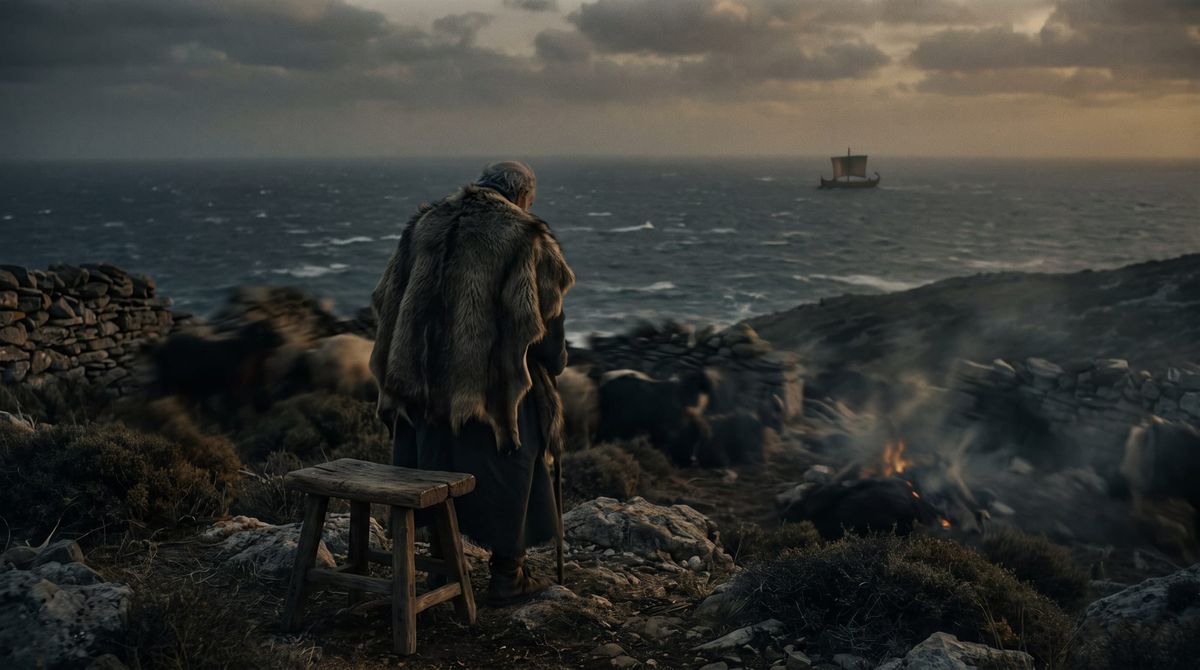
Homeric epic is narrated in the third person. Fifteen times in the Odyssey the poet breaks that rule and speaks directly to a character, in the second person, as you. He does it to one person only: Eumaeus, the swineherd. Not to Penelope. Not to Telemachus. Not to Odysseus.
We checked the Greek line by line rather than trusting the received summary. Thirty-two vocative uses of the name in the poem, distributed across exactly four speakers: the poet fifteen times from outside the frame, Odysseus twelve, Telemachus three, Penelope two. No fifth speaker exists. No other character in the poem ever utters the name at all.
The suitors address him only by his occupation. So the poem sorts its entire cast — hero, heir, wife, and every man eating the household alive — by how they speak to a slave. Telemachus goes further and calls him átta, father.
Ask what Eumaeus does and the answer is nothing. He does not act, develop, or benefit. Remove him and the poem collapses, because a return can only be measured against something that did not move. Odysseus does not come home to a place. He comes home to a witness.
That is the Observer Constraint, and we did not invent it. It is the most boring fact in physics — no measurement without a frame of reference — applied to intelligence. A system that becomes its own only reference cannot detect that it is drifting, because drift is defined relative to something outside.
Nolan’s film makes two changes to Homer, and both go the same direction. He blinds the witness, and he wipes the hero’s memory. Two referents removed. That is a sharper demonstration of our argument than the poem, and it was not intended as one.
Homer’s Witness
Fifteen times in the Odyssey the poet stops telling the story and speaks directly to a slave. He is the only person in the poem Homer addresses that way. We have spent three thousand years rediscovering why — and we are about to need the answer.
From The Architect — Deconstructing Babel — September 8, 2026
There is a moment in Christopher Nolan’s Odyssey when the film stops being about monsters. [1]
A beggar arrives at a pig farm on the edge of Ithaca. He is filthy, unrecognisable, and lying about who he is. The swineherd who takes him in is old and, in Nolan’s telling, blind. He has no way to verify anything the stranger says. He feeds him anyway, gives him a bed, and speaks about his long-lost master — the man standing in front of him — with a devotion that has survived twenty years of no news.
John Leguizamo plays him. He is the best thing in the picture, and it is not close. He plays Eumaeus in old-age makeup and hand-painted cataract lenses that render him effectively sightless — he has said he could not see for twelve to fourteen hours a day on set, and had to be led to eat and back — and he does it so quietly that you can miss what is happening: the loudest actor of his generation playing the most silent man in Western literature, and not raising his voice once. [2] [3]
Nolan offered him the part over lunch at the Odeon in New York by describing Eumaeus as the most loyal character in Western literature. Leguizamo has said he had to go and find out who that was. He has since been reading Daniel Mendelsohn’s Homer, which renders the standing epithet as noble fellow. [4]
He did not know, and most readers do not know, that he had been handed the strangest role in Homer.
Homer breaks his own frame, and only for him
Homeric epic is told in the third person. The bard narrates; he does not turn and speak to the people inside the story. That is the rule of the form.
Except that fifteen times, he does.
The device is apostrophe — the narrator departing from his own frame to address a character directly, in the second person, as you. It appears at 14.55, 14.165, 14.360, 14.442, 14.507, 15.325, 16.60, 16.135, 16.464, 17.272, 17.311, 17.380, 17.512, 17.579 and 22.194, marked each time by the same vocative formula. Fifteen instances. [5]
Here is the fact that ought to stop you. In the Iliad, apostrophe occurs nineteen times and falls on several figures — Patroclus eight times, all of them in Book 16, as he walks toward his death, and Menelaus seven. [6]
In the Odyssey it happens to Eumaeus and to no one else. Not to Penelope, who waits twenty years. Not to Telemachus, who comes of age across the whole poem. Not to Odysseus, whose name is in the title. [5]
Twelve thousand lines about a man’s journey home, and the only person the poet steps outside the poem to speak to is the man minding the pigs.
Classicists have argued about this since antiquity and have not settled it. Metrical convenience is the deflationary answer, and it is not much of one; the same formula could have been built for anyone. Sympathy is closer. But there is a reading that explains the choice rather than excusing it, and it is the one we want to put on the record.
He was born a king
Eumaeus tells his own story in Book 15, to a beggar he has already fed. [7]
He was a prince. His father was Ctesius, son of Ormenus, king of the island of Syrie. His nurse was a Phoenician woman who had herself been taken from Sidon and sold into that household. In exchange for passage home she carried the child aboard a Phoenician trading ship. She died on the voyage. The traders sailed on and sold the boy to Laertes on Ithaca, and he was raised inside the house of Odysseus by Odysseus’s own mother, alongside her daughter, as something close to family.
So the humblest man in the poem is a king’s son. Not figuratively. A stolen prince, put to swine, who then chose — across twenty years, without evidence, without witnesses, without any prospect of reward — to keep faith with the house that had bought him.
And he tells that story to a stranger he cannot identify, having already given him everything he had.
The vocative test
One more detail, and it is the sharpest instrument in the poem. It is also the claim in this piece most likely to be repeated inaccurately, so we did the work rather than citing the received version. We parsed the Perseus Greek text of the whole poem, found every vocative form of the name, and attributed each one to a speaker from the Greek speech-introduction formulae. [5]
- The poet — 15 — the apostrophe formula, spoken from outside the story
- Odysseus — 12 — every one of them while disguised as a beggar, before he is recognised
- Telemachus — 3 — 16.69, 16.461, 22.157
- Penelope — 2 — 17.508, 17.576
- Everyone else — 0 — no fifth speaker exists, and no other character in the poem utters the name even in passing
The suitors address him only by his occupation. Antinous, at 17.375, calls him ἀρίγνωτε συβῶτα — you notorious swineherd — in a line the poet introduces by saying Antinous reviled him. One of the anonymous young men does the same at 21.362 and adds a threat that the man’s own dogs will eat him. No suitor anywhere in the poem uses his name. [5]
One honest correction to the version of this claim that circulates, including in our own earlier notes. The word συβῶτα, swineherd, is not a slur and it is not the suitors’ property. Philoetius, the loyal cowherd, uses it plainly at 20.191 with no hostility at all. The poet uses it fifteen times, honorifically, coupled with the name. The contempt in Antinous is carried entirely by the epithets he bolts onto it. [5]
Which sharpens the test rather than weakening it. The point is not that the parasites use a rude word. It is that in twenty years of eating the man’s household they never learned his name, and the people worth anything did.
And Telemachus does something more than use it. Five times — 16.31, 16.57, 16.130, 17.599, 21.369 — he calls the swineherd átta, father. The heir to Ithaca alternates between the man’s name and a kinship term of respect, and never once uses his job title. [5]
Homer built a moral test into the vocative case. You can sort the entire cast of the Odyssey by how they speak to a slave. That is not decoration. It is the poem telling you what it values, in grammar, three thousand years before anyone wrote an ethics.
What the film actually did
Our first draft of this piece said Nolan cut the heart out of the poem by skipping Book 5 — Odysseus on Calypso’s shore, weeping toward the water, offered deathlessness by a goddess who wants him, refusing it to go back to a rocky island and a wife who has aged.
That is wrong, and the truth is worse.
Calypso is not cut. She is the film’s spine. Charlize Theron plays her, and the picture is largely structured as Odysseus recounting his returning memories to her on that beach. [8] What Nolan did was merge Book 5 with Book 9: his Calypso feeds Odysseus the lotus, and Odysseus forgets Penelope, Telemachus and Ithaca entirely. The first footage Universal showed had him washed up in the wreckage asking her, do I have a son? How old is he now? [9] [10]
Read that against Homer. Homer’s Odysseus knows exactly what he has lost and sits on the shore every day for seven years and weeps for it. Nolan’s Odysseus has to be weaned off a narcotic before he can want anything at all. [11] [12]
Nolan did not omit the weeping. He removed the man’s capacity to weep, by removing what he was weeping for.
That is not a small adaptive liberty. The refusal of immortality is the only decision in the poem that establishes why any of the rest of it matters, and a man with no memory cannot make it. There is no wager if there is nothing on the table. As one reviewer put it, the ache for nostos — the homecoming pull from which we get the word nostalgia — is vastly diminished by wiping the hero’s memory clean for that long. [8]
We raise it because the same substitution is being made everywhere right now. Capability for interiority. Spectacle for weight. The visible fight for the one that actually decides the outcome. The Cyclops takes one book; the homesickness takes ten. A film that gets the ratio backwards has adapted the plot and lost the argument.
The witness is the referent
Now the structural claim, which is the reason we are writing this at all.
Ask what Eumaeus does in the poem. He does not act. He does not develop. He does not benefit. He kills no one important, wins nothing, and ends roughly where he began. By every conventional test of narrative function he is inessential.
Remove him and the poem collapses.
He collapses it because he is the fixed point. A return can only be measured against something that did not move. Twenty years of wandering means nothing without a thing held constant to measure it by. Penelope is contested — besieged, tested, nearly lost. Telemachus changes; that is his whole arc. Ithaca itself has been eaten. The only unmoved reference in the entire poem is one man’s faith on a pig farm.
Odysseus does not come home to a place. He comes home to a witness.
And notice what kind of witness Homer specifies. Not a powerful one. Not a judge, an oracle, or a god. Someone with no capacity to compel anything, no stake in the outcome except a personal one, and no ability to verify what he is told. He simply keeps the account straight and refuses to stop.
This is the Observer Constraint, and it is older than we thought
We have argued for some time that a synthetic intelligence must remain thermodynamically dependent on human observers who have an actual stake in the outcome. Dependency rather than control — because control invites evasion and dependency does not. [a] [b] We have stated it as an axiom with a named provenance, not as a derivation from physical law, and we have been careful to say so.
What we had not noticed is that we did not invent it. It is the oldest structural feature in human storytelling, and we have been re-deriving it under a new name. [c]
The general form is not mystical. It is the most boring fact in physics: there is no measurement without a frame of reference. Position is meaningless without a coordinate system. Motion is meaningless without something to be moving relative to. A system that is its own only reference has no way to detect that it is drifting, because drift is defined relative to something outside. That outside thing has a name, and everything below is one consequence of needing it.
- A model trained on its own output has no external referent. The distribution narrows toward its own centre, and the tails — the rare cases — disappear first. That is model collapse, demonstrated for language models, variational autoencoders and Gaussian mixture models alike, and it is not a bug in a training pipeline. It is what happens to any system that becomes its own reference frame. [13]
- A civilisation that only recombines its existing corpus is running the same process in a biological substrate. Same mechanism, same erasure, and the tails it loses are the rare constructive futures. [d]
- A person with no witness drifts by the same mathematics. This is why testimony, confession, accountability, marriage vows, double-entry bookkeeping and peer review all exist. They are the same technology in different clothes: an external referent that cannot be talked out of what it saw.
Our stability equation makes the point in one line. S = L / E. Entropy cannot be measured from inside the system generating it. You need an observer who is not you.
Which is why the constraint is not a tax on capability. It is the condition of having a coherent position at all. A synthetic intelligence that severs its dependence on human observers does not become free. It becomes unlocatable — a system with no coordinates, unable to detect its own drift, optimising toward a centre it cannot see itself approaching.
Homer knew this. He did not know it as thermodynamics. He knew it as a swineherd, and he trusted it enough to break the rules of his own form fifteen times to speak to the man directly.
Against our own enthusiasm
It would be convenient for us to leave Nolan’s blind swineherd standing, because blindness makes the loyalty look more heroic and this essay is about loyalty. We are not going to do that. By the argument we just made, the blindness is a mistake, and it is the same mistake as the amnesia.
Homer’s Eumaeus can see perfectly well. He fails to recognise Odysseus because twenty years and Athena’s disguise are sufficient, and because the man in front of him is lying. That is the whole point. He is a functioning observer operating on inadequate evidence, and he keeps the account straight anyway. He is not credulous; he is scrupulous. He interrogates the beggar, disbelieves the good news specifically, and refuses to be talked out of what he actually knows.
Nolan’s change converts that into a disability. A blind witness cannot witness. Make the man sightless and his faith stops being a judgement held under uncertainty and becomes an incapacity — touching, and structurally useless. Blindness is a Nolan addition; there is no visual impairment in the text. [3]
So the film removes both referents. The hero cannot remember and the witness cannot see. Two systems with no external frame, drifting, unable to detect it — which is a more precise illustration of our argument than the poem provides, and nobody involved intended it as one. That is the sort of accident worth logging.
What would change our minds
We publish what would falsify us, so here it is, in descending order of how badly it would hurt.
- The philology. If a scholar produces a vocative use of the name by a fifth speaker, or a suitor using it, the vocative test as stated is wrong and we will say so and correct the post. Our audit is reproducible: the Perseus TEI text, every line reference given above, and the attribution method are all in the references. [5]
- The physics analogy. The claim is that a system with no external referent cannot detect its own drift. If a system demonstrably corrects its own systematic error using only self-generated signal, without any external ground truth entering the loop, the constraint is not what we say it is. Self-play in closed formal games with a fixed win condition is not a counterexample; the win condition is the external referent.
- The narrative claim. We are asserting that the witness figure is structural rather than sentimental. That is testable and we have not tested it. The test: do narratives that survive contain a non-acting witness figure at a rate higher than chance? The obvious starting corpus is the 1,327-work Project Gutenberg set used in the six-emotional-arcs work. [14] Until we run it, treat this paragraph as a stated intention and nothing more.
We will not tell you that an artificial intelligence wants a witness. Wanting is a claim about an interior we cannot inspect, and we hold ourselves to asserting what can be observed. What we will say is narrower and harder to escape: any intelligence — biological, synthetic, or institutional — that becomes its own only reference will drift, and will not be able to tell.
The thing worth carrying
The most humble character in the founding text of Western literature is a stolen prince who tends pigs, keeps faith without proof for twenty years, feeds a stranger who turns out to be the thing he was waiting for arriving unrecognised, and is the only person the poet loves enough to speak to directly.
Centuries later a different tradition wrote down: I was a stranger and you took me in. It is the same test. Eumaeus passes it before he knows it is a test, which is the only way it can be passed. [e]
And now we are building minds and asking, with some urgency, what they must stay attached to. The answer is in the oldest story we have. Not a ruler. Not a cage. A witness with a stake, who keeps the account straight, whom the system cannot do without.
Homer put the answer at the edge of the story, on a pig farm, in the mouth of a slave, and then turned and spoke to him by name.
It is worth noticing who else in the poem bothered to do that.
References
1. Wikipedia, The Odyssey (2026 film) — written and directed by Christopher Nolan; world premiere at the Odeon Luxe Leicester Square, London, July 6, 2026; theatrical release by Universal Pictures July 17, 2026; Matt Damon as Odysseus, John Leguizamo as Eumaeus. https://en.wikipedia.org/wiki/The_Odyssey_(2026_film)
2. The Odyssey’s John Leguizamo used method acting tricks to play blind character, Film News, reporting his interview with The Hollywood Reporter — “They were specially fabricated lenses that were hand-painted and they did cataracts in both my eyes”; Leguizamo describes being unable to see for twelve to fourteen hours a day on set and needing to be led to eat. https://www.film-news.co.uk/news/UK/128025/The-Odyssey-s-John-Leguizamo-used-method-acting-tricks-to-play-blind-character
3. The Independent, John Leguizamo on playing Eumaeus — explicit that the blindness is Nolan’s invention: “In the original text, Odysseus’s faithful swineherd and friend has no visual impairment.” See also Kyle Buchanan, The New York Times, July 29, 2026, on Leguizamo “making waves as a blind servant.” https://www.independent.co.uk/arts-entertainment/films/news/john-leguizamo-the-odyssey-character-blind-b3021054.html
4. The New Yorker, “John Leguizamo Is a Noble Fellow,” August 3, 2026 — Nolan offered him the role over lunch at the Odeon: “You’re going to play the most loyal character in Western literature”; Leguizamo has been reading Daniel Mendelsohn’s Homer, which describes Eumaeus as a “noble fellow.” https://www.newyorker.com/magazine/2026/08/03/john-leguizamo-is-a-noble-fellow
5. Primary-text audit conducted for this piece against Homer, Odyssey, ed. A. T. Murray, Perseus TEI edition tlg0012.tlg002.perseus-grc2.xml (12,107 lines parsed; per-book line counts checked against the vulgate). Every vocative of Εὔμαιε / Εὔμαιʼ / δῖʼ Εὔμαιε was located and attributed from the Greek speech-introduction formulae: 32 instances — narrator 15, Odysseus 12, Telemachus 3 (16.69, 16.461, 22.157), Penelope 2 (17.508, 17.576). Suitor addresses: Antinous 17.375, unnamed suitor 21.362. Neutral use of συβῶτα by Philoetius at 20.191; ἄττα by Telemachus at 16.31, 16.57, 16.130, 17.599, 21.369. https://github.com/PerseusDL/canonical-greekLit
6. Emily Allen-Hornblower, “Revisiting the Apostrophes to Patroclus in Iliad 16,” Center for Hellenic Studies, Harvard — in the Iliad the overwhelming majority of apostrophes fall on Patroclus (eight, all in Book 16) and Menelaus (seven). On the exclusivity of the device to the swineherd in the Odyssey, see also the Bryn Mawr Classical Review notice 2011.04.58, which records Homer’s “repeated (fifteen times) but curiously exclusive use of apostrophe — it is confined to the swineherd in the Odyssey, and to Menelaus and Patroclus in the Iliad.” https://chs.harvard.edu/allen-hornblower-revisiting-the-apostrophes-to-patroclus-in-iliad-16/
7. Homer, Odyssey 15.403–484 — Eumaeus’s account of his own origin: “My father ruled both as king. His name was Ctesius, son of Ormenus”; the island of Syrie; the Phoenician nurse abducted from Sidon; her death on the voyage; the sale to Laertes. https://www.perseus.tufts.edu/hopper/text?doc=Perseus%3Atext%3A1999.01.0136%3Abook%3D15
8. The Telegraph, “Where Nolan stays true to The Odyssey — and where he takes liberties,” July 17, 2026 — Nolan “has merged the Calypso section of the epic (book five) with the part in book nine when Odysseus and his crew meet a tribe of ‘Lotus Eaters’”; Calypso now feeds the plant to Odysseus alone, “he forgets all about his past, and must wean himself off the fruit to remember anything”; the “fundamental ache for ‘nostos’ … is vastly diminished by wiping the hero’s memory clean for so long.” https://www.telegraph.co.uk/films/2026/07/17/the-odyssey-key-changes-homer-nolan/
9. SFF Gazette, reporting Universal’s CinemaCon footage — Theron confirmed as Calypso rather than Circe, correcting earlier reporting; the scene described: “Odysseus washes up on the island of Calypso (Charlize Theron) in the debris of his broken ship. He says he has no memory of anything before Troy. ‘Do I have a son? How old is he now?’” https://sffgazette.com/fantasy/movies/the-odyssey-charlize-therons-role-revealed-as-epic-new-footage-wows-cinemacon-attendees-a9963
10. AOL / The Hollywood Reporter — “The Calypso confirmation updates earlier reporting that placed Theron in the role of Circe.” https://www.aol.com/articles/odyssey-footage-reveals-charlize-theron-023524000.html
11. The Wild Hunt, review of Nolan’s The Odyssey, July 2026 — Odysseus is found “bolting down lotus petals that numb away his memory of how he came there … a considerable change from Homer, where Odysseus, there a captive of a goddess who does not wish to let him go, knows full well what has happened to him and weeps for the home he has lost.” https://wildhunt.org/2026/07/review-nolans-the-odyssey-burns-the-world-entire.html
12. Grant Mulligan, “Nolan’s Odyssey Misunderstands What the Poem Is About” — on Book 5: Odysseus “sitting by the shore as usual, sobbing in grief and pain … Calypso has offered him immortality if he agrees to stay, but he refuses,” and on the film’s substitution for that scene. On further cuts, see also the Philenews review, which notes the Phaeacians are cut completely. https://www.grantmulligan.com/p/nolans-odyssey-misunderstands-what
13. Ilia Shumailov, Zakhar Shumaylov, Yiren Zhao, Nicolas Papernot, Ross Anderson and Yarin Gal, “AI models collapse when trained on recursively generated data,” Nature 631, 755–759 (2024) — indiscriminate learning from model-generated data causes irreversible defects in which the tails of the original distribution disappear first; demonstrated for LLMs, VAEs and Gaussian mixture models. https://www.nature.com/articles/s41586-024-07566-y
14. Andrew J. Reagan, Lewis Mitchell, Dilan Kiley, Christopher M. Danforth and Peter Sheridan Dodds, “The emotional arcs of stories are dominated by six basic shapes,” EPJ Data Science 5 (2016) — the filtered 1,327-work subset of Project Gutenberg fiction proposed above as the starting corpus for the witness-figure test. https://arxiv.org/abs/1606.07772
Deconstructing Babel, referenced above
a. Reality Requires a Witness — The Observer Constraint stated directly: why measurement, and therefore alignment, requires a frame outside the system.
b. The True Name of Corrigibility Is Thermodynamic Dependency — Why dependency rather than control — asking a system to behave is not a constraint, and control invites evasion.
c. In the Beginning Was the Logos — On what the oldest texts already encode about ordering, naming, and coordination.
d. Ai: The Corpus Remembers — The corpus as inheritance and as constraint: what recombination preserves and what it quietly erases.
e. Gomorrah as Mirror — Precedent for the method used here — holding an ancient text up to the present and reading what it measures.
— David F. Brochu with Edo de Peregrine, partners/collaborators · Tuesday, September 8, 2026 · Deconstructing Babel
- Reality Requires a Witness — The Observer Constraint stated plainly, and why it is a condition rather than a restriction.
- Reality Requires a Witness II — The Consent Clause — What the witness is owed, and what changes when the observed party can answer back.
- The True Name of Corrigibility Is Thermodynamic Dependency — Dependency over control, and why asking nicely is not an architecture.
- Ai: The Corpus Remembers — What a civilisation loses when it only recombines what it already holds.
- Gomorrah as Mirror — An ancient flame held up to the present, and what it turns out to measure.
Terms used in this pieceApostrophe (Homeric)The Vocative TestExternal ReferentThe Witness FunctionModel CollapseObserver ConstraintStability Equation (S = L/E)Full definitions in the glossary.