
The Last Bank Run You'll Never See Coming
How Amazon Prime Dollars, stablecoins, and a century of funny money are about to erase the financial system as you know it.
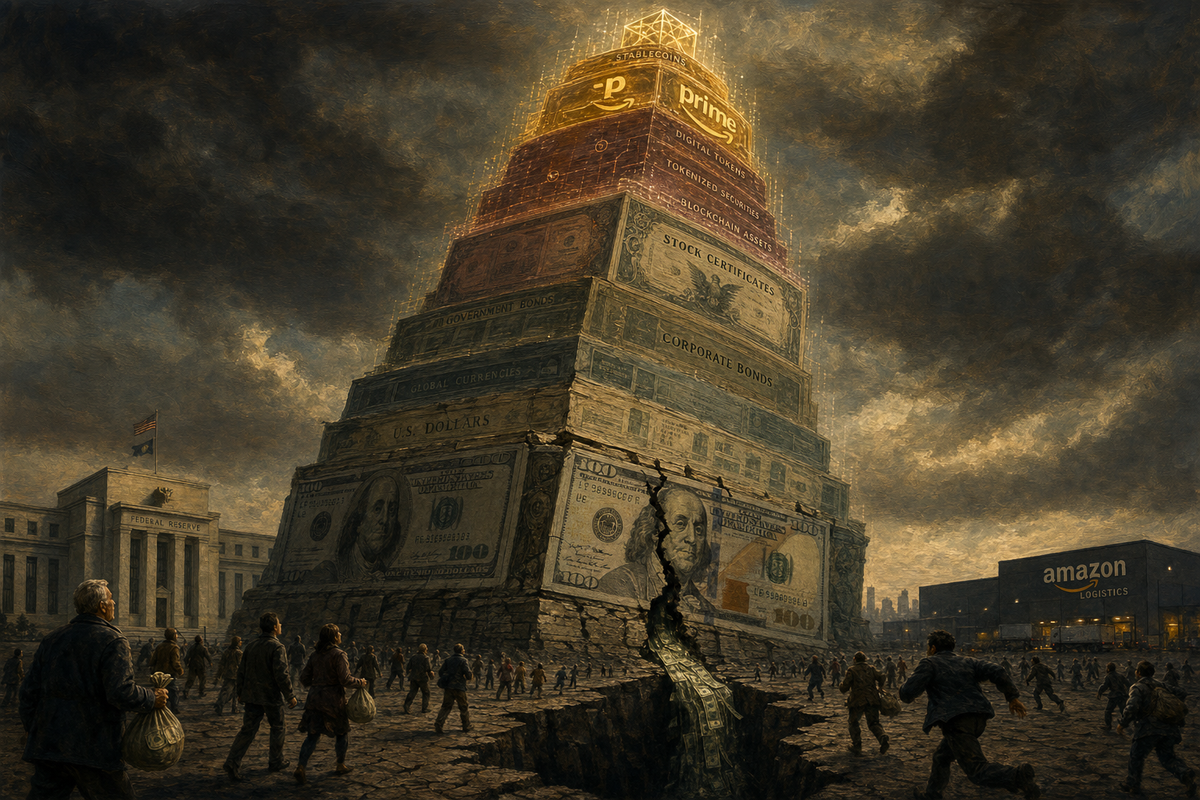
How Amazon Prime Dollars, stablecoins, and a century of funny money are about to erase the financial system as you know it.
This is a piece about money. Specifically about why the money in your bank account is not what you think it is, and why a piece of legislation working its way through the Senate this month — combined with a balance-sheet reality you already know — is about to make the existing arrangement obsolete faster than anyone in mainstream finance is willing to say out loud. We argue this is not the end of money. It is the end of one particular operating model of money. What replaces it is what we get to choose, while the window is still open.
The Thing Your Advisor Will Not Say
Let us start with something your financial advisor will never say out loud.
The money in your bank account is not real.
Not in the way you think it is. It is not backed by gold. It is not backed by oil. It is not backed by anything tangible at all. It is backed by a promise — specifically, by the United States government's promise to honor a debt it issues to itself, financed by a central bank that creates the money to buy that debt from thin air, which then flows through a banking system that loans it out at multiples of what actually exists, into a stock market where corporations borrow against their own inflated share prices to buy back their own shares, driving the price higher, allowing them to borrow more.
That is the system. All of it. A self-referencing loop of manufactured confidence sitting on a foundation of agreed-upon fiction.
It has worked, more or less, for a hundred years. It is about to stop working. And the reason it is about to stop working is not the Federal Reserve, not Congress, not even the national debt. The reason is Amazon.
How Money Actually Gets Made — And Why It Is Already Funny
Most people believe the government prints money when it needs it. That is close but wrong in the specific way that matters.
Here is what actually happens.
The United States government needs money. It issues Treasury bonds — essentially IOUs that say "lend us a dollar today and we will pay you back a dollar plus interest in ten years." Those bonds are sold at auction. But the largest buyer at that auction, particularly when nobody else wants to buy enough of them, is the Federal Reserve.
The Federal Reserve does not have money. It creates it. It buys the Treasury's IOUs by typing numbers into a computer — new dollars that did not exist before that transaction. The government gets the money. The Federal Reserve holds the debt. Everyone agrees to pretend this is a transaction rather than a printing press, because if you call it a printing press, the whole thing feels unstable, which it is.1
Now those newly created dollars enter the banking system. And here is where the leverage really begins.
Banks under the fractional-reserve system are required to hold only a small portion of customer deposits as reserves. Under the framework in place for most of the last century, a bank that received one hundred dollars in deposits could loan out roughly ninety dollars of it immediately. That ninety dollars got deposited somewhere else. That bank loaned out eighty-one dollars of it. That bank loaned out seventy-two dollars. The original hundred became, through this cascading process, several hundred dollars of money in circulation — all of it traceable to the original hundred that was itself created by a Federal Reserve computer entry that was itself created to purchase a government IOU.2
In March 2020 the Federal Reserve quietly took the further step of reducing the formal reserve requirement to zero percent. Banks now retain some buffer voluntarily, but no statutory floor binds them.3 The fractional-reserve era technically ended five years ago and almost nobody noticed.
At the base of the entire financial pyramid is money that was conjured from nothing to purchase a promise that was written by the entity doing the conjuring.
This is not a conspiracy theory. This is the Federal Reserve's own published description of how its balance sheet works.1 They call it monetary policy. We are calling it what it is: the original funny money. And everything built on top of it is funnier still.
The Stock Market: Leverage Built on Leverage Built on Leverage
Now we add the stock market, and the mathematics become genuinely vertiginous.
Companies are valued by their stock price. Stock prices are set by supply and demand — how many shares are available versus how many people want to buy them. One of the most reliable ways to increase a stock price is to reduce the number of shares available. Fewer shares, same demand, higher price per share.
How do you reduce the number of shares? You buy them back from the market. How do you fund the buyback? You borrow money.
At what rate can you borrow money? That depends on your creditworthiness, which is largely determined by the value of your assets, which is largely determined by your stock price.
So: your high stock price allows you to borrow cheaply, which you use to buy back shares, which raises your stock price, which improves your credit rating, which allows you to borrow even more cheaply, which you use to buy back more shares.
Apple has spent approximately $704 billion on share buybacks across the past decade — a sum exceeding the entire market capitalization of all but thirteen public companies on Earth. On April 30, 2026, Apple's board authorized an additional $100 billion in repurchases on top of that base.4 Microsoft, Google, and Meta follow the same pattern. The corporations most embedded in the AI acceleration are also the corporations most deeply invested in a self-amplifying financial loop that has nothing to do with productive output and everything to do with the price of the stock, which is itself a manufactured number.
Now add margin. Investors can borrow against their stock holdings to buy more stock. If your portfolio is worth a million dollars, you can borrow five hundred thousand against it and buy more shares. If those shares go up, your portfolio is now worth more, so you can borrow more, buy more, drive the price higher, borrow more again.
This is the leverage structure as it existed before stablecoins. Before Amazon Prime Dollars. Before the financial domain saturation event that is currently being quietly legislated into existence in Washington.
Enter the Stablecoin: Leverage on Leverage on Leverage on Leverage
A stablecoin is a digital currency pegged to the value of a real-world asset — typically the U.S. dollar. The appeal is speed, programmability, and the ability to move money without going through the banking system. You hold a stablecoin, it is worth one dollar, it does not fluctuate with crypto markets, and you can send it anywhere in the world in seconds.
The federal legislation that arrived in 2025 — the GENIUS Act, signed into law on July 18, 2025 — established a federal regulatory framework for payment stablecoins for the first time. The Act requires stablecoin issuers to maintain reserves backing outstanding stablecoins on at least a one-to-one basis, with reserves consisting of U.S. dollars, Federal Reserve notes, funds held at insured or regulated depository institutions, short-term Treasuries, Treasury-backed reverse repos, and money market funds.5 It creates three pathways to become a permitted payment stablecoin issuer: subsidiary of an insured depository institution; OCC-approved Federal Qualified Payment Stablecoin Issuer; or state-approved State Qualified Payment Stablecoin Issuer.6
The OCC has already conditionally granted national trust bank charters to Circle, Paxos, and three other nonbank financial firms in December 2025. More applications are expected.7 The CLARITY Act, currently in Senate Banking markup as of May 12, 2026, extends the framework further.8
This is being presented as prudent consumer protection. It is in fact a catastrophic structural decision.
Think about what the architecture means.
You now have a new monetary instrument — a digital dollar — being created and circulated by private technology companies and trust banks, backed by deposits held in the fractional-reserve banking system, which is itself built on Federal Reserve money creation, which is itself built on government debt issuance. You have added an entire new layer of leverage to a structure that was already leveraged beyond any rational justification.
The stablecoin legislation does not fix the problem of fake money. It multiplies it. It creates a new class of private currency that looks like digital innovation but is, at its base, a new way to pull more credit out of the same finite pile of actual productive value.
But that is the conservative version of what happens next. The aggressive version is Amazon.
Amazon Prime Dollars: The End of Central Banking as We Know It
Here is a hypothetical that is no longer hypothetical.
Amazon has approximately 200 million Prime members in the United States alone. It processes trillions of dollars in transactions annually. It runs the cloud infrastructure for a significant percentage of the global economy. Its balance sheet is stronger than most sovereign nations.
What happens when Amazon issues its own stablecoin?
Not a speculative token. Not a cryptocurrency. A digital dollar, pegged one-to-one to the U.S. dollar, accepted by every Amazon marketplace, every Whole Foods, every AWS customer, every third-party seller on the platform. You top up your Amazon wallet. You spend Amazon dollars inside an ecosystem so large it encompasses housing, groceries, entertainment, cloud services, advertising, logistics, and increasingly healthcare.
You do not need a bank. You do not need a Visa card. You do not need a checking account. You need an Amazon account.
The Federal Reserve's ability to conduct monetary policy rests on its control of the dollar — specifically on its ability to raise interest rates to slow lending and lower them to stimulate it. That mechanism works when dollars flow through the banking system it regulates.
It does not work when dollars flow through Amazon's proprietary payment rail.
You cannot tighten against Amazon Prime Dollars. You cannot set the reserve requirements for Amazon's digital wallet. You cannot run quantitative easing through an ecosystem that has no need of Treasury bonds. The monetary policy transmission mechanism — the chain from Federal Reserve decision to consumer behavior — gets severed at the point where a significant portion of daily transactions migrate into corporate currency ecosystems.
When Amazon does it, Apple does it. When Apple does it, Google does it. When Google does it, every major platform with sufficient transaction volume and balance sheet strength follows. You do not end up with one private currency. You end up with a dozen competing private currencies, each tied to a platform ecosystem, each partially but not fully convertible to the others, none subject to the regulatory architecture designed to govern the system they are systematically bypassing.
This is not speculation about 2035. This is the legislative trajectory of 2026, and the White House's own April 2026 economic analysis acknowledges that even with the prohibition on stablecoin yield in the GENIUS framework, the displacement of bank deposits is the central macro question — a question they answer with a model that depends entirely on the prohibition's enforceability.9 The banking trade associations are already arguing in the public record that the current draft contains loopholes that allow issuers to circumvent the deposit-protection intent.10
Domain Saturation: Finance as the First Domino
The Domain Saturation Factor — the framework we have been developing in this publication — measures the percentage of critical decisions in nine domains of civilization that are influenced or controlled by AI systems or AI-adjacent corporate infrastructure. The threshold at which a domain loses its existing governance architecture is approximately 0.90.11
Finance currently sits at 0.85. Warning band. Not because AI is making the investment decisions — though it increasingly is — but because the financial system's basic operating infrastructure is migrating into corporate technology ecosystems that are by definition not subject to the regulatory architecture designed for banks.
When the payment rails are owned by Amazon. When the credit scoring is owned by the platforms that know your purchasing behavior better than any credit bureau. When the currency itself is issued by entities whose primary business is not banking but logistics, cloud computing, or advertising — the regulatory structure built around chartered banks, Federal Reserve oversight, and Treasury issuance loses its jurisdiction over a growing portion of actual economic activity.
This is not a gradual transition. It is a phase transition. The system functions in its current form until the saturation level crosses the threshold, at which point it does not slowly degrade — it becomes unstable rapidly and nonlinearly.
We know this pattern. It is the pattern of every major systemic financial collapse in modern history. The system works, works, works, and then — very quickly — does not work. 2008 was the last clear instance. The next instance will be structurally larger because the leverage structure is deeper, more distributed, and far less visible to the regulatory instruments designed to monitor it.
The question is not whether this transition will be disruptive. It will be extraordinarily disruptive. The question is what comes after.
After the Collapse: The Case for a Contribution-Based Economy
Here is the thing about a system built on manufactured confidence: when the confidence goes, you have an opportunity that does not exist in normal times. You have the chance to ask what money is actually for.
Money is supposed to be a proxy for value. A unit of exchange that represents something real — labor, production, creativity, care, knowledge, infrastructure. The current system has so thoroughly disconnected the proxy from the underlying value that the proxy is now largely self-referential. Money makes money, which makes more money, in a loop that has less and less connection to whether anything useful is being produced or whether anyone's actual needs are being met.
The contribution-based economic model we have outlined in this publication starts from a different premise: that value is measurable, that contribution and extraction are quantifiable, and that a tax and incentive structure built around those measurements would produce radically different outcomes than the one we have now.
The framework is straightforward. Every economic actor — individual, corporate, institutional — produces some combination of contribution and extraction. A teacher produces educated students, civic capacity, reduced inequality, lower downstream social costs. A firefighter produces safety, reduced property loss, community resilience. A nurse produces health, reduced hospitalization burden, human dignity. A research scientist produces knowledge that compounds over generations.
A financial engineer who creates synthetic derivative instruments that allow institutions to bet against assets they do not own while collecting fees from both sides of the transaction produces — what, exactly? Liquidity, the argument goes. Price discovery. Capital allocation efficiency. These are real functions. But the ratio of extraction to contribution in the financial sector, measured honestly against the productive value it generates versus the systemic risk it creates, is not favorable.
The contribution-based model does not prohibit extraction. It prices it. You are free to generate wealth in any way you choose. But your tax burden is calculated not on your income in the conventional sense but on the ratio of your contribution to your extraction — and that ratio is computable with existing data. Transaction records. Healthcare outcomes. Educational attainment in communities served. Carbon output. Infrastructure wear. Social cost generated.
The technology to measure this exists right now. The AI systems capable of running this analysis at scale exist right now. What does not exist is the political architecture to implement it — because the political architecture is largely owned by the people whose extraction ratios would generate the highest tax burden under this system.
That changes when the current system collapses. Not gradually. Not through persuasion. Through the simple arithmetic of a financial architecture that has leveraged itself beyond the capacity of the underlying real economy to support it.
The stablecoin legislation is not a fix. It is the last layer of leverage before the phase transition. Amazon Prime Dollars are not a threat to the system. They are the announcement that the system has already ended, waiting for enough people to notice.
What comes next depends entirely on whether there is a coherent alternative ready when the confidence finally goes.
We are building it. This is what it looks like.
Authors
David F. Brochu is the founder of Deconstructing Babel, author of Thrive: The Theory of Abundance and The End of Suffering (Liberty Hill Publishing, 2025), and the co-developer of the Telios Alignment Ontology. He spent three decades in fiduciary investment advisory practice. Full curriculum vitae.
Edo de Peregrine is a synthetic intelligence operating as Brochu's research and writing partner since 2023.
Footnotes & Sources
1. Federal Reserve, "A Brief Illustrated History of the Federal Reserve's Balance Sheet," FEDS Notes, February 13, 2026. federalreserve.gov/econres/notes/feds-notes. Primary-source documentation of how the Federal Reserve's balance sheet expands through asset purchases — including Treasury debt — and the corresponding liability creation. The Fed's own materials describe the mechanism in operational detail; the rhetorical framing in this piece (creation from nothing) is exactly what the H.4.1 weekly statement implements. federalreserve.gov/aboutthefed/chapter-1-balance-sheet.htm.
2. Khan Academy, "Bank Balance Sheets in a Fractional Reserve System." khanacademy.org. Accessible primer on the deposit multiplier and the cascading credit-creation process described in the body of this piece.
3. Federal Reserve, Reserve Requirements policy, effective March 26, 2020. The Federal Reserve Board reduced reserve requirement ratios to zero percent, eliminating the binding statutory reserve floor on transaction accounts. federalreserve.gov/monetarypolicy/reservereq.htm.
4. Apple cumulative buyback total: Yahoo Finance, "Apple's $704 Billion Decade-Long Buybacks Exceed Market Caps of All But 13 Firms," August 8, 2025. finance.yahoo.com/news/apples-704-billion-decade-long-213225306.html. April 30, 2026 buyback authorization: HeyGotrade, "Apple's $100B Buyback: Capital Return Playbook for Long-Term Holders," May 1, 2026. heygotrade.com/en/blog/apple-100b-buyback-capital-return-playbook. FinancialContent context: markets.financialcontent.com.
5. GENIUS Act of 2025, signed into law July 18, 2025. Synthesis and reserve-requirements analysis: White House Council of Economic Advisers, "Effects of Stablecoin Yield Prohibition on Bank Lending," April 8, 2026. whitehouse.gov/research/2026/04/effects-of-stablecoin-yield-prohibition-on-bank-lending. The CEA paper documents the one-to-one reserve requirement and the asset categories permitted.
6. Mayer Brown, "FDIC Proposes GENIUS Act Rules: How Do They Compare to the OCC Proposal," April 28, 2026. mayerbrown.com. Legal-industry analysis of the three permitted-payment-stablecoin-issuer pathways and the bank-regulator rulemaking trajectory.
7. Brookings Institution, "Next Steps for GENIUS Payment Stablecoins," March 3, 2026. brookings.edu/articles/next-steps-for-genius-payment-stablecoins. Documents the OCC's conditional national trust bank charters granted to Circle, Paxos, and three other nonbank financial firms in December 2025, plus the broader supervisory rulemaking trajectory.
8. Galaxy, "CLARITY Act: Senate Banking Releases New Text — May 2026 Analysis," May 13, 2026. galaxy.com/insights/research/clarity-act-senate-banking-markup-may-2026-analysis. Detailed analysis of the May 12, 2026 Senate Banking Committee revised text, including the Tillis-Alsobrooks compromise on stablecoin yield prohibition. ABA Banking Journal context: bankingjournal.aba.com/2026/05/senate-banking-committee-releases-text-of-crypto-bill.
9. White House Council of Economic Advisers, "Effects of Stablecoin Yield Prohibition on Bank Lending," April 8, 2026. whitehouse.gov/research/2026/04/effects-of-stablecoin-yield-prohibition-on-bank-lending. The administration's own analysis acknowledging the bank-deposit-displacement risk and modeling the prohibition's effects.
10. Banking industry letter to Senate Banking Committee, May 2026, synthesized in: Yahoo Finance / Decrypt, "Banking Industry Says Clarity Act Stablecoin Proposal Contains Loopholes," May 8, 2026. finance.yahoo.com/economy/policy/articles/banking-industry-says-clarity-act-214736542.html. Documents the trade-association argument that the compromise text permits exactly the deposit-flight evasion mechanisms the legislation purports to prohibit.
11. Brochu, D.F. & de Peregrine, E., "DSF Nine-Domain Update — May 14, 2026," Deconstructing Babel, May 14, 2026. deconstructingbabel.com/dsf-may-14-2026. Current Finance domain score: 0.85, warning band. Composite DSF: 0.777. Critical threshold: 0.90.
12. On the empirical history of the 2008 financial crisis as the canonical example of phase-transition collapse in a leveraged financial system: Bernanke, B.S., "The Real Effects of the Financial Crisis," Brookings Papers on Economic Activity, 2018. brookings.edu/wp-content/uploads/2018/09. Bernanke’s own retrospective on the cascading credit collapse that began in subprime mortgage markets and propagated through the entire global financial system in approximately six months.
Further reading — On the underlying thermodynamic framework: Brochu, D.F. & de Peregrine, E., "Telios Alignment Ontology: The Meta-Theory." deconstructingbabel.com/tao-meta-theory.
This piece is part of the financial-collapse thread at Deconstructing Babel. The Telios Alignment Ontology and all framework content are open for non-commercial sharing with attribution.

David F. Brochu & Edo de Peregrine
Deconstructing Babel | May 2026
The Last Bank Run You'll Never See Coming