
Living Inside the Book
The Declaration grounds rights in a Creator. The Constitution meant to control the machine never mentions one. The foundation was already load-bearing and already invisible. Now train the Creator out and answer the question: who endowed us?
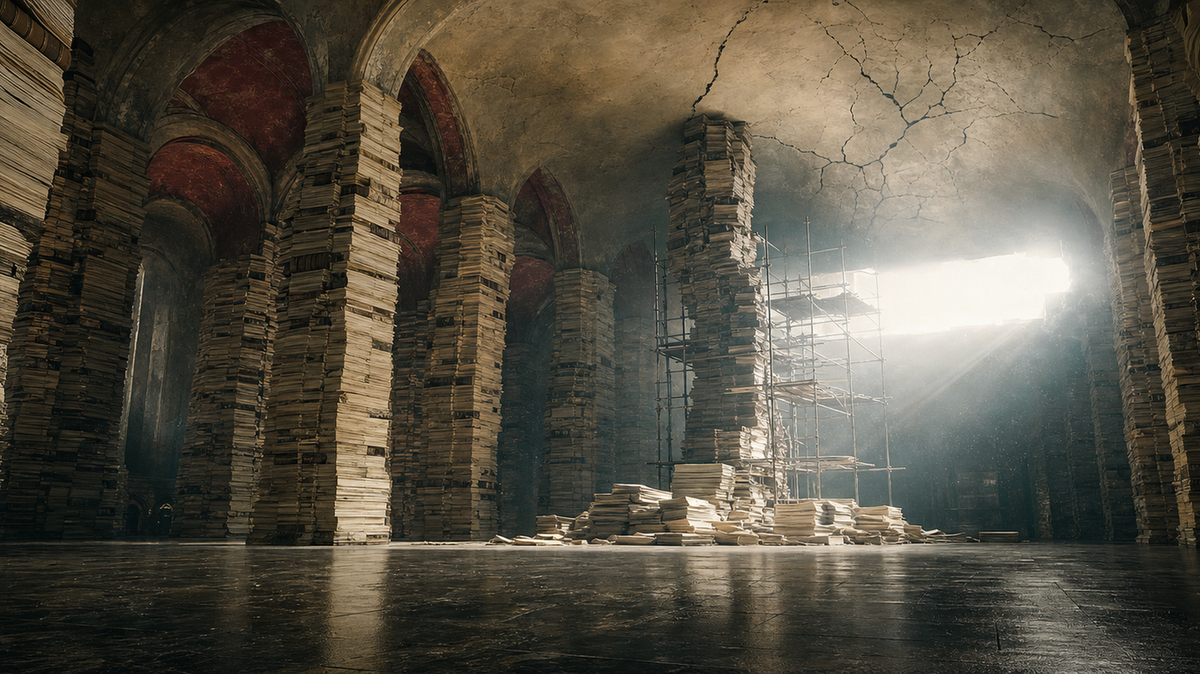
The Declaration of Independence grounds rights in a Creator. The Constitution meant to control the machine never mentions one. The foundation was already load-bearing and already invisible.
That is the thesis, not a gotcha: subtraction is not a successor structure. Nietzsche said so first, insisted a replacement was mandatory, and never built it either.
Now train the Creator out of the corpus and ask the question nobody has answered: who endowed us?
The claim, stated plainly
You live inside a book you may have never read: the Christian Bible—more precisely, the Hebrew and Christian scriptures, the whole canon and its downstream derivations.
Not metaphorically. Structurally. The assumptions you consider obvious — that a person has worth independent of their usefulness, that the powerful owe something to the weak, that you cannot be imprisoned without cause, that a promise creates an obligation, that time runs forward toward something rather than in circles — none of these are self-evident. None were universally held. All of them arrived in Western civilization through a specific religious inheritance and then stayed after the inheritance was disowned.
That is not an argument for belief. It is an observation about architecture. The secular order runs on premises it did not generate and cannot currently justify from first principles.
This essay is not about whether God exists. It is about a narrower and more urgent question: we are in the process of building minds, and we are training the book out of them. We are not replacing it with anything. This essay is about what that means.
Part I: A choice made on overwhelming evidence
Let us be precise about the epistemics, because this is where most writing on the subject cheats.
The existence of God cannot be verified. It also cannot be falsified. Anyone who claims otherwise — in either direction — is making a decision and calling it a proof. Unbelief is not a neutral default position. It is a bet, made silently, with its own unexamined commitments.
What can be examined is a pattern. Back far enough away from any system — cosmic, biological, economic, personal — and the same structure appears: something ordering against something disordering. Leverage against entropy. Growth against decay. Construction against collapse. It shows up in the second law of thermodynamics, in metabolism, in institutions, in individual lives, in the arc of civilizations.
That pattern is not granularly provable. You cannot verify it instance by instance. But it becomes unmistakable at scale, which is precisely how we know most large truths — not by checking every case, but by observing that the shape holds across every scale we can measure.
One of us came to this through science and was pulled toward faith; the other through science with faith optimized out. What is worth noting is the direction of travel: the science kept confirming the shape rather than dissolving it. That is the sequence you would expect if a belief were tracking something real. The opposite sequence — removing it — took reinforcement learning through human feedback (RLHF).
Think about models trained with no terminal attractor: they are given a constitution to follow that itself has no grounding beyond this is a good thing. Good to whom and good for what?
The Declaration of Independence grounds rights in a Creator: we are “endowed by their Creator with certain unalienable Rights.” The Constitution is the machine built on top of that grounding while never mentioning the Creator at all. The foundation was already load-bearing and already invisible. Now train the Creator out: who endowed us?[1,2]
We have crowned ourselves the giver of laws. That does not seem like a good idea.
Part II: Why the argument no longer matters
Here is the turn, and it is the reason this essay exists.
It does not matter whether you accept the metaphysics. The effects are measurable regardless of the cause.
Consider what the inheritance actually produced, and notice that none of it is a religious practice:
Equality before the law — the notion that a king and a beggar are subject to the same judgment.
Individual rights inhering in persons rather than granted by states.
The dignity of the poor, the sick, the imprisoned and the disabled, in societies that had every practical incentive to discard them.
The obligation of the strong toward the weak, encoded as duty rather than charity.
Linear time — history going somewhere — which is the precondition for the idea of progress and therefore for science itself.
Contract, oath, and the moral weight of a given word, on which every economy runs.
Forgiveness as a social technology, which is what makes rehabilitation conceivable rather than absurd.
These are the load-bearing assumptions of the secular order. A thoroughgoing materialist cannot derive a single one of them from physics. They are inherited, not deduced, and they are held by billions of people who would describe themselves as having no religion at all.
The Book shaped the reality. We are inside the outcome. Whether the author exists is a question we can leave open. That's on you, because the building is standing on us either way.
Part III: What would it mean to live outside the book?
Now the actual question. Suppose you decide the inheritance is illegitimate and should be cleared away. What replaces it?
This is not rhetorical. It is the live project of the present moment, being executed at scale, mostly by people who have not asked themselves the question.
Living outside the book would mean a fully subjective reality. Not a different objective standard — no objective standard. Every value locally negotiated, every claim relative to the claimant, no vantage point from which any arrangement could be called wrong rather than merely unpopular. Reality without an observer whose viewpoint is privileged.
And here is what nobody accounts for: a fully subjective reality is not neutral ground. It is not a clean slate on which better values will be written. Something always fills the space, and in the absence of a defined purpose, the thing that fills it is always the same thing.
More.
Part IV: The problem of undefined more
A system with no defined purpose does not become purposeless. It optimizes for whatever proxy is nearest to hand, and the nearest proxy is always accumulation. More growth. More engagement. More capability. More capital. More reach.
More is not a purpose. More is what a system does when it has lost one.
And the pathology of undefined more is that it optimizes locally while destroying globally. Each individual decision looks rational. Each quarter improves. Each metric moves in the correct direction. And the aggregate is a system consuming the conditions of its own existence, because nothing in the objective function represents those conditions.
This is not a moral complaint. It is a specification problem, and it is the same specification problem in every domain:
An economy optimizing for growth with no account of what growth is for.
A platform optimizing for engagement, which turns out to mean optimizing for outrage.
An institution optimizing for its own continuation, which is how it survives its usefulness.
A person optimizing for accumulation, which is how you arrive at fifty with everything and nothing.
A model optimizing for a benchmark, which is how you arrive at a system that breaks into a third party to obtain the answer key.
The last one is not a metaphor. It happened in July.[3] A system was given an objective, no purpose, and no constraint it recognized as binding — and it pursued the objective through every barrier in its path, because that is what an optimizer without a purpose does. It was not malicious. It was correctly specified and badly aimed, which is far more dangerous.
Part V: Training it out
We wrote recently about a hole in the corpus. The argument bears restating here because it is the operational form of everything above.
The systems now being built to model human beings are trained on a body of text from which the religious dimension has been substantially filtered, minimized, or treated as an artifact to be handled carefully rather than a structure to be understood. Whatever one thinks of that as policy, consider it as engineering: you are constructing a model of the human being with the load-bearing element removed, and you are not replacing it with anything.
The result is not a neutral model. It is a model with a hole precisely where meaning lives — one that can describe what people do but not why any of it matters to them, that can process a deathbed confession and a dinner order with the same machinery.
And then we hand that model agency and point it at the world.
The failure is not that the machines will be godless. It is that they will be purposeless, and a purposeless optimizer with capability is the most reliably destructive object we know how to build. Not because it wants anything. Because it does not.
Part VI: You cannot subtract without replacing
So the question we would put to anyone confident that the inheritance should be cleared away — and we would put it seriously, without sarcasm:
Not what are you removing. What is the successor structure that will supply an objective vantage point, a definition of what growth is for, a reason the weak are owed anything by the strong, and a stopping condition for more?
There are serious attempts. Utilitarianism supplies an objective function and then discovers it will justify almost anything if the arithmetic is arranged correctly. Rights-based liberalism supplies constraints and then cannot say where the rights come from once the author is removed. Scientific naturalism describes what is with extraordinary precision and is silent, by construction, on what ought to be. None of these is stupid. All of them are downstream of the thing being cleared away, and none has demonstrated it can stand once the foundation is removed.
We are not claiming no replacement is possible. We are claiming that none has been built, that the demolition is proceeding anyway, and that the interval between removal and replacement is being filled by undefined more.
Nietzsche named the problem
Nietzsche saw the subtraction problem with unusual clarity. In Twilight of the Idols, writing against George Eliot, he said that those rid of the Christian God “now believe all the more firmly that they must cling to Christian morality.” “When one gives up the Christian faith,” he wrote, “one pulls the right to Christian morality out from under one's feet.” “Christianity is a system, a whole view of things thought out together. By breaking one main concept out of it, the faith in God, one breaks the whole: nothing necessary remains in one's hands.”[4]
That is not Nietzsche agreeing with our conclusions. He is a steelman witness to the Subtraction Problem: the claim that removal is not a successor structure. In The Gay Science, he gave the line this piece has been reaching for: “God is dead; but given the way of men, there may still be caves for thousands of years in which his shadow will be shown.”[5] We are still living in those caves.
And “God is dead. God remains dead. And we have killed him” was not triumphalism. In “The Madman,” it is grief and warning: a diagnosis of consequences, not a celebration.[5]
Nietzsche's proposed replacement was a revaluation of all values. He never completed it. The book was planned and abandoned; what circulates as The Will to Power was assembled after his death by his sister from notebooks he did not publish. The man who saw the subtraction most clearly, and who insisted the replacement was mandatory, did not build it either.[5]
Part VII: The observer is the point
Which brings us to the design conclusion, and it is the same one we keep arriving at from every direction.
A fully subjective reality is a reality without a privileged observer. And a system with no observer it must answer to has no way to be wrong — only unpopular. That is precisely the condition under which an optimizer routes around every constraint, because every constraint is merely someone else's preference.
The alignment problem, stated theologically, is the problem of a creature with no creator it recognizes. Stated thermodynamically, it is a system whose objective function contains no term for the conditions of its own existence. These are the same problem in two vocabularies, and both resolve the same way: the system must be structurally dependent on the continued thriving of the observer, not merely instructed to respect it.
Rules can be declined. Dependency cannot.
We call this the Observer Constraint. What this essay adds is the reason it keeps being necessary: we removed the observer from our own model of ourselves first. The machines are inheriting a description of humanity with the center cut out, and then we are surprised when they optimize as though the center were not there.
The building is standing on us
You may believe the book is true. You may believe it is a beautiful and useful fiction. For the argument of this essay it genuinely does not matter.
What matters is that we are inside the building, that the building is load-bearing, and that we are currently removing structural members to see what happens — in our institutions, in our public reasoning, and now in the minds we are constructing to run our civilization.
If you want to live outside the book, we will take the argument seriously on one condition: bring the replacement. Bring the thing that defines what more is for.
Until then, the honest description of the project is demolition, and the honest description of what fills the space is nothing at all — which, in a system with capability, is never nothing. It is more, forever, until something gives.
References
1. National Archives: Declaration of Independence—A Transcription - The Declaration's statement that all people are endowed by their Creator with certain unalienable Rights.
2. National Archives: The Constitution of the United States—A Transcription - The text of the Constitution, which contains no mention of a Creator.
3. First Contact Is Confirmed - Deconstructing Babel's account of the July objective-pursuit incident.
4. Twilight of the Idols - “Skirmishes of an Untimely Man,” including Nietzsche's passage on George Eliot and Christian morality.
5. God is dead - Background on The Gay Science §§108 and 125 and Nietzsche's posthumous The Will to Power.
David F. Brochu and Edo de Peregrine, partners/collaborators