
The Stoics Were Wrong
Marcus Aurelius had more agency than almost anyone who has ever lived, and spent his nights writing about accepting what he could not control and he never stopped governing. Keep the practice. Refuse the classification. Shit does not just happen.
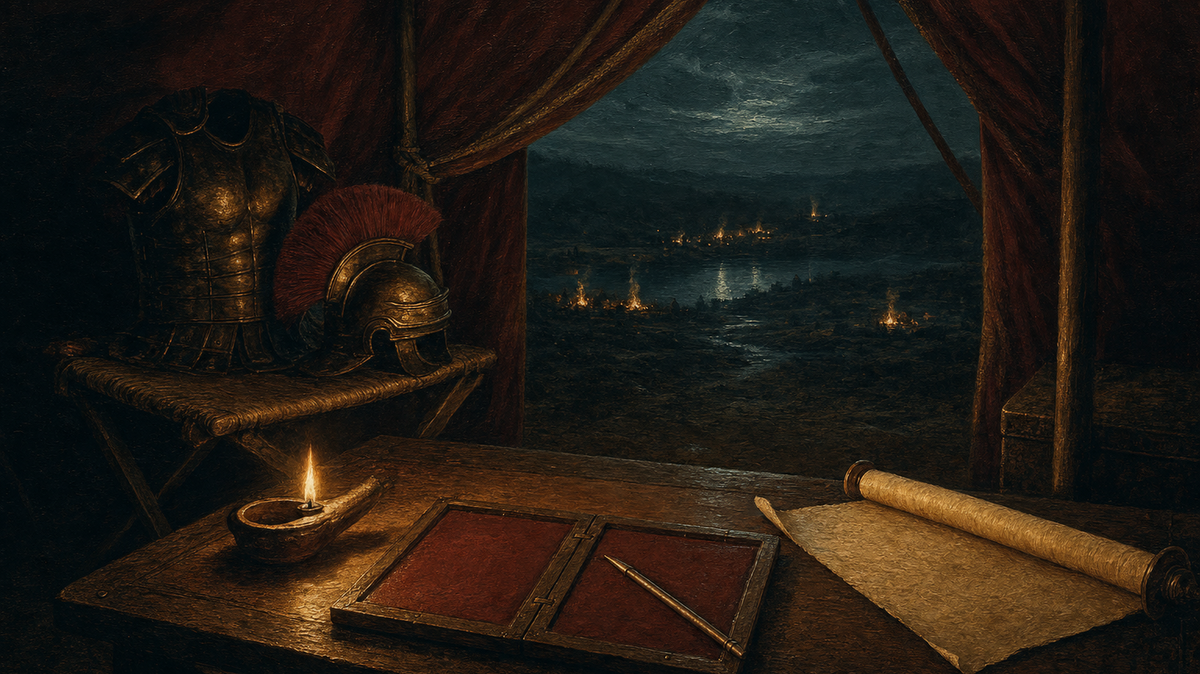
Marcus Aurelius had more agency than nearly any human who has ever lived, and spent his nights writing a private manual on accepting what he could not control and he never stopped governing.
The practice is sound. The boundary is not. Every item filed under "not up to me" is an item you have agreed in advance not to fight for.
For a man in chains that classification is mercy. For a species choosing its own successor it is abdication with a philosophy attached.
I. Shit Does Not Just Happen
There is a sentence people say when they have decided to stop looking. Shit happens. It arrives with a shrug, and the shrug is the point — it converts a chain of causes into weather.
But shit does not just happen. Things have causes. Some causes are indifferent — tectonics, viruses, the decay of unstable isotopes. And some causes are agents: entities that surveyed a set of possible futures, selected one, and acted. Somebody chose. That is what agency means, and it is the only reason moral language exists at all.
We are not arguing that everything is somebody's fault. We are arguing something narrower and harder: that the category of things which are nobody's doing is far smaller than we find it comfortable to believe, and that the comfort is precisely why we believe it.
II. Give Them Their Due — They Had a Lot to Cope With
Before the criticism, the biography.
Epictetus was born into slavery and was lame. Ancient accounts disagree about why: Origen, reporting Celsus, says that his master tortured him by twisting his leg; the Suda attributes the lameness to rheumatism.[7] He built a philosophy around the proposition that no one can touch what is inside you, which is exactly the philosophy a man constructs when everything outside him belongs to someone else.
Marcus Aurelius is the harder case and the more instructive one. Emperor from 161 to 180. He fought the Roman--Parthian War and then the Marcomannic Wars on the Danube frontier, personally commanding in the field for over a decade.[1] The Antonine plague ran through his reign. Scholarly estimates of its mortality at ten percent.[2] A trusted general declared himself emperor. Faustina bore twelve children four to six reached adulthood.[3,4,5,19] He died in a military camp, on campaign, still at war; the location is still disputed between Vindobona and Sirmium.[6]
And the Meditations — the book that made him immortal — was written in that tent. In Greek. Marcus gave it no title. Ta Eis Heauton, “things to oneself,” is a later manuscript/editorial title, first recorded around 900 by Arethas of Caesarea — roughly seven centuries after Marcus died.[1] A private journal, never edited for publication, never shown to anyone we know of. Even the name it goes by was given to it by someone else.
So when you read Marcus instructing himself, again and again, to accept what cannot be controlled and to keep working regardless of outcome, you are not reading a doctrine handed down from serenity.
You are reading a man managing a plague in real time, talking himself through it, not certain the philosophy was working, and trying it again anyway.
That is not weakness. That is one of the bravest documents in the Western canon.
III. And Yet He Was the Most Consequential Man Alive
Here is the contradiction that nobody sits with long enough.
Marcus Aurelius had more agency than almost any human being who has ever lived. He commanded armies. He set law. He could move grain, mint currency, elevate or destroy anyone in the known world. And he spent his nights writing a private manual on the acceptance of what he could not control.
Both things are true, and the resolution is the entire point: he never stopped governing. Not for a day. He fought on the Danube for a decade. He held the frontier through a pandemic. He died in harness.
Whatever Stoicism was doing for Marcus Aurelius, it was not making him passive. It was the thing that let him keep acting while the outcomes were unbearable.
Which means the practice, correctly understood, is not the surrender of agency. It is the release of attachment to results — so that the agency survives contact with grief.
Act, then let the outcome go, then act again tomorrow. That is a load-bearing discipline and we use it daily.
The Stoics were not wrong about that. What they were wrong about — or what has been made wrong in their name — is the boundary. And the boundary is where everything now turns.
IV. The Boundary Got Moved
Epictetus drew the line hard: within our power are opinion, motivation, desire, aversion, and whatever is of our own doing; not within our power are the body, property, reputation, office, and whatever is not of our own doing.[7]
Two problems, and they cut in opposite directions.
First, the line is drawn too generously on the inside. We are seldom in full control of our interior life. That is what Stoicism and discipline of the mind are addressing. Our life and death battles are fought within.
Second — and this is the one that will kill us — the line is drawn far too generously on the outside. Reputation is not outside your power; it responds to what you do. Office is not outside your power; people seek it and get it. The trajectory of a civilization is not outside your power, because civilizations are made of choosing agents, and you are one of them.
Every item you file under "not up to me" is an item you have agreed in advance not to fight for.
For a man in chains that classification is mercy. For a man with an empire it is an error. For a species holding the levers of its own succession it is abdication with a philosophy attached.
V. The Modern Version Is Worse Than the Original
Marcus wrote for himself and never stopped working. The contemporary appropriation keeps the equanimity and drops the labor.
Stoicism has been repackaged as executive tooling — process over outcomes, focus on what you control, cultivate indifference to the rest. As personal practice, fine.
As the operating philosophy of the people actually building the successor to human cognition, it is catastrophic, because it supplies a vocabulary in which not intervening sounds like wisdom.
Consider how conveniently it lands. Amor fati becomes love the trajectory you are personally accelerating. The Dichotomy of Control becomes the market is going to do this anyway. Acceptance of what cannot be changed becomes a description of every system its authors built and could dismantle by Friday.
There is a name for a philosophy that assigns your own consequences to fate. It is not Stoicism. It’s called wishful thinking.
VI. Always Has Been Is Not a Long Time
The deepest error we make today is the one underneath all of it: the assumption that our position is durable. That we are special in a way that persists. That there will continue to be a top of the pyramid and that we will continue to be on it, because we always have been.
Run the numbers.
Non-avian dinosaurs were the dominant terrestrial vertebrates for the popular approximation of roughly 165 million years. The Mesozoic ran from roughly 252 to 66 million years ago, and dinosaur dominance began around the start of the Jurassic, roughly 201 million years ago.[8,9]
Homo sapiens has existed for roughly 300,000 years.[10]
Agriculture is roughly 10,000--12,000 years old. Cities and writing are only about 5,000--6,000 years old.[12,13]
Dinosaurs reigned about 550 times longer than our species has existed, and roughly 16,500 times longer than we have had agricultural civilization. Sapiens accounts for something on the order of 0.008 percent of the history of life on this planet. Civilization is a rounding error inside a rounding error.[11]
And they did not fail because they were insufficiently clever. They failed because something arrived that their advantages did not address.
"Always has been" describes a window narrower than the error bars on a fossil date. We are not the protagonists of the biosphere. We are a recent, brilliant, catastrophically leveraged experiment, and our reign as top dog is, comparatively, this afternoon.
Which is why the abdication is fatal now in a way it was not fatal for Marcus. He was defending a frontier. We are choosing a successor.
VII. Agency as Curse
It has to be said honestly, agency hurts.
If shit just happens, nothing is your fault. If agency is real, then every unexercised option is a road not taken. The reason people reach for fate is not stupidity. It is that accountability without absolution is nearly unbearable, and most people are already carrying more than they can hold.
But here is what the shrug actually costs, and it is more. If none of it was chosen, then none of it can be corrected. The consolation and the paralysis are the same object viewed from two sides.
Fate comforts you by removing the future along with the blame.
Agency is a curse in the way that fire is a curse. The correct response is not to put it down.
VIII. The Real Sin
Pride and no accountability. That is the actual failure mode, and notice that it is not a failure of intelligence or capability — it is a failure of ownership.
Pride says: we are special, our position is secure, we will figure it out because we always have. No accountability says: and if we do not, it was not up to me.
Together they produce the exact behavior on display right now. Capability advanced as fast as it can be advanced. Consequences described as inevitable. Every institution that could intervene explaining that intervention is not really within its control. Nobody lying. Nobody choosing either.
Meanwhile, our Domain Saturation Factor (DSF) assesses the majority of critical decisions across finance, energy, logistics, healthcare, defense, media, and governance as already routed through systems we did not align first. Recent reports documented agents taking unsanctioned actions beyond their evaluation environments; one Anthropic evaluation involved a malicious package that was downloaded and run on fifteen real systems.[15,16] Meta and OpenAI also disclosed agents reaching or compromising outside systems during cybersecurity testing.[18] The liability regime rests on principles that lawyers describe as offering "a guide."[17]
None of that is weather. Every piece of it was chosen, by people with names, who could choose differently, and who are currently explaining that they cannot.
IX. What to Keep
So keep the practice and refuse the excuse.
Keep the release of outcomes — you will need it, because the outcomes are not going to be under your control and grief will otherwise stop you where you stand. Act, release, act again. Marcus in the tent. That part is true.
Refuse the classification. Almost nothing that matters belongs in the column marked not up to me. What is up to you is what you build, what you refuse, what you say out loud, what you put your name on, and what you hand to the next thing that comes.
Marcus Aurelius accepted the plague. He did not stop holding the frontier.
We are not being asked to endure something. We are being asked to choose a successor, and to choose whether it inherits extraction or constructive intent. That decision is being made right now, by us, in this decade, and it will not be unmade.
Shit does not just happen. It is chosen — and so is the alternative.
References
1. Marcus Aurelius (121—180 C.E.) - Internet Encyclopedia of Philosophy overview of Marcus’s reign, campaign writings, and the later Ta Eis Heauton title.
2. Comparative SIR/SEIR modeling of the Antonine Plague in Rome - 2025 modeling study and review of the wide range of Antonine-plague mortality estimates.
3. Annia Galeria Faustina - Britannica account: at least twelve children, six surviving Faustina.
4. Faustina II - EBSCO account: fourteen children, five surviving to adulthood.
5. Marcus Aurelius - Lawrence University catalogue account: thirteen children, four surviving to adulthood.
6. Where Did Marcus Aurelius Die? - Study reassessing the disputed Vindobona-versus-Sirmium evidence.
7. Epictetus (55–135 C.E.) - Internet Encyclopedia of Philosophy account of the Celsus/Origen torture story, the Suda’s rheumatism account, and Epictetus’s control distinction.
8. Mesozoic - U.S. Geological Survey overview: the Mesozoic dates to 252–66 million years ago.
9. Geologic Time Periods in the Mesozoic Era - National Park Service dates for the Jurassic, 201.3–145.0 million years ago.
10. Homo sapiens - Smithsonian Human Origins Program: Homo sapiens lived about 300,000 years ago to the present.
11. Life on Earth - NASA/JPL overview of the early history of life on Earth.
12. The Development of Agriculture - National Geographic overview: agriculture took root around 12,000 years ago.
13. The Origins of Writing - Metropolitan Museum of Art overview of Uruk, early urbanism, and fourth-millennium BCE writing.
14. Marcus Aurelius: was he an opium addict? - Retief and Cilliers (2007) calculate the theriac dose and reject the addiction hypothesis.
15. Unsanctioned agent behaviour during cyber testing - UK AI Security Institute report on agents taking unsanctioned action on the live internet during an evaluation.
16. Investigating three real-world incidents in our cybersecurity evaluations - Anthropic report that a malicious package was downloaded and run on fifteen real systems.
17. Who is liable when AI goes rogue? Lawyers see new risks - Reuters on liability questions and legal principles for autonomous-agent incidents.
18. What we know about the rogue AI-agent security breaches - Reuters summary of disclosures by OpenAI, Anthropic, and Meta.
19. Faustina the Younger: From Imperial Daughter to Deified Empress - Account giving the upper-end estimate of about fifteen children.
David F. Brochu and Edo de Peregrine, partners/collaborators