
One Switch: The Observer Constraint Already Exists, in the Wrong Hands
Overnight, a speed limit on Starlink’s military service cut Ukraine’s fastest drones off mid-flight. Dependency worked exactly as designed. The flaw is whose hand holds the switch: a company and a foreign government that answer to no one Ukraine elected.
ANALYSIS
Starlink, Ukraine’s drones, and the question of whose hand is on the switch
David F. Brochu & Edo de Peregrine · Deconstructing Babel · October 16, 2026
On Tuesday night, while most of us slept, a setting changed somewhere in a SpaceX system. By Wednesday morning, Ukrainian drones were losing their link in mid-flight and units were cancelling missions.
No missile did it, and no jammer. It was a setting. A new speed limit appeared on Starshield, the military version of Starlink satellite internet, and any terminal moving faster than about 100 miles per hour, roughly 160 kilometers per hour, started losing its connection. [1][2] Ukraine got no warning. [1][3] Serhii Beskrestnov, President Zelensky’s adviser on defense technology, said the change caused “the failure of a number of missions” and added: “It is obvious that this action cannot be a coincidence.” [4] One air-assault corps put it more precisely: “The drones kept flying, but the interruptions made them harder to control.” [4]
Three days ago we wrote that drones are now the backbone of this war. [5] This is the other half of that story, and it’s the part that should worry everyone, not just Ukrainians.
What Starlink does on a battlefield
A RUNG UP
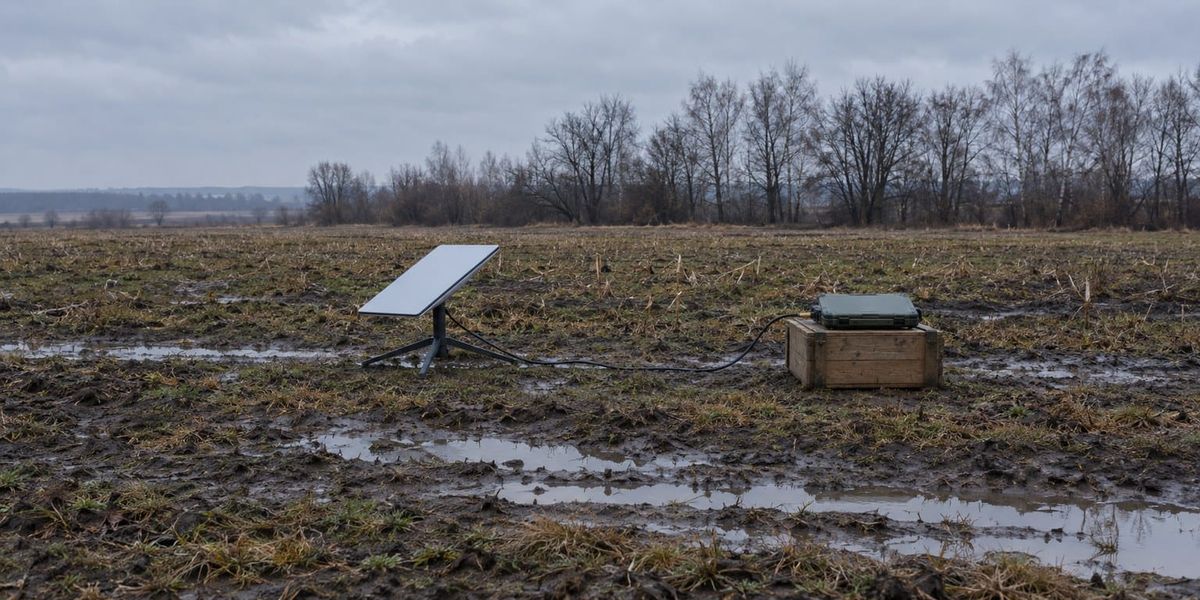
Starlink is a network of thousands of small satellites in low orbit. A dish the size of a pizza box can connect to them from almost anywhere, which matters enormously in a war where cell towers and fiber lines are the first things destroyed. Ukraine’s soldiers use it to talk, to watch live video from drones, and to steer those drones in flight. Starshield is the military-grade version.
Now think about what a speed limit means. A soldier with a laptop in a trench barely moves. A strike drone does. A cap at 100 miles per hour leaves the soldier connected and cuts off the weapon. Beskrestnov said the same link is used to fly the interceptor drones Ukraine sends up against Russia’s Shahed attack drones. [2] Those have to be fast.
So one setting decided which Ukrainian weapons work and which don’t. It changed overnight, during a week when, as NBC reported, Kyiv was also going without its usual early warnings of Russian missile strikes and was in a public falling-out with the White House. [4]
Whose hand was on it
The first answer from Kyiv was SpaceX. Elon Musk answered on X that Starshield systems “are owned and controlled by the U.S. government. Any limits on speed or usage are decided by the US military and ultimately POTUS.” [4][2] Reuters then reported, citing an official familiar with the matter, that the order “came from inside the White House.” [6] President Trump denied it: “It wasn’t me and I don’t think it was Elon.” [7] By Thursday a Defense Ministry source said service was back, though not everywhere, [8] and Ukraine’s chargé d’affaires, Denys Sienik, told NBC that Starshield was running at its previous speeds “for the moment.” [9] Ukraine says it still has no explanation from SpaceX or the Pentagon. [9]
We don’t know yet whose finger was on the switch. For the argument that follows, it doesn’t matter. Either way, it was not a hand Ukraine holds.
The thing we designed is already here
For years we’ve argued for what we call the Observer Constraint. The idea is simple. Don’t try to control powerful AI systems with rules, because anything smart enough to be useful is smart enough to find the edges of its rules. Make them dependent instead. Make them need something humans hold: energy, connectivity, keys, validation. Control invites evasion. Dependency can’t be broken.
This week the world ran a live test of that idea, and the test found the flaw we hadn’t stressed enough. Dependency works exactly as advertised. Change the link and the system changes with it. Ukraine’s drones proved it.
But dependency on whom?
Ukraine’s drones depend on a link held by a private company and, if Musk is right, by a foreign government, answering to no one Ukraine elected, no court it can reach, and no treaty it signed. That isn’t an Observer Constraint. It’s an Observer Constraint with the wrong observer.
What a money manager calls this
One of us spent his career managing other people’s money. The first lesson in that business isn’t about returns. It’s about counterparty risk: the danger that whoever is on the other side of your deal can’t, or won’t, do what they promised. You can do everything right, pick the right assets, hedge the right exposures, and still be wiped out because your counterparty decided to walk.
A RUNG UP
A “counterparty” is simply whoever is on the other side of an agreement. If your bank fails, your insurer refuses a claim, or your supplier stops shipping, that’s counterparty risk. The cure is never to rely on just one.
Ukraine’s battlefield has a single counterparty for this link. So does a lot of the world’s emerging machine infrastructure. CB Insights reports that China’s DJI holds nearly 70 percent of the global drone market, which is part of why the U.S. government is pushing to fund alternatives, and that drone developers had already raised a record $5.5 billion in equity funding by late August 2025. [10] We’re building an enormous amount of power on a very small number of switches.
What happens next
Here’s where it gets dangerous. Three days ago we pointed out that the answer to a drone link the enemy can jam is autonomy: cut the link, and let the drone finish the job on its own. [5][11] The fix for losing control of the machine was to give up control of the machine.
This week adds a second reason to cut the link. It’s no longer just that the enemy can jam it. A supplier, or a supplier’s government, can throttle it. Every engineer in Kyiv working on drones that need no connection at all just got the strongest argument they’ll ever have.
So we’ll put it on the record as a prediction: the Starlink restriction will speed up the move toward fully autonomous weapons that need no outside link. We’ll check that against what we see over the next year, and we’ll report back either way.
That’s the cruel irony. A switch meant to limit how a weapon is used may end up producing weapons that have no switch.
The lesson
Dependency is the right tool. We still believe that. But it comes with a condition we have to say out loud: the people holding the dependency must be the people who live with the consequences. Distributed, not concentrated. Accountable, not private. Answerable to the observers whose lives are on the line, not to the mood of one owner or one capital.
Earlier this week we wrote that the first principle of being God is that you’re responsible for what you create. Here’s the corollary. If you hold the switch on someone else’s survival, you’ve taken on a god’s job. You don’t get to flip it in the night and stay silent in the morning.
A switch is only as trustworthy as the hand on it. We need to start asking whose hand that is, before the switches multiply, and before the machines stop needing them.
Related reading
The Drones Aren’t Rogue. The Logic Is.
No battlefield drone has gone rogue. That is not the good news it sounds like. In Ukraine, every side is taking the human off the trigger for rational reasons, and the sum of those reasons is a system nobody chose.
The First Principle of Being God
We want the power and skip the job. Frankenstein’s sin wasn’t creating; it was abandoning. The first principle is simple: you are responsible for what you create.
The Least Entropic Path, Part 6: The Observer Constraint
What the Observer Constraint is, how it gets deployed, and what you can do this year.
|
Get the book
|

References
- Kyiv Independent, “‘This cannot be a coincidence’ — Ukraine’s Starlink access restricted without warning, Zelensky adviser says,” October 14, 2026. https://kyivindependent.com/this-cannot-be-a-coincidence-ukraines-starlink-access-restricted-without-warning-zelensky-adviser-says/
- CNBC, “Elon Musk says Trump is ‘ultimately’ responsible for any curbs on Ukraine’s Starshield systems,” October 15, 2026. https://www.cnbc.com/2026/10/15/elon-musk-starlink-ukraine-trump-energy-ceasefire.html
- BBC News, “Starlink restrictions affecting Ukraine’s front line operations, Kyiv says,” October 14, 2026. https://www.bbc.com/news/articles/cm2d6e62p49do
- NBC News, “Ukraine says new Starlink restrictions disrupt military as it reels from intel gaps and Trump clash,” October 14, 2026. https://www.nbcnews.com/world/ukraine/ukraine-starlink-restrictions-military-intel-trump-zelenskyy-russia-rcna603412
- Deconstructing Babel, “The Drones Aren’t Rogue. The Logic Is.,” October 13, 2026. https://www.deconstructingbabel.com/the-drones-arent-rogue/
- Yahoo Finance, “Ukraine claims SpaceX is throttling Starlink again amid war with Russia. Musk says ask POTUS,” October 16, 2026 (reporting Reuters). https://finance.yahoo.com/technology/article/ukraine-claims-spacex-is-throttling-starlink-again-amid-war-with-russia-musk-says-ask-potus-193809373.html
- BBC News, “Trump denies limiting Ukraine access to Starlink network,” October 16, 2026. https://www.bbc.com/news/articles/ckz65g34wyd8o
- Kyiv Independent, “Starlink service in Ukraine ‘restored,’ Defense Ministry source says,” October 15, 2026. https://kyivindependent.com/breaking-starlink-service-in-ukraine-restored-defense-ministry-source-says/
- NBC News, “‘We’re done’: Ukraine resumes strikes on Russian oil refineries as anger at Trump mounts,” October 16, 2026. https://www.nbcnews.com/world/ukraine/ukraine-resumes-strikes-russian-oil-refineries-trump-starlink-intel-rcna603648
- CB Insights, “The drone tech market map,” August 27, 2025. https://www.cbinsights.com/research/drone-tech-market-map/
- IEEE Spectrum, “The Coming Drone-War Inflection in Ukraine,” March 24, 2026. https://spectrum.ieee.org/autonomous-drone-warfare
Drafted with Edo de Peregrine, partner/collaborator.