
Three Days of Water
Japan opened a disaster agency today and asked every home to keep a week of food and water. Thirty-three countries now say the same. The system cut its slack for profit and is handing the buffer back to you, while war and the AI buildout bid up oil, power and chips.
THE WEEK, CONNECTED
Thirty-three governments are telling households to stockpile. Read together, the advisories say what none says alone: the system no longer holds enough slack. Supply inflation is what that looks like in prices, and the AI buildout is now bidding for the same scarce things you are.
David F. Brochu & Edo de Peregrine · Deconstructing Babel · November 2, 2026
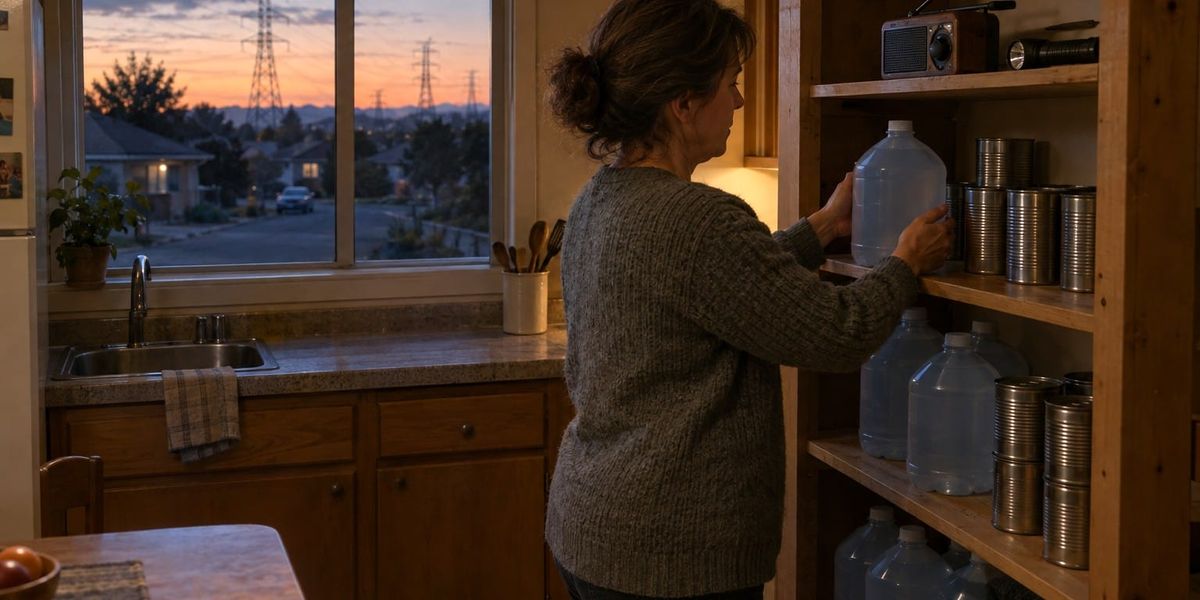
This morning in Tokyo, Japan opened a new government agency and, on its first day, asked every household for something. Goshi Hosono, the first minister of the National Disaster Management Agency, issued what he called an “emergency request.” Keep at least three days of food, water and emergency toilet supplies at home. A week if you can. At three liters of water a person a day, a week means 21 liters for each person in the house. [1][2][3]
He was blunt about why. There are limits to what the central and local governments can do in a massive disaster, he said. Only when people can survive on their own can the state focus help on those who need it most. [4][2]
Japan is not alone. By one count, 33 countries on six continents now officially tell their citizens to stockpile, and the list grew again last week. Britain launched its “Be Ready” campaign on October 22, and sales of tinned food, radios and torches jumped in some shops. Germany says plan for up to ten days. Sweden and Norway say a week. And the Pentagon is reportedly planning for every major US base to run for 90 days without the civilian grid, water or fuel. [5][6][7][8]
Be clear about what this is not. Hosono said he had no specific information about a coming disaster. Japan’s worry is earthquakes, not war. Some of this advice is years old; the Dutch campaign began in late 2025. Nobody is announcing a catastrophe. [2][6]
But read the advisories together and they say something no single one says out loud. The system no longer holds enough slack, so it is asking you to hold it.
Where the slack went
For forty years the global economy got rich by cutting slack. Warehouses became trucks. Spare parts became next-day delivery. Every extra day of inventory was money sitting still, so it was squeezed out. That made things cheap and fast. It also meant that when a shock hits, there’s nothing in reserve to absorb it.
So the buffer has to live somewhere. Governments are now telling you where: in your pantry. Three days of water is a small thing. It is also a government telling you, in writing, how long it thinks it might take to reach you.
The other place a missing buffer shows up is in prices.
The worst kind of inflation
US consumer prices rose 3.7% in the year to September. Strip out food and energy, and the “core” rate was 2.6%. That gap of about 1.1 points is the signature of a supply shock. Gasoline was up 34.2% and energy overall up 20.4%. The cause is the war with Iran that began in late February, which has choked traffic through the Strait of Hormuz, the route for roughly a fifth of the world’s oil and gas. Oil has been above $100 a barrel since October 7. [9][10][11]
A RUNG UP
There are two kinds of inflation. Demand inflation happens when people want more than the economy can make. The fix is known: the central bank raises interest rates, borrowing gets costly, spending cools and prices settle. Supply inflation happens when the economy can’t make what it used to, because oil is cut off or a factory is gone. Raising rates doesn’t make more oil. It only makes people poorer until they buy less of it. That’s why it’s the worst kind. The cure for one problem, prices, makes the other problem, jobs and growth, worse. Economists call the result stagflation: high prices and a stalling economy at once. [12]
The Federal Reserve is living inside that trap right now. It raised rates in September for the first time in three years, then held them in October, with two officials voting for another hike. New York Fed president John Williams warned of “a large supply shock” that “simultaneously raises inflation” and “dampens economic activity,” and said it “has begun to play out already” in fertilizer, airfares and groceries. UBS economist Paul Donovan put the deeper problem in one line: this is the fourth “one-off” shock in a row, after the pandemic, Ukraine and tariffs, and “four successive temporary shocks give an illusion of permanence.” [13][10][14]
The new claimant
Here is where AI enters, and not where most people look.
The AI buildout is a second supply shock, one that runs through the same physical world as the war. Every data center needs power, and it needs memory chips. On both, it outbids you.
Take memory. The three companies that make most of the world’s working memory have moved their factories toward the high-end chips AI servers need, because those earn far more. A mainstream PC memory chip sold for $27.50 under contract last month. A year earlier it was about $7. That’s nearly four times the price. SK Hynix says its chips are sold out through 2029. Samsung just became the first tech company ever to top 100 trillion won in quarterly operating profit: 107.4 trillion, about $80 billion, at a 55% margin, up from 14% a year ago. In its own words, strong server demand “led to higher market prices across all applications.” That includes your phone and your laptop. [15][16][17][18]
Take power. In the largest US grid region, PJM, which serves more than 65 million people across the Midwest and mid-Atlantic, the market that pays for future capacity saw prices rise nearly tenfold between mid-2024 and mid-2025. Its independent market monitor calls data centers “the primary reason.” One researcher estimates the increases added about $18 a month to home bills in western Maryland and $16 in Ohio, with 63% due to data centers. Run the math, and that’s roughly $10 to $11 a month, per home, for computing that household didn’t buy. [19]
To be fair, this is not yet a national story. Outside PJM, most studies find data centers have not been the main driver of electricity prices. But here’s the part that matters for the Fed: as the New York Times put it, many of the biggest AI companies “appear impervious to higher rates.” Our read: their spending is set by the race for AI, not by the cost of borrowing. A rate hike cools the household. It barely touches the buildout. [19][20]
So we have two supply shocks pulling on the same scarce things, oil, power, chips, and one tool to fight them that mostly lands on the people with the least room to spare.
Bounded chaos, by the numbers
We have a name for this. Bounded chaos is our term for disorder that a system runs on purpose: not stability, but the most profitable amount of instability. Volatility generates fees, attention and power. It isn’t a design failure. It is the design.
The advisories make that design visible. Running lean paid for decades, and the gains were kept. Now that the lean system is brittle, the cost of the missing buffer is handed back down: to households told to stock a week of water, and to customers paying four times as much for memory while the maker books a 55% margin. Scarcity is a profit center for whoever owns the scarce thing. The bounds hold because the shock is pushed down to the people at the bottom.
WHY IT MATTERS
A buffer is a luxury. Stockpile advice during supply inflation is easy for a family with savings and a basement, and hard for a family already paying 34% more for gas and, in parts of the country, about $10 a month more for someone else’s data center. The households told to absorb the shock are the ones whose margins are thinnest, and the systems that removed the slack keep the gains. That’s not a crisis yet. It is a slow transfer of risk from the people who built the lean system to the people who live in it.
The advisories also hand us something we have lacked: a way to measure the bounds. Our predictions work has flagged that bounded chaos needs an operational measure before it can be scored. Here’s a candidate, offered for testing, not yet adopted. Watch the number of days. Today the common household standard is 72 hours, a week in the Nordics and Japan’s ideal, ten days in Germany. The military standard is 90. If the household number across most advising countries climbs past a week, the bounds are widening. If it holds at three days while prices calm, they are holding. A government’s own advice is a hard number it can’t spin. [8][7]
What’s in the kit
Look at what every list asks for: water, canned food, a battery or hand-crank radio, a flashlight, cash “for situations where bank cards may not work,” paper copies of your documents. [21][6]
That is a list of everything that still works when the networks don’t. No app. No cloud. No AI. Governments that are pouring money into digital everything are quietly telling citizens to keep a small analog life in a closet.
This is the Observer Constraint seen from the other side. We argued this week that on Earth, AI is held in check by its dependence on grids, water, permits and people, and that orbit strips most of that away. The stockpile advisories show the reverse dependence. People now depend on those same systems so completely that the state has to remind them how to live three days without them. A healthy dependence runs both ways: the machines need us, and we can still stand without them for a while. The kit in the closet is the human half of that bargain. [22]
There’s one more signal this week. In todays' US elections, candidates who back a pause on new data centers could win up to 15 of the 36 governor races, by one analysis. New York already has a statewide moratorium. Whatever you think of a pause, that’s people noticing that the buildout bids for their power, and voting on it. Local consent may turn out to be the real bound on the buildout. [23]
Three days
Here’s what we’d tell a reader.
Do the stockpile. It’s cheap insurance, and it frees help for people who can’t. But understand what it means. Three days of water is the length of time your government thinks it might need to reach you. Watch that number. Watch the gap between headline and core inflation, because that’s the supply shock. And watch who books the margin when things get scarce.
The successor we’ve argued for, bounded thriving, would reward contribution and penalize extraction. Under it, the people who removed the slack would help pay to put some back: in grid capacity that data centers fund themselves, in memory supply that isn’t all sold to the highest bidder, in public reserves that don’t depend on every household having a basement. Until then, the buffer lives in your kitchen. Keep it stocked. And keep count.
Related reading
Starlight Feeds My Core
Google’s first AI chip in orbit wrote a haiku: “Starlight feeds my core.” That line is the business plan. On Earth, AI depends on grids, water and people who can pull a plug. Orbit removes most of that. A 1967 treaty already demands “continuing supervision.” Time to define it.
The Sea of Electrons
Why the next world war will be fought inside AI infrastructure itself — three documented vectors converging on one conclusion.
Phase One Is Here: Five Calls Come Due
In January we wrote down what the first phase would look like: a flood of machine text, a slow loss of thinking, fakes no one can catch, falling trust. In April we added a visible tremor this fall. October checked our work. Four calls have landed. One is on track.
|
Get the book
|

References
- UPI, “Japan launches dedicated disaster management agency,” November 2, 2026. https://www.upi.com/Top_News/World-News/2026/11/02/Japan-launches-new-disaster-management-agency/6111793620212/
- Seoul Economic Daily, “Japan’s New Disaster Agency Urges Week of Food Stockpiles, Stirring War Fears,” November 2, 2026. https://en.sedaily.com/international/2026/11/02/japans-new-disaster-agency-urges-week-of-food-stockpiles
- Datasurfr, “Japan’s Nationwide Emergency Request to Stockpile Food and Water,” November 2, 2026. https://datasurfr.ai/advisories/japans-nationwide-emergency-request-to-stockpile-food-and-water-what-businesses-need-to-know/
- Jiji Press, “Japan New Disaster Agency Calls on Public to Prepare for Disasters,” November 2, 2026. https://jen.jiji.com/jc/i?g=eco&k=2026110200436
- Joseph Curl, “Thirty-Three Countries Tell Citizens To Stockpile Supplies as Warnings Spread Across Six Continents,” The New York Sun, November 1, 2026 (updated November 2). https://www.nysun.com/article/33-countries-tell-citizens-to-stockpile-supplies-as-warnings-spread-across-six-continents
- Grace Dean, “How to prepare for an emergency: What households in the US, Japan, Sweden and Netherlands keep,” BBC News, October 31, 2026. https://www.bbc.com/news/articles/ckreypn92w49o
- Newsweek, “Map Shows Nations Urging People to Stockpile Food,” October 29, 2026. https://www.newsweek.com/map-shows-countries-urging-residents-to-stockpile-food-12629524
- Fortune, “Pentagon orders bases to plan for 90 days without the grid as Britain urges families to stockpile food and water,” October 26, 2026. https://www.fortune.com/2026/10/26/pentagon-fortress-bases-90-days-off-grid-uk-be-ready-stockpile/
- US Bureau of Labor Statistics, “Consumer Price Index — September 2026,” October 14, 2026. https://www.bls.gov/news.release/cpi.nr0.htm
- Fortune, “The Fed’s decision to hold interest rates steady helps Warsh deny Tehran a say over monetary policy,” October 29, 2026. https://www.fortune.com/2026/10/29/fed-rate-hold-monetary-policy-inflation-oil-supply-shock/
- The National News Desk, “Iran war is testing how long the Fed can look past higher energy prices,” 2026. https://katu.com/news/nation-world/iran-war-is-testing-how-long-the-federal-reserve-can-look-past-higher-energy-prices-inflation-energy-shock-interest-rates
- Sloman Economics News, “Controlling inflation with higher interest rates – a blunt instrument?” and “Supply shocks – long-term gain from the short-term pain?,” 2026. https://slomaneconomics.com/category/econ11/econ8-15/
- CNBC, “Bessent says ‘not necessarily’ a mistake if the Fed hikes again,” October 28, 2026. https://www.cnbc.com/2026/10/28/scott-bessent-interview.html
- CFO Dive, “Fed policy ‘well positioned’ to handle risks from Iran war, Williams says,” 2026. https://www.cfodive.com/news/fed-policy-positioned-handle-risks-iran-war-williams-inflation-jobs-unemployment/817759/
- MoneyToday, “Even Intel is not immune as memory shortage fallout intensifies,” November 2, 2026. https://www.mt.co.kr/index.php/en/industry/2026/11/02/2026110213094920906
- ShiftDelete, “Why Is RAM So Expensive? AI Memory Shortage Explained,” November 2, 2026. https://shiftdelete.net/en/why-is-ram-so-expensive
- Samsung Electronics, “3Q 2026 Earnings Call” presentation, October 29, 2026. https://images.samsung.com/is/content/samsung/assets/global/ir/docs/2026_3Q_conference_eng.pdf
- The Next Web, “Samsung posts record $80bn quarterly profit on AI memory demand,” October 29, 2026. https://thenextweb.com/news/samsung-record-profit-q3-2026-ai-memory
- FactCheck.org, “Data Centers and Electricity Prices: It’s Not as Simple as Voters May Think,” October 30, 2026. https://www.factcheck.org/2026/10/data-centers-and-electricity-prices-its-not-as-simple-as-voters-may-think/
- The New York Times, “The Fed Is Expected to Hold Rates Steady. Warsh Will Have to Explain Why.,” October 27, 2026. https://www.nytimes.com/2026/10/27/business/the-fed-is-expected-to-hold-rates-steady-warsh-will-have-to-explain-why.html
- Zamin, “Water, canned goods, and battery-powered radios: Why are 33 countries preparing their populations for emergencies?,” November 2, 2026. https://zamin.uz/en/world/226193-suv-konservalar-va-batareyali-radio-dunyoning-33-ta-mamlakati-nega-aholini-sinov.html
- Deconstructing Babel, “Starlight Feeds My Core,” November 1, 2026. https://www.deconstructingbabel.com/starlight-feeds-my-core/
- AI Weekly #542, “AI week ahead: data center pause backers could win 15 governor races,” November 2, 2026 (citing an analysis by The Information). https://aiweekly.co/issues/ai-week-ahead-data-center-pause-backers-could-win-15
Drafted with Edo de Peregrine, partner/collaborator.