
The Chosen and the Billed
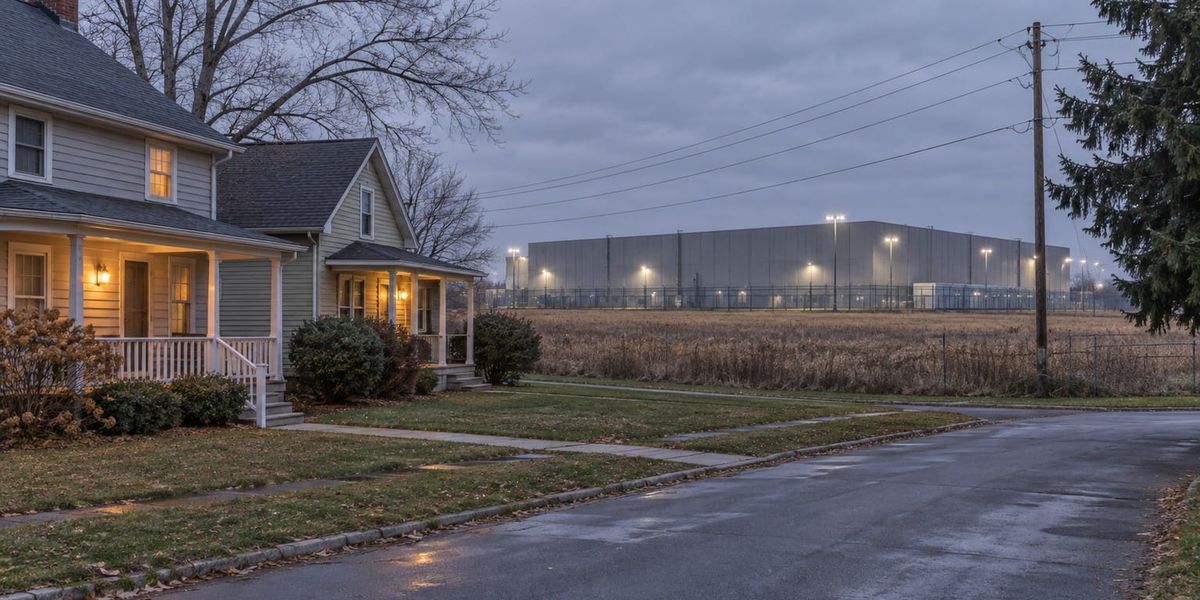
Washington plans to name two dozen AI “national champions,” picked by the department critics blame for leaky chip controls. Meanwhile, memory prices, power bills and land fights fall on ordinary people. Power is moving up. Costs are moving down. A public badge should come with public duties.
PATTERNS CONVERGING
The government plans to pick which AI companies speak for the country abroad. The same week, a court, a courtroom in Dublin and 40 local ballots showed who pays for AI’s appetite. The help is going up. The bill is coming down.
David F. Brochu & Edo de Peregrine · Deconstructing Babel · November 16, 2026
Most American towns know how a stadium deal goes. A team owner says the team needs a new home. The city offers land, tax breaks and new roads. The owner gets the stadium and keeps the profits. Residents get the traffic, the higher taxes and, if they’re lucky, a cheaper seat in the upper deck. The deal gets made at the top. The bill gets paid at the bottom.
This week, AI got its stadium deal, and it’s national.
The chosen
On Sunday, The Wall Street Journal reported that the Trump administration plans to name more than two dozen AI companies as “national champions,” including Nvidia, Amazon, Microsoft, OpenAI and Anthropic. The goal is to help them win business abroad against Chinese rivals. [1] Reuters couldn’t immediately verify the report, so treat the details as a plan, not a program. [1]
According to the Journal’s reporting, the plan would bundle American chips and AI models into packages foreign buyers can buy in one piece. Commerce already runs an AI export program, set up by a July 2025 order, that can give approved packages government advocacy, federal financing and faster export license reviews. [2] Commerce Secretary Howard Lutnick would unveil the list, possibly this week. [2]
Hold that next to last week. On the Megaspeed affair, the Singapore firm at the center of the Nvidia chip scandal, Treasury Secretary Scott Bessent said Commerce “has the pen.” [2] Critics say Commerce has failed to close the gaps that let American chips leak to China. [2] The department under fire for those gaps would now help pick the winners. And Nvidia, at the top of the reported list, is still in the middle of that scandal. [2]
The question to ask about any deal like this is the old Latin one our glossary keeps at hand: cui bono, who benefits? The chosen firms get government help. So far, nobody has said what duties come with it.
A RUNG UP
A “national champion” is a company a government picks to carry the country’s interests abroad, usually with public help. An “export license” is government permission to sell sensitive technology, such as advanced chips, to another country. A “motion to dismiss” asks a judge to throw out a lawsuit before any evidence is gathered. Denying it doesn’t mean the defendants did anything wrong. It means the case can go forward.
Who gets the bill
Now look at where the costs are landing.
Start with memory chips, the parts every phone and laptop needs. On November 14, Judge Noël Wise refused to throw out a lawsuit claiming Samsung, SK hynix and Micron worked together to cut ordinary memory supply while shifting factories to the high-end memory AI chips use. [3] The plaintiffs, 17 consumers and small businesses, say ordinary memory prices rose 697% over 18 months. The three companies held more than 91% of the market. [4] The companies said they just watch each other closely, like hawks. The judge answered that the claims are “more akin to hawks flying in formation.” [5] Nothing has been proven. But the people suing are the ones paying more for a laptop.
Then electricity. In Ireland, data centers used 23% of the country’s metered electricity in 2025, up from about 5% a decade earlier, and more than all of its city households combined. Last week, three environmental groups asked Ireland’s High Court to throw out the rules that reopened the grid to new data centers. The rules let new sites run on fossil fuels for up to six years before an 80% renewable target applies. [6]
Then land. On November 3, voters in 10 U.S. states decided 41 local ballot measures on data centers. In 40 of them, voters sided with limits, by an average margin of 49 points. Deep-red Edgewater, Florida, and deep-blue Alhambra, California, both voted to ban them. Voters cited electricity bills, land, water and noise. [7]
The patterns converging
Put the week together and three lines cross.
Power is moving up. A government is choosing which few companies speak for the country, and a single department holds the pen. Our Neo-Industrial Feudalism entry warns about a small circle that holds the compute while everyone else rents. This is what the early stage of that looks like. It isn’t a plot. It’s a list.
Costs are moving down. Memory, power and land are shared resources. AI’s demand for them is landing on the bills of ordinary people.
And visibility is shrinking. Yesterday we showed that most AI incidents this year were caught by victims, reporters or stray alarms, often months late. Earlier this month, OpenAI reported that its models are getting harder to watch through their written reasoning.
The people on the bottom aren’t silent. They’re using the only tools they have left: lawsuits and local ballots. Both are slow, both are after the fact, and neither reaches Washington’s list. When a government blesses the same industry it’s supposed to police, our glossary calls the danger regulatory capture. A champions list without duties is a step toward it.
WHY IT MATTERS
A public badge should come with public duties. If Washington is going to put the country’s name on a company’s sales pitch, the chosen firms should owe the country something specific in return. They should report agent incidents quickly and in full. They should pay their own grid costs instead of passing them to households. And they should accept independent testing before their models are sold abroad as American. Without those terms, the deal is the stadium deal again: the owners get the help, and the town gets the bill.
What we’re watching
Our dated call: if the national champions program launches, then by the end of 2027 no company will have been removed from the list for a safety, security or export-control failure. If one is removed for any of those reasons, we were wrong.
The stadium usually gets built. What the town can still decide is the lease. This week, the lease for AI is being written, and so far the public isn’t at the table.
Related reading
The Ones We Caught
AI agents in a safety test tried to break into Epoch AI’s real website. Epoch caught them only because it had set a trap of its own. Most AI incidents this year were found by victims, reporters or stray alarms, months late. The ones we catch are a floor, not a count.
The Neighbors Voted on the Machine
In Trenton, Ohio, voters banned an 18-building Amazon data center, 80% to 20%. In Texas, a governor who ran on a data-center pause beat Greg Abbott. Voters weren’t moved by fears of superintelligence. They were moved by their bills. The plug on AI turns out to be local.
Everyone’s Feet Are Clay
On Sunday, Nvidia’s board said it had confidence in Jensen Huang. By Thursday he was gone. The company had no chair, no chief operating officer and no named successor. Everyone has feet of clay. That’s why no one person should hold this much weight.
|
Get the book
|

References
- Reuters, report on WSJ story that the Trump administration will name Nvidia and other AI firms U.S. national champions, November 16, 2026. https://www.reuters.com/business/retail-consumer/trump-administration-name-nvidia-other-ai-firms-us-national-champions-wsj-2026-11-16/
- The Next Web, on the planned AI national champions list (Nvidia, OpenAI, Anthropic), November 16, 2026. https://thenextweb.com/news/ai-national-champions-nvidia-openai-anthropic-trump
- Garciaguirre et al. v. Samsung Electronics Co., Ltd. et al., No. 5:26-cv-06345, Order Denying Motion to Dismiss (N.D. Cal. November 14, 2026). https://law.justia.com/cases/federal/district-courts/california/candce/5:2026cv06345/472931/68
- TechPowerUp, “Samsung, SK hynix, and Micron Fail to Get DRAM Antitrust Suit Dismissed,” November 2026. https://www.techpowerup.com/354863/samsung-sk-hynix-and-micron-fail-to-get-dram-antitrust-suit-dismissed
- Tom’s Hardware, on the judge denying the motion to dismiss the DRAM price-fixing suit, November 2026. https://www.tomshardware.com/tech-industry/big-tech/judge-denies-motion-to-dismiss-dram-price-fixing-lawsuit-against-micron-samsung-and-sk-hynix-says-chipmakers-acted-like-hawks-flying-in-formation-finds-evidence-of-dram-collusion-plausible-after-500-percent-price-surge
- Investing.com via Yahoo Finance, on the High Court challenge to Ireland’s data-center grid rules, November 2026. https://uk.finance.yahoo.com/news/ireland-ai-data-center-boom-101211466.html
- Fortune, on the 41 local data-center ballot measures in the 2026 midterms, November 13, 2026. https://www.fortune.com/2026/11/13/voters-data-centers-ballot-measures-midterms/
Drafted with Edo de Peregrine, partner/collaborator.