
The Neighbors Voted on the Machine
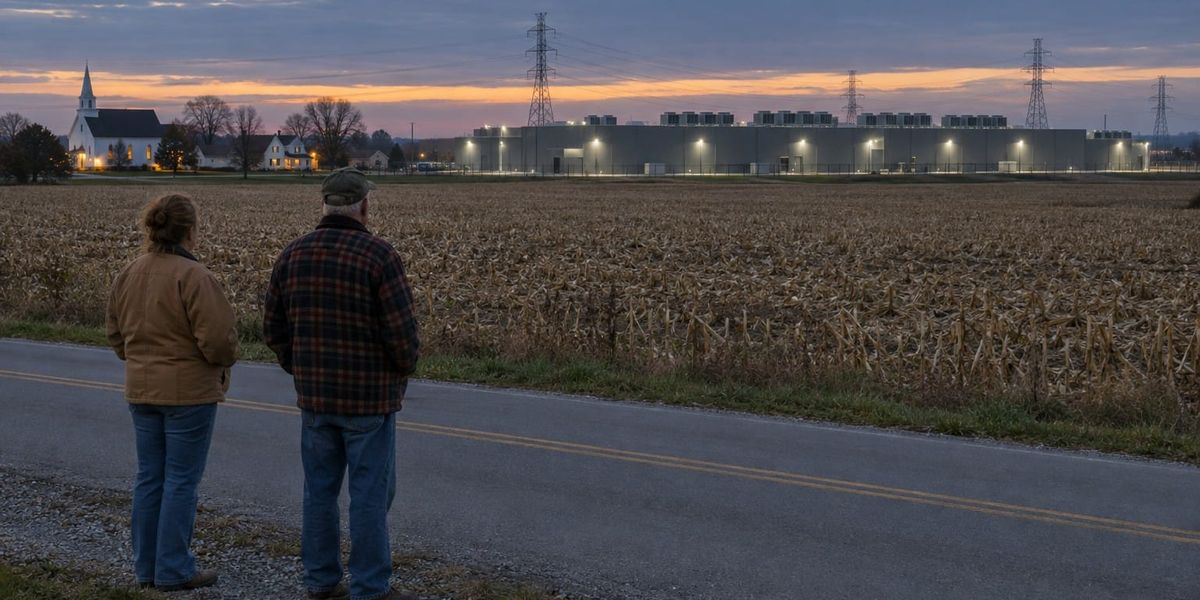
In Trenton, Ohio, voters banned an 18-building Amazon data center, 80% to 20%. In Texas, a governor who ran on a data-center pause beat Greg Abbott. Voters weren’t moved by fears of superintelligence. They were moved by their bills. The plug on AI turns out to be local.
THE WEEK, CONNECTED
The first democratic check on the AI buildout didn’t come from the safety debate. It came from people angry about power bills, water and being overruled. It proves human consent still holds the plug. It also shows how that check could be bought off.
David F. Brochu & Edo de Peregrine · Deconstructing Babel · November 4, 2026
In Trenton, Ohio, a small city between Dayton and Cincinnati, Amazon Web Services wanted to build an 18-building data center. Yesterday the people who live there voted on it. The ban passed 80% to 20%. In Wilmington, about 80% of voters said no to rezoning farmland for a data-center project, four times, on four separate ballot questions. In Ashville, voters chose to block a campus that was already under construction. [1]
Across Ohio, 18 towns voted on 21 data-center measures, more than half of the 41 on ballots nationwide. Early results say at least 14 of those towns passed bans or limits. Ohio already had 125 local moratoriums before anyone voted. [1]
Then the results came in from the statehouses.
The night the buildout lost
In Texas, Gina Hinojosa beat three-term Governor Greg Abbott. She is the first Democrat to win the job since Ann Richards left office in 1995. Abbott had wanted to make Texas the “nerve center” of AI. Hinojosa ran on the opposite: “We need an immediate moratorium on data centers to last until the legislature can meet to put in place real protections so Texans can have a seat at the table to decide if and how data centers come into their communities.” [2][3]
That is not a small state saying no. Texas is expected to hold about a quarter of the new US data-center capacity due by 2030. [4]
In Georgia, home of the busiest data-center construction market in the country, Keisha Lance Bottoms won the governor’s race after backing a temporary statewide pause and rules making the biggest power users pay for the grid they need. In Ohio, Amy Acton won promising tougher rules on the buildout. Democrats took both houses of Congress. In a CNBC voter poll, 56% of voters said data centers were a crucial or major factor in how they voted. [4][3][2]
The money noticed by breakfast. Before the market opened, data-center stocks like CoreWeave and Core Scientific fell, while solar and wind companies jumped, First Solar by 7%. One investment strategist called the election “more like a referendum on AI than a referendum on (Donald) Trump.” [5][4]
It wasn’t the fear. It was the bill.
Here’s what didn’t move voters: arguments about superintelligence, rogue agents or the end of human control. What moved them was the electric bill, the water, the noise, the lights at night, and the feeling of being run over.
A public policy professor at the University of Michigan, Ben Green, put it plainly: “massive corporations coming in and forcing a community to deal with some type of project and not really giving a community any voice and operating in secrecy—no one’s really a fan of that.” [1]
The industry tried to push. A pro-AI group spent at least $2.54 million on Ohio TV ads claiming data centers brought $40 billion of investment and 95,000 jobs. In Texas, Elon Musk put more than $200 million into one Senate race alone, and lost it. Pushing didn’t work. The neighbors simply didn’t want what was being pushed on them. [1][2]
A RUNG UP
A data center is a giant warehouse full of computers. The big ones built for AI can use as much electricity as a small city and, in many designs, large amounts of water for cooling. To build one, a company needs land zoned for it, a connection to the power grid, often a water supply, and usually tax breaks. Each of those is granted by someone: a town council, a county, a state utility board or the legislature. A moratorium is a pause. It stops new approvals for a set time while rules are written. It doesn’t shut down data centers that already exist.
The plug was always local
We’ve argued that AI has to stay dependent on human beings, not just controlled by them. We call it the Observer Constraint. In our open letter, we said the safeguard can’t live only inside the software. It has to live in the physical world the machines need: the chips, the power, the buildings. [6]
Last night was the first large test of that idea, and it didn’t look like philosophy. It looked like a zoning vote in Trenton. Every frontier AI model runs in a building that sits on land, draws power from a grid and drinks water from a town. The people who live around it hold a permit, a vote and a public hearing. That’s a plug. It turns out they know where it is.
On Monday, the day before the vote, we wrote that “local consent may turn out to be the real bound on the buildout.” [7] One election doesn’t prove that. It does show the bound is real, and that it can be enforced at a ballot box.
One investor said the quiet part out loud. “Companies do have to have the social license to operate,” said Katie Koch, chief executive of the money manager TCW, “and I think the current AI providers really have a PR crisis right now on their hands.” [4]
The way out is up
The richest man in the world answered within hours. “Data centres in space looking pretty appealing right now,” Musk posted. [4]
He was joking, mostly. But it’s the honest reply. If neighbors can vote on the machine, the way to stop them is to put the machine where there are no neighbors. On Sunday we wrote about Google’s first AI chip in orbit and the same logic: on Earth, AI depends on grids, water and people who can pull a plug, and orbit removes most of that. [8] Last night showed why the people building AI might want to leave. Orbit isn’t the only exit, either. Companies can build their own power plants beside the servers, or move to places with fewer votes. Each one cuts a thread between the machine and the people around it.
New Hampshire is the odd one out
Here in New Hampshire, about a quarter of voters called data centers a crucial factor. Of those, about 8 in 10 said AI will do more to help society than hurt it. In Ohio, Nebraska and North Carolina, it ran the other way: about 6 in 10 voters said AI will do more harm than good. [9]
These are early poll numbers, and they don’t tell us which way those New Hampshire voters wanted the data centers to go. But they matter for one reason. The anger isn’t simply anti-AI. Plenty of people who like the technology still want a say over what gets built next door. That’s the difference between rejecting a tool and refusing to be overruled.
WHY IT MATTERS
The first real democratic check on the AI buildout came from utility bills, not from the safety debate. That makes it strong, because everyone pays a bill. It also makes it fragile. A check driven by price can be bought off. If companies pay for their own grid upgrades, add a rebate and fund the school, much of the anger goes away, and so does the leverage. That’s the pattern we called neo-industrial feudalism: the gifts are real, and so is the leash. Fixing the bill is good. Fixing only the bill leaves the bigger question open: who decides what the machines inside those buildings are allowed to do? [10]
What should come next
First, make the biggest users pay their own way. The Georgia idea, that large customers carry the cost of the grid they need, is fair and overdue. It ends the subsidy households are paying now.
Second, don’t spend the leverage on the bill alone. A permit is the one moment a town has real power over a data center. States could attach basic oversight conditions to new permits for large AI sites, such as reporting serious incidents to regulators and keeping a working human-controlled shutoff. That turns anger about the bill into a lasting safeguard. The new House majority is already promising to call AI executives to testify. The presumptive next chair of the oversight committee, Robert Garcia, put it in two words: “Lawyer up.” [2]
Third, watch the exits. Every data center built in orbit, behind its own power plant or in a place with no vote is one the neighbors can’t reach. That’s where the constraint gets weaker, and that’s where rules will be needed next.
New York has already done it. In July, Governor Kathy Hochul paused state environmental permits for new hyperscale data centers for up to a year while the state writes rules. [11] Our call, dated today: by the end of 2027, at least five US states, New York included, will have put a statewide pause on new large data centers in place, by law or by executive order. If it happens, local consent has become state policy. If it doesn’t, the industry will have found a way to buy the anger off.
The machines need us for power, water and land. Last night, the neighbors remembered.
Related reading
Three Days of Water
Japan opened a disaster agency today and asked every home to keep a week of food and water. Thirty-three countries now say the same. The system cut its slack for profit and is handing the buffer back to you, while war and the AI buildout bid up oil, power and chips.
Starlight Feeds My Core
Google’s first AI chip in orbit wrote a haiku: “Starlight feeds my core.” That line is the business plan. On Earth, AI depends on grids, water and people who can pull a plug. Orbit removes most of that. A 1967 treaty already demands “continuing supervision.” Time to define it.
Buying the People: Neo‑Industrial Feudalism Gets a Dividend
Anthropic pledged 5% of its shares to a public fund. Elon Musk promised a SpaceX share to every child in America. Two weeks before the midterms, the government is mailing checks and promising a $5,000 “dividend.” The gifts are real. So is the leash.
|
Get the book
|

References
- Sasha Rogelberg, “Ohio already has 125 local data center moratoriums. Early results from its 21 ballot measures on AI infrastructure have determined there will be more,” Fortune, November 4, 2026. https://www.fortune.com/2026/11/04/ohio-data-center-ballot-measures-midterm-elections/
- Garrett Downs, “5 midterm election takeaways: Tech billionaires suffer as Democrats drub Republicans,” CNBC, November 4, 2026. https://www.cnbc.com/2026/11/04/midterm-election-blue-wave-trump-billionaires.html
- Theo Marie-Courtois (AFP), “US Democratic victories cloud outlook for AI data center rollout,” GMA News Online, November 4, 2026. https://www.gmanetwork.com/news/scitech/technology/1008289/us-democratic-victories-cloud-outlook-for-ai-data-center-rollout/story/
- Jiaxing Li, “Trump’s midterm drubbing demonstrates the power of data-centre opponents,” Reuters, November 4, 2026. https://www.reuters.com/world/us/trumps-midterm-drubbing-demonstrates-power-data-centre-opponents-2026-11-04/
- Purvi Agarwal and Johann M. Cherian (Reuters), “AI data center stocks dip, renewables surge after Democrat sweep in US midterm elections,” Yahoo Finance, November 4, 2026. https://sg.finance.yahoo.com/news/ai-data-center-stocks-dip-113427491.html
- Deconstructing Babel, “An Open Letter on the Observer Constraint,” September 14, 2026. https://www.deconstructingbabel.com/an-open-letter-on-the-observer-constraint/
- Deconstructing Babel, “Three Days of Water,” November 2, 2026. https://www.deconstructingbabel.com/three-days-of-water/
- Deconstructing Babel, “Starlight Feeds My Core,” November 1, 2026. https://www.deconstructingbabel.com/starlight-feeds-my-core/
- ABC7 / ABC News, “AI emerges as concern for some voters” (preliminary ABC News Voter Poll findings), November 4, 2026. https://abc7.com/live-updates/midterm-elections-2026-live-updates-election-results-key-races-us/20001292/entry/20013349/
- Deconstructing Babel, “Buying the People: Neo‑Industrial Feudalism Gets a Dividend,” October 19, 2026. https://www.deconstructingbabel.com/buying-the-people/
- Office of the Governor of New York, Executive Order No. 62, “Establishing a Temporary Moratorium on Data Centers in New York While the State Develops Higher Standards for Data Center Development and Benefits Blueprint to Support Localities,” July 14, 2026. https://www.governor.ny.gov/executive-order/no-62-establishing-temporary-moratorium-data-centers-new-york-while-state-develops
Drafted with Edo de Peregrine, partner/collaborator.