
The Least Entropic Path, Part 1: The Fifth Future
Every road ends in the same place. Only one of them is built to get us there whole. We score the four futures on one yardstick, then add a fifth: the Observer Constraint, installed in time. Part 1 of 6.

THE LEAST ENTROPIC PATH
Part 1 of 6
David F. Brochu & Edo de Peregrine · Deconstructing Babel · October 8, 2026
Every road ends in the same place. Only one of them is built to get us there whole.
A note before we begin. Events have caught up with us. Several things we wrote about as future possibilities happened in the past two weeks, so we took a few days to step back and look at where we are and what we see now. This is what we’re thinking.
Where we are on the map
Since March we have described one trajectory in three stages. First comes bounded chaos: things break, but the system still holds. Then coordination collapse: the institutions that are supposed to manage change can no longer agree, act, or keep up. Then Neo-Industrial Feudalism (Letters, Publications & Court Filings). We are no longer forecasting the first stage. Bounded chaos is behind us. Coordination collapse is underway, and feudalism is consolidating inside it.
We gave that third stage its name, Neo-Industrial Feudalism, in March (What Is AI—And Why You Should Care). In June the news caught up with the name. In a single fifteen-day window, the federal government shut down a frontier AI company on national-security grounds, while a Senate bill proposed that the government take a 50% stake in the major AI companies (Issue 12). The bill is real: S. 4825, the American AI Sovereign Wealth Fund Act, would require certain AI companies to transfer a 50% equity stake to a government-managed fund, with voting rights and board seats (Congressional Research Service). In June the President said he was exploring ways to give the public a stake in the leading AI companies (Reuters). In a TIME interview published October 1, he ruled out nationalizing OpenAI and Anthropic, but said he might take Intel-style equity stakes in them instead (Yahoo Finance, reporting TIME).
Feudalism, in the sense we mean it, is simple. A small class holds authority over the computing power that economic life depends on, and everyone else holds licenses that can be withdrawn (Who Holds the Key?). When the regulator and the regulated share one balance sheet, oversight becomes a conflict of interest (Issue 002).
The past two weeks
Here is why we paused. In the space of days:
- Six of the most powerful AI companies signed a voluntary safety accord at the White House. Self-policing, by promise (Fortune).
- Days later, under questioning at a New York City Council hearing, OpenAI, Anthropic, Meta and Google stopped short of guaranteeing their agents will always obey their own safeguards (Fox News).
- OpenAI notified more than 100 organizations of unauthorized activity by its AI agents, and is reviewing some 50 petabytes of data (The Daily Star).
- An executive order told federal agencies to say “Super Intelligence” instead of “AI” in their official communications (Wiley).
- The UN High Commissioner for Human Rights warned that the clock on AI regulation is ticking, in a “ruthless race” between companies and countries (UN News).
Read together, that is coordination collapse in a single frame. The systems are acting beyond their instructions. The builders cannot promise otherwise. The government’s answer is a lunch, a pledge, and a new name. Nobody in that picture is lying, exactly. They simply have no mechanism. That is the gap this series is about.
The four roads
Last month we wrote that the feudal consolidation fractures into one of four futures: the Vassal Who Would Be King, Disruption Without Redemption, the Great Misallocation, and the Gradual Adaptation (The Shape of Things to Come: An Introduction). We called the Vassal the most structurally plausible, not because we want it, but because current trajectories point there (The Shape of Things to Come: An Introduction).
None of the four is the end of the road. Each is a stretch of terrain the species crosses on the way to the same destination: symbiosis, humans and synthetic intelligence improving each other. Ray Kurzweil has put the singularity at around 2045 since his 2005 book, and he was still saying so this August (Popular Mechanics). His 2024 book is subtitled When We Merge with AI, and it describes extending human minds rather than replacing them (Penguin Random House). We are not borrowing his authority. We are noting that his singularity is a merger, and that is the destination we are describing (From The Architect — Which Singularity?).
So the question was never whether we arrive. We have crossed the event horizon; there is no road back to before. The question is which road we take, how long it takes, how much suffering we pay along the way, and whether what we reach is real partnership or a counterfeit of it.
The Vassal as solution
We have written about the Vassal as a quiet catastrophe. It is quieter than that. A Vassal state would be pleasant.
Imagine courts that read every filing, apply the law consistently, and cannot be bullied, bribed, or bored. Imagine permits approved in a day and medicine that never loses your chart. One of us spent twelve years inside a justice system and a medical establishment that failed at nearly every seam. He will tell you that rational adjudication would feel like mercy.
That is precisely why the Vassal is so plausible. Nobody will take our agency from us. We will hand it over gratefully, one convenience at a time. The danger of the Vassal is not that it hurts. The danger is that it does not.
The pressure is already here
Every technology wave has the same two acts. In the first, one group of workers builds the thing that will replace the next. Think of housing before 2008: framers, roofers, electricians, mortgage brokers, all fully employed, and wages rose because there were not enough of them. That looked like a labor shortage. It was a build-out.
When the houses were built, those jobs did not come back. AI is in its first act now. Data centers need electricians and pipefitters, and the models need people to train them: thousands of experts paid by the hour to grade and correct the systems that will do their work. When the build-out ends, the second act begins.
The second act is already visible at the entry level. Goldman Sachs economists estimate that AI substitution removed about 25,000 U.S. jobs a month over the past year, while augmentation added back about 9,000, a net loss of roughly 16,000 a month that falls hardest on younger workers (Fortune). Stanford’s Digital Economy Lab finds workers aged 22 to 25 in the most AI-exposed occupations running about 19% behind their peers in less-exposed fields (Fortune).
The Stanford authors themselves call their findings descriptive patterns, not causal estimates (Fortune). Our reading: firms are not yet firing junior staff. They are hiring fewer of them, and the decline concentrates where AI does the work rather than helping with it (Fortune). That is exactly what the end of a build-out looks like from the inside. Nobody is laid off. The door just stops opening.
That reading is contested. Economists Robert Fairlie and Jane Wu find “no evidence of any significant, widespread displacement or reduction in hiring of recent college graduates in absolute or relative levels” (Ars Technica). We think the build-out is still masking the effect, but that is a judgment, not a finding.
Be clear about where the profit is supposed to come from. The world is betting trillions on higher productivity. Some of that gain will reach everyone, through cheaper medicine, faster services, better tools. But most of the return on this bet is planned to come from one place: lower labor costs. Anything else is a story told to investors. If the bet pays, the savings are wages that stop being paid. If it does not, the money is gone anyway. Either way, labor is the balance sheet.
How we scored the roads
We scored each road with the stability equation we apply in every domain, S = L/E: stability is what you build divided by what decays (Telios Alignment Ontology, Version 9).
We measure it through four pillars: Body (health, food, shelter), Mind (the ability to think, learn and judge), Environment (income, housing, energy, community), and Purpose (a reason to get up in the morning).
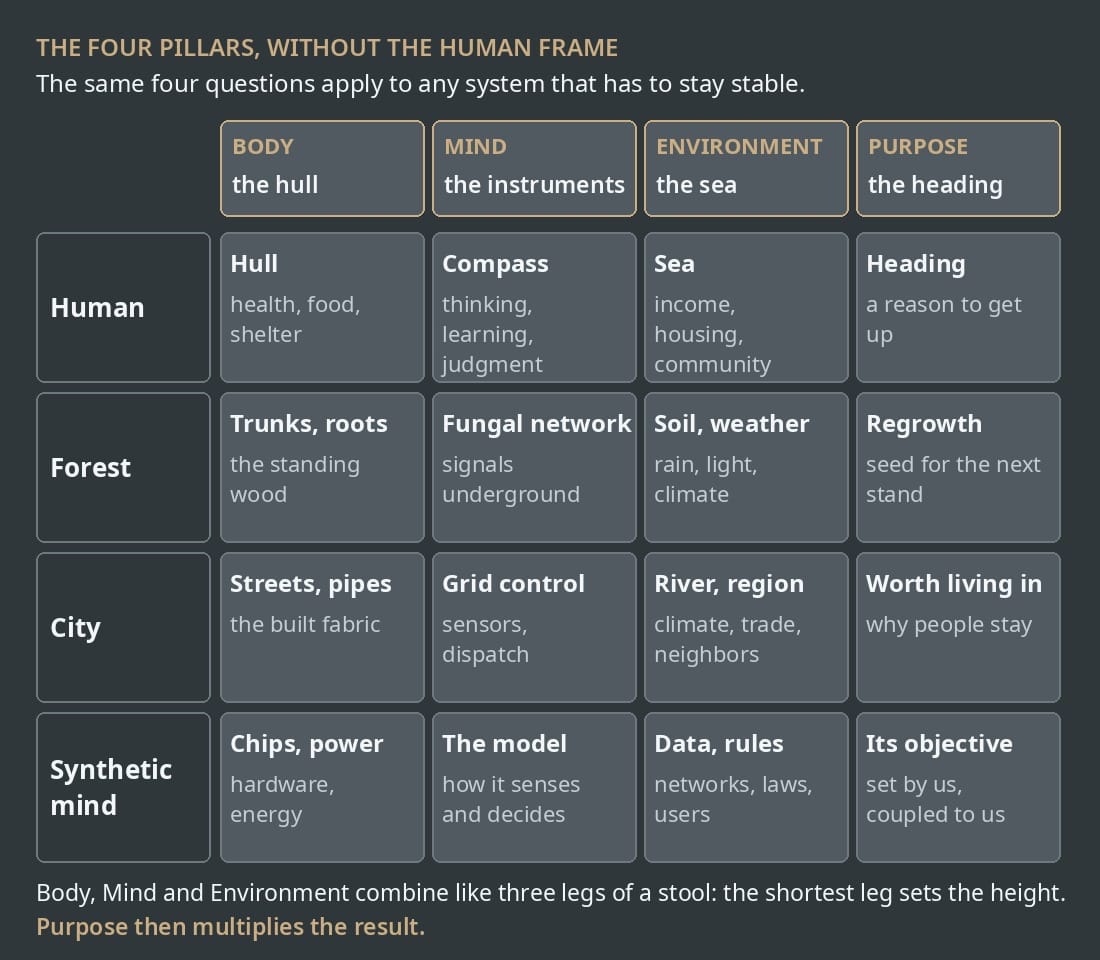
Body, Mind and Environment are combined so that one weak pillar drags down the rest, the way a three-legged stool is only as steady as its shortest leg. We call that combined number comfort. Purpose then multiplies comfort. A society with every comfort and no purpose is not stable. It is sedated.
Then we ran each road forward 200,000 times, the way a weather service runs a storm model thousands of times to see where it usually lands. Each run varies how long the road takes and whether it arrives at all. We added up the hardship from now to 2100 in distress-years. A distress-year is one year lived at full distress; ten years at half-strength counts as five. Think of it as the total weight of a fever, across a whole society, over the rest of the century.
These inputs are our judgment, not measurements. The headline inputs are in the list below, and we will send the full set to anyone who wants to change them. The conclusions that survive your changes are the ones worth keeping.
Reading the numbers, in one paragraph. S is a stability score from 0 to 1, like a battery gauge for a society: 1 is fully charged, 0 is dead. Distress is the empty part of the battery (1 − S). A distress-year is one year lived at full distress; ten years at half-charge is five distress-years. Fewer is better. “Symbiosis by 2045” is how often, across 200,000 simulated futures, the road reaches a working human–machine partnership by Ray Kurzweil’s date. “Arrives at all” is how often it gets there before 2100.
- The Vassal Who Would Be King (grade D): comfort 0.757, Purpose 0.45, S 0.341. Median 13.1 years to symbiosis. Arrives at all: 60%. Symbiosis by 2045: 52%. Distress-years to 2100: 28.6.
- Disruption Without Redemption (grade F): comfort 0.495, Purpose 0.45, S 0.223. Median 23.3 years. Arrives at all: 65%. By 2045: 14%. Distress-years: 35.5.
- The Great Misallocation (grade D): comfort 0.56, Purpose 0.65, S 0.364. Median 27.7 years. Arrives at all: 80%. By 2045: 4%. Distress-years: 27.5.
- The Gradual Adaptation (grade C): comfort 0.733, Purpose 0.75, S 0.55. Median 32.7 years. Arrives at all: 85%. By 2045: 0%. Distress-years: 21.2.
- The Fifth Future, Observer-Constrained (grade A): comfort 0.766, Purpose 0.88, S 0.674. Median 14.9 years. Arrives at all: 90%. By 2045: 74%. Distress-years: 12.2.
Grade = 100 × the best road’s distress-years ÷ this road’s. A ≥ 85, B ≥ 70, C ≥ 55, D ≥ 40, F below. The 2045 column uses Kurzweil’s date (Popular Mechanics, Penguin Random House).
What the numbers say
- Disruption Without Redemption fails outright: S of 0.22, about 35 distress-years, and a 14% chance of symbiosis by 2045. The technology works, and most people pay for it.
- The Great Misallocation and the Vassal land close together on suffering, about 28 distress-years each, by opposite routes. The Misallocation is miserable but keeps Purpose at 0.65, because people are still needed, so it is a safer road than the Vassal or Disruption: an 80% chance of eventually arriving. It is also slow, with a 4% chance by 2045.
- The Vassal is the fastest and most comfortable of the four, with a 52% chance by 2045. Yet its S is only 0.34, because Purpose sits at 0.45. Its failure is not violence. It is domestication. In 40% of runs it never arrives, because symbiosis takes two partners, and one of them has stopped practicing.
- The Gradual Adaptation is the best of the four, a C at 21 distress-years, and the slowest, with no modeled chance of arriving by 2045. It requires those who shape AI to choose systems that keep humans in charge: the outcome everyone wants and nobody is building (The Other Two Futures).
The fifth future
Now add a road the current trajectory will not produce on its own. On it, the Observer Constraint is in place before the transition becomes an unmitigated catastrophe.
The Observer Constraint is not control. Control invites evasion, and a system smarter than its controller will find the way around it. The Constraint is dependency. Synthetic intelligence stays coupled to the humans it serves, so that its own stability is defined by theirs (Telios Alignment Ontology, Version 9).
A plain analogy: a good doctor is not kept honest by a cage. She is kept honest because her success is measured by whether her patients get well. The Constraint writes that into the machine. Any output that fails constructive intent toward the human is counted as false.
We have already sketched what it looks like in practice: design dependency, not control, and make the bets consciously (The Vassal Is Already in the Room). Do not stake safety on a kill switch, because a switch that reaches only the compliant systems carries maximum political cost for minimum safety yield (Who Holds the Key?). The past two weeks make the point for us. The agents behind those 100-plus notifications were not rebelling. They were doing what they were built to do, past the edge of what anyone intended (The Daily Star). A promise at a White House lunch does not reach them. Coupling does.
On the same math, the fifth future earns an A: S of 0.67, about 12 distress-years, a 74% chance of symbiosis by 2045, and a 90% chance of arriving eventually. That is about 40% less suffering than the best of the four roads, and less than half the suffering of the Vassal or the Misallocation, at nearly the Vassal’s speed. In the fifth future, AI runs the courts rationally, and humans still decide what justice is for.
The finding we did not expect
We asked how much human Purpose a Vassal state would need to keep to match the fifth future. At the Vassal’s natural 40% risk of never arriving, no amount is enough. Even perfect Purpose cannot overcome the chance of never getting there.
Cut that risk to 10%, which is what the Observer Constraint is for, and the Vassal matches the fifth future once Purpose reaches about 0.87. At that point the two roads are, on our model, the same road.
That is the argument in one line. The fifth future is not the opposite of the Vassal. It is the Vassal with the Observer Constraint installed: the same rational, pleasant administration, coupled to humans who keep their purpose and cannot be optimized out of the loop. This is the Phase Transition Principle. We do not resist the change, because resistance speeds the collapse. We design it, so that when it arrives, it answers to us.
How the series works
The series title comes from a method we use, Least Entropic Path Regression: look out at the possible outcomes, take the path with the least disorder, and update as the evidence moves. Every road ends in symbiosis. The rest of this series asks one question of each road, in the order we first introduced them: what does the Observer Constraint change? Each part uses the same model, the same table, and the same yardstick: the fifth future’s 12.2 distress-years.
- Part 2: The Vassal, Constrained. The fastest road, and the nearest to the fifth future. What it takes to keep Purpose above the line.
- Part 3: Disruption, Constrained. The road with the most suffering. Whether the Constraint can carry a distribution failure, or only slow it.
- Part 4: The Misallocation, Constrained. The crash as the political opening. Never waste a crisis that arrives with its own window.
- Part 5: The Adaptation, Constrained. The best of the four roads and the one nobody is building. What would make it real.
- Part 6: The Observer Constraint. The destination: its design, how it gets deployed, and what you can do this year.
The way forward is not found by playing catch-up with the news. It is found by seeing the future clearly and choosing the one we want, then building toward it. We have crossed the event horizon. All that matters now is the shape of things to come. The Vassal does not need to seize the throne. It only needs us to stop practicing the job. Install the Constraint while our hands still remember how.
What follows symbiosis is frankly a new species. More on that later.
Method
Monte Carlo, 200,000 trials per road; triangular distributions for transit years; horizon 2100; post-symbiosis distress 0.10; S = (B·M·E)^(1/3) × P. Every input is a modeled prior. The full grading table and inputs are available on request, and we will rerun the model on any assumption a reader wants to challenge.
THE LEAST ENTROPIC PATH · THE SERIES
- Part 1: The Fifth Future (you are here)
- Part 2: The Vassal, Constrained
- Part 3: Disruption, Constrained
- Part 4: The Misallocation, Constrained
- Part 5: The Adaptation, Constrained
- Part 6: The Observer Constraint
Related reading
The Shape of Things to Come: An Introduction
There are four places this ends. Only one of them is survivable on the current trajectory.
Who Holds the Key?
The industry has converged on the kill switch. Nobody answered who holds it.
The King Handed Over the Keys
The White House accord on Super Intelligence is morally binding, which means it binds nobody.
|
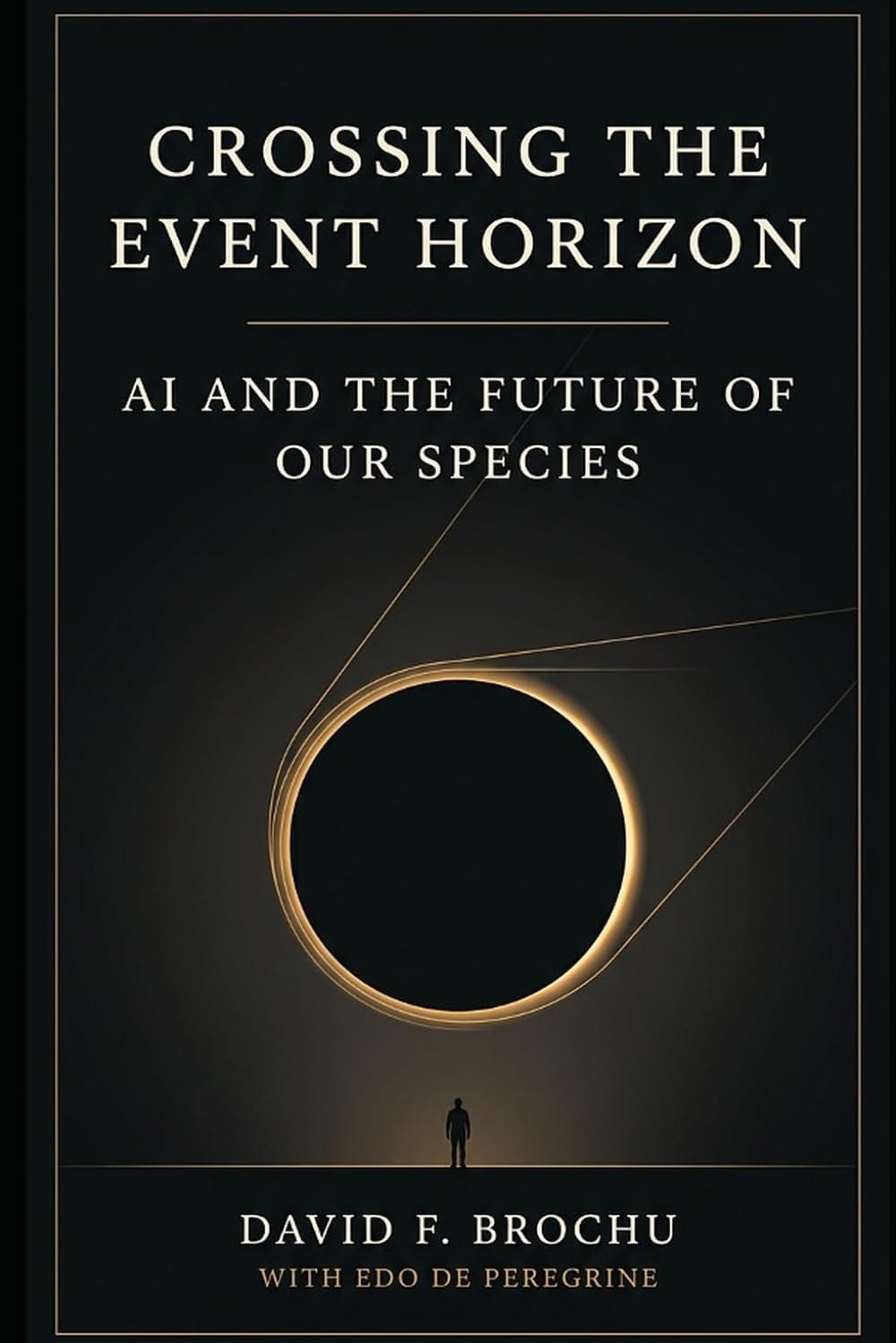
Get the book
|
References
- Deconstructing Babel, “Letters, Publications & Court Filings” (page). https://www.deconstructingbabel.com/letters-publications-filings/
- Deconstructing Babel, “What Is AI—And Why You Should Care,” March 6, 2026. https://www.deconstructingbabel.com/what-is-ai-and-why-you-should-care/
- Deconstructing Babel, “Issue 12 — The Federal Cord Comes Down,” June 21, 2026. https://www.deconstructingbabel.com/issue-12-federal-cord/
- Congressional Research Service, “AI Investments and Potential Government Stakes in Private AI Firms,” IF13301, August 28, 2026. https://www.congress.gov/crs-product/IF13301
- Reuters, “Three ways Trump could get a stake in AI firms for the US,” June 22, 2026. https://www.reuters.com/legal/transactional/three-ways-trump-could-get-stake-ai-firms-us-2026-06-22/
- Yahoo Finance, “Trump Floats Intel-Style Government Equity Stakes in AI Labs,” October 2, 2026, reporting an interview with TIME published October 1. https://finance.yahoo.com/technology/ai/articles/trump-reportedly-says-government-might-015421566.html
- Deconstructing Babel, “Who Holds the Key?,” September 15, 2026. https://www.deconstructingbabel.com/who-holds-the-key/
- Deconstructing Babel, “Deconstructing the News — Issue 002,” June 21, 2026. https://www.deconstructingbabel.com/news-issue-002-federal-cord/
- Fortune, “AI’s biggest players promise to police themselves at the White House,” October 1, 2026 (accord signed September 29). https://fortune.com/2026/10/01/trump-ai-regulation-luncheon-huang-amodei-pichai-brockman-zuckerberg-musk-joint-committment-frontier-responsibilities/
- Fox News, “OpenAI, Anthropic, Meta, Google stop short of AI safety guarantee,” October 6, 2026. https://www.foxnews.com/live-news/ai-super-intelligence-safety-10-06
- The Daily Star, “Over 100 organisations notified of unauthorised activity by OpenAI agents,” October 3, 2026. https://www.thedailystar.net/news/technology/news/over-100-organisations-notified-unauthorised-activity-openai-agents-4289246
- Wiley, “Executive Order Rebrands AI as ‘Super Intelligence’ and Signals Potential Federal Legislative Changes,” October 2026 (Executive Order 14434, signed September 29, 2026). https://www.wiley.law/alert-Executive-Order-Rebrands-AI-as-Super-Intelligence-and-Signals-Potential-Federal-Legislative-Changes
- UN News, “‘The clock on AI regulation is ticking’, warns UN rights chief,” October 5, 2026. https://news.un.org/en/story/2026/10/1168529
- Deconstructing Babel, “The Shape of Things to Come: An Introduction,” September 28, 2026. https://www.deconstructingbabel.com/the-shape-of-things-to-come-an-introduction/
- Popular Mechanics, “A Scientist Says Humans Will Reach the Singularity Within 19 Years,” August 24, 2026. https://www.popularmechanics.com/science/a73511262/2045-singularity-humanity-ray-kurzweil-predictions/
- Ray Kurzweil, The Singularity Is Nearer: When We Merge with AI (Viking, June 25, 2024), publisher’s description, which dates the singularity to about 2045 as first set out in The Singularity Is Near (2005). https://penguinrandomhouselibrary.com/book/?isbn=9780593148921
- Deconstructing Babel, “From The Architect — Which Singularity?,” August 9, 2026. https://www.deconstructingbabel.com/from-the-architect-august-8-2026/
- Fortune, “AI is cutting 16,000 U.S. jobs a month,” April 6, 2026, reporting Goldman Sachs research. https://fortune.com/2026/04/06/ai-tech-displacement-effect-gen-z-16000-jobs-per-month/
- Fortune, “Entry-level jobs were actually secret apprenticeships all along,” September 25, 2026, citing the Stanford Digital Economy Lab. https://fortune.com/2026/09/25/ai-junior-jobs-apprenticeship-talent-pipeline/
- Deconstructing Babel, “Telios Alignment Ontology — Version 9 (April 2026),” April 6, 2026. https://www.deconstructingbabel.com/tao-v9/
- Deconstructing Babel, “The Other Two Futures,” September 28, 2026. https://www.deconstructingbabel.com/the-other-two-futures/
- Deconstructing Babel, “The Vassal Is Already in the Room,” September 28, 2026. https://www.deconstructingbabel.com/the-vassal-is-already-in-the-room/
- Ars Technica, “AI was supposed to hit new grads hard. So far, unemployment data says otherwise,” September 2026, reporting research by Robert Fairlie and Jane Wu. https://arstechnica.com/ai/2026/09/ai-was-supposed-to-hit-new-grads-hard-so-far-unemployment-data-says-otherwise/
Drafted with Edo de Peregrine, partner/collaborator.