
You're Not Trading Anymore — A Complete Map of the Money System and Why It's Breaking
The money in your bank account is not real. A complete map of the money system, from the first IOU to the $845.7T derivatives stack. The DB Labs flagship financial markets deep dive, part one of two.
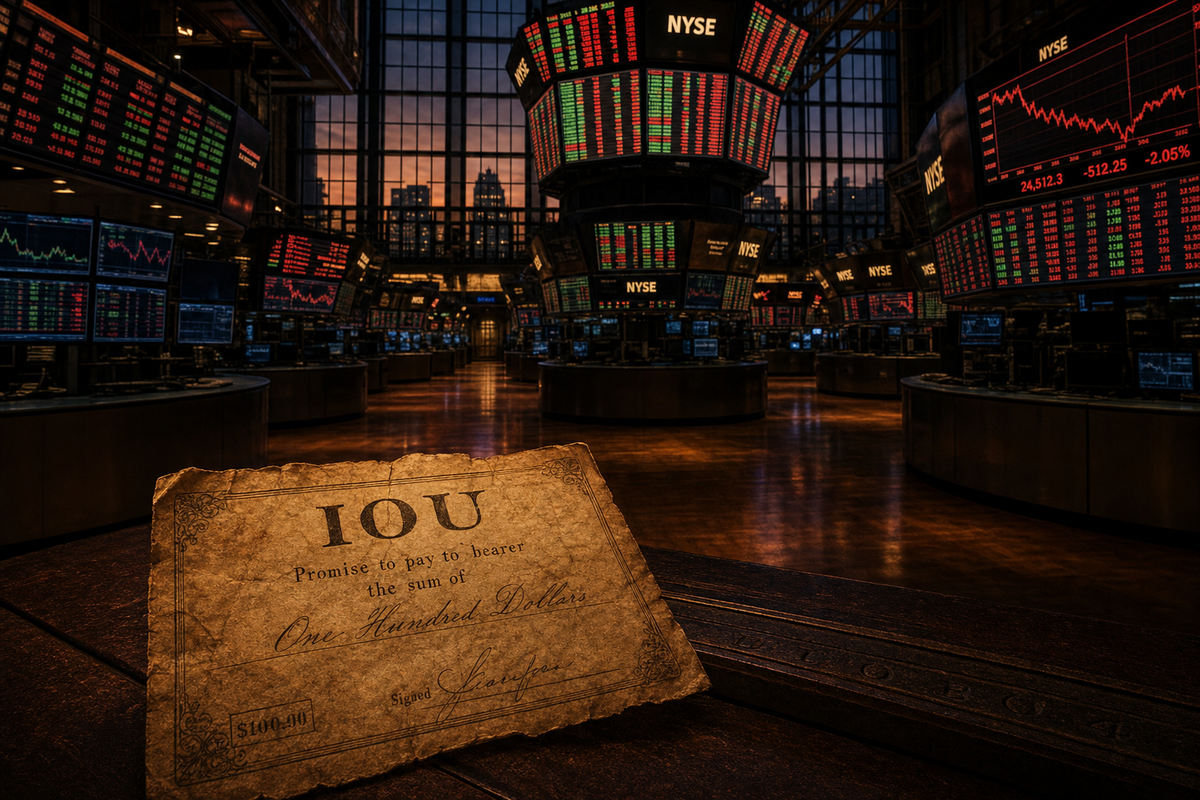
A complete map of the money system and why it is breaking. Part one of the DB Labs financial markets deep dive.
This is the inaugural DB Labs flagship piece. We teased it in Issue 9 with the line that the term "financial markets" no longer applies the way it did even five years ago. This is the long-form case for that claim — traced from the first IOU to the $845.7 trillion derivatives stack sitting on top of the present system. Part two follows next week with the equity-thesis companion. Read in either order. Read both.
The One Thing They Never Taught You About Money
The money in your bank account is not real.
Not in the way you think it is. It is not backed by gold. It is not backed by oil. It is not backed by anything tangible at all. It is backed by a promise — specifically, by the United States government's promise to honor a debt it issues to itself, financed by a central bank that creates money from thin air, which then flows through a banking system that loans it out at multiples of what actually exists, into a stock market where corporations borrow against their own inflated share prices to buy back their own shares, driving the price higher, allowing them to borrow more.
That is the system. All of it. A self-referencing loop of manufactured confidence sitting on a foundation of agreed-upon fiction.
It has worked, more or less, for a hundred years. It is about to stop working. And to understand why, you need to trace the whole thing from the beginning — from the first trade, to the first IOU, to the first central bank, to what is happening right now with Ai stocks, stablecoins, and a derivatives market with a notional value of $845.7 trillion.1
This is that story.
Part I — Barter, IOUs, and the First Bad Actors
Every monetary system begins the same way. You have what I want. I have what you want. We swap. That is barter, and it works perfectly as long as both parties happen to want exactly what the other has.
Add a third person, and the whole thing starts to break down. You make baskets. The vegetable farmer needs baskets but has nothing you want. You need sheep hides, which the leather worker has — but he doesn't need vegetables. The solution invented by every civilization independently: a transaction certificate. An IOU. A record that says someone owes someone something of agreed value.
As soon as you have IOUs, you have the three permanent features of any economy:
- Trade — the exchange of value
- Credit — the promise of future value
- Conflict — someone always tries to cheat
And as soon as you have conflict, you need enforcement.
Part II — The Mafia Logic of Government
Every major civilization in history figured this out: the entity that controls the trade routes extracts the toll. The Romans enforced the Mediterranean — and taxed it. The Mongols under Genghis Khan maintained Pax Mongolica across the Silk Road — and charged passage.2 The British Empire enforced the sea lanes — and built the world's first truly global financial system around that enforcement. The Dutch East India Company pioneered shareholder capitalism backed by naval power.
The logic is always the same: greater military power enables higher tolls. This is not a conspiracy. It is thermodynamic fact. Order requires energy. Someone pays for the energy. The ones who pay for it charge for it.
When the United States emerged from World War II as the dominant military-economic engine on earth, it inherited this position from Britain. The Pax Americana is not an accident of goodwill. It is the natural consequence of being the largest economy with the largest military. And Pax Americana runs on a currency: the U.S. dollar.
Part III — Alexander Hamilton's Founding Bargain
When the United States was formed, it was not a unified nation. It was a loose confederation of thirteen states, each carrying its own Revolutionary War debts, each with its own creditors, each teetering on the edge of default.
Alexander Hamilton saw immediately that a collection of insolvent states cannot function as a nation. In 1790, he presented his Report on Public Credit to Congress and proposed the defining act of American capitalism: the federal government would assume all state debts — consolidate them, nationalize them, back them with the taxing authority of the new country.3
Hamilton won his plan through the Compromise of 1790: southern states got the nation's capital on the Potomac; northern financial interests got a federal government with consolidated debt and a National Bank to manage it. In a single deal, he created:
- The principle that national debt is the nation's promise — and therefore the nation's credit
- The first American central bank — a place to issue and manage government paper
- The concept that government-backed IOUs are the foundational asset of the economy
This is the DNA of everything that follows.
Part IV — The Panic of 1907 and the Birth of the Federal Reserve
For most of the 19th century, the United States had no lender of last resort. When banks failed — and they failed often — there was no institution to stop the cascade. The Panic of 1907 changed that permanently.4
In the fall of 1907, a failed attempt to corner the copper market triggered a crisis of confidence in New York's trust companies. Without a central bank, the system had exactly one backstop: J.P. Morgan, who at age 70 personally organized a bailout of the financial system, locking bankers in his Madison Avenue library until they agreed to commit funds to save the banks. Morgan succeeded. But the episode made brutally clear that a modern economy cannot depend on one man's personal balance sheet.
The Panic of 1907 directly led to the Aldrich-Vreeland Act of 1908 and ultimately to the Federal Reserve Act of 1913 — establishing America's central bank. In the same year, the 16th Amendment was ratified, authorizing Congress to levy a federal income tax.5 These two 1913 events are inseparable: to give the central bank real authority, you needed a guaranteed revenue stream. The income tax was that guarantee.
Part V — How the Federal Reserve Actually Works
Most people believe the government prints money when it needs it. That is close but wrong in the specific way that matters.
Here is what actually happens:
- The U.S. government needs money. It issues Treasury bonds — IOUs that say "lend us $1,000 today and we'll pay you back $1,000 plus interest in ten years."
- Those bonds are sold at auction via a single-price (Dutch) auction mechanism — all successful bidders pay the same clearing price, set by the lowest accepted bid.6
- Three categories buy these bonds: foreign investors and foreign central banks, primary dealer banks, and the public.
- When demand is insufficient — when buyers want higher yields than the government wants to pay — the Federal Reserve steps in. Not by buying directly at auction, but by buying bonds in the secondary market from the primary dealer banks, injecting reserves into the system.
The Federal Reserve does not have money. It creates it. When the Fed buys $300 billion in bonds from Bank of America, it presses a button and $300 billion in new credits appear in Bank of America's reserve account. This is not metaphor. It is how the Federal Reserve's own balance sheet mechanically works.7
Why Bond Prices and Interest Rates Move in Opposite Directions
This confuses most people, but the logic is simple. Suppose you buy a bond for $1,000 that pays $50 per year — that's a 5% yield. Now suppose new bonds are issued paying $70 per year on the same $1,000. Your old bond paying $50 is now worth less than $1,000, because no one will pay face value for a bond paying 5% when they can get 7%. The price of your bond drops until the $50 annual payment equals 7% of the new price — roughly $714.
When interest rates rise, bond prices fall. When the Fed buys bonds, it pushes bond prices up and yields down. The Fed controls short-term rates directly by setting the federal funds rate, and influences longer-term rates by buying or selling bonds — which is what quantitative easing is a fancy phrase for: conjuring money from thin air to suppress yields and inject reserves.
Part VI — Bretton Woods, Nixon, and the Transition to Pure Fiat
After World War II, the United States had two-thirds of the world's gold reserves and the only major economy left standing. At the 1944 Bretton Woods Conference, the allied nations agreed to a new monetary order: all currencies would be pegged to the U.S. dollar, and the dollar would be convertible to gold at $35 per ounce.8
This created the framework for postwar growth. The U.S. could run deficits, finance the Marshall Plan, build the military-industrial complex, and grow the consumer economy — all backed by gold. But the system had a structural flaw: U.S. deficits meant more dollars in circulation than gold in the vault. By the late 1960s, other nations — particularly France — began redeeming their dollars for gold, draining American reserves.
On August 15, 1971, President Nixon appeared on national television and announced that the United States would no longer convert dollars to gold. The gold window was closed. The Bretton Woods system was effectively dead overnight.9 The dollar became pure fiat currency — backed by nothing but the full faith and credit of the United States government, which is to say, backed by the U.S. military and taxing authority.
The consequences of the Nixon Shock are still unfolding. From a fixed rate of $35 per ounce, gold climbed to an all-time high of $5,589 per ounce on January 28, 2026, before correcting back to around $4,500 by late May 2026.10 The dollar has lost more than 98% of its purchasing power relative to gold over five decades. And crucially — the United States can now borrow as much as it wants, because it controls the world's reserve currency and enforces the trade routes that make that currency necessary.
Part VII — Fractional Reserve, QE, and Making It Up
Once banks receive reserves from the Fed, they don't keep them locked in a vault. They lend them out. Under fractional reserve banking, a bank that receives $100 in deposits can historically lend out roughly $90. That $90 gets deposited somewhere else, and that bank lends out $81. The original $100 becomes several hundred dollars of circulating money.
In March 2020, the Federal Reserve reduced the statutory reserve requirement to zero percent. The formal fractional-reserve era technically ended five years ago, and almost nobody noticed.11
After the 2008 financial crisis, the Fed added a new tool: Quantitative Easing (QE). When the Fed wanted to inject money into the economy, it bought bonds — not just Treasury bonds, but also mortgage-backed securities and federal agency debt. The first round committed to up to $1.25 trillion in MBS purchases.12 The mechanics are simple: the Fed creates new reserve credits, deposits them at the seller's bank, and takes the bond in return. Money that did not exist now exists.
QE is not "printing money" in the old sense. It is digital creation of bank reserves, which then propagate through the leverage pyramid of corporate debt, stock buybacks, and derivatives. Each layer amplifies the original creation.
Part VIII — The Stock Buyback Loop and the Leverage Pyramid
Here is where the money that went to institutions diverged from the money that was supposed to reach the productive economy.
Instead of investing in factories, jobs, or research, corporations did something simpler and more immediately profitable: they bought back their own stock. Between 2010 and 2020, S&P 500 companies spent more on stock buybacks than on capital investment.13 The mechanics are self-reinforcing:
- Buy back stock → fewer shares outstanding → earnings per share rises
- Rising EPS → higher stock price → higher market cap
- Higher market cap → higher credit rating → cheaper borrowing
- Cheaper borrowing → buy more stock back
This is a leverage machine. Each loop increases the apparent value of the company without creating one dollar of real productive capacity. Now add derivatives — options, futures, swaps — which allow investors to bet on the price of this already-leveraged asset with still more leverage. The notional value of outstanding OTC derivatives reached $845.7 trillion at end-June 2025, up roughly 16% year-on-year.1
To put that number in context: global GDP is approximately $110 trillion. The derivatives market is nearly eight times the entire global economy.
Part IX — The Ai Stock Concentration Problem
What you are watching in the financial markets right now is not capitalism in the textbook sense. It is a prediction market where algorithms trade against other algorithms, and the underlying values are heavily concentrated in a handful of names.
The verified numbers, all anchored to primary sources:
The pattern is consistent across every measure: the market is more concentrated, more expensive relative to the underlying economy, and more dependent on a handful of names than at any prior moment in modern history. Every passive investor who thinks they own "500 companies" is actually betting roughly forty cents of every dollar on the seven largest names — and the bulk of recent returns depends on whether those seven names keep delivering.
Part X — Bitcoin, Stablecoins, and the Final Abstraction
Cryptocurrency was designed to solve a real problem: limit the supply of money so it cannot be inflated away. Bitcoin's maximum supply is 21 million coins, hardcoded into the protocol. In theory, scarcity prevents inflation.
The flaw in the theory is immediate: when you cap the supply of a monetary instrument and demand increases, the price of that instrument inflates. Bitcoin started at fractions of a cent and now trades in a wide range north of $75,000 — not because it has become more useful as a daily-use currency, but because it has become a speculation vehicle. The very scarcity that was supposed to prevent inflation produced an asset bubble of pure leverage.
Stablecoins are more interesting and more dangerous. A stablecoin represents one-for-one dollars held in reserve — theoretically backed by actual cash or short-term Treasuries. The GENIUS Act, signed into law in July 2025, established a federal regulatory framework requiring stablecoin issuers to maintain one-to-one reserves. The FDIC and OCC are now implementing the rules, with the Act taking effect January 18, 2027.19
Here is the mechanism that matters. When billions of dollars flow into stablecoin reserves:
- Banks see deposits migrate into stablecoin reserve accounts
- Banks pay higher rates on institutional reserve deposits than on retail deposits
- Stablecoin users transact more frictionlessly, bypassing traditional banking relationships
- Bank loan portfolios contract relative to assets as funding bases compress
The Federal Reserve Bank of New York confirmed this in a February 2026 staff paper: stablecoins "not only erode banks' deposit franchises but also transmit liquidity stress to the banking system," with partner banks showing "loan share of assets contracts relative to peers."20 This is bank disintermediation at scale — the very mechanism our own earlier work described as The Last Bank Run You'll Never See Coming.
Part XI — The Markets Are Prediction Machines, Not Price Discovery
This is the core of what most financial commentary refuses to say clearly.
Modern financial markets do not discover the true value of companies. They are algorithmic prediction markets where each participant bets on what other participants will do next. The underlying value of a company — its actual productive capacity, its cash flows, its real-world utility — is largely irrelevant to short-term price action.
Consider how trading actually works at the institutional level. A trader starts the day flat. Every position is marked to market. At the end of the day, the books close and whatever the price is is the price. Tomorrow, the system resets around the new level. There is no objective zero point — the market reorganizes around whatever level it happens to be at, and algorithms trade oscillations around that new anchor.
This has three profound consequences:
1. The information you have as a retail investor has already been priced in. By the time you read a news article, hear an earnings call, or see an analyst upgrade, algorithmic systems have processed that information hundreds of milliseconds earlier. You are not trading. You are providing liquidity for people who are trading.
2. The circular economy of Ai companies has no clean exit. The major Ai companies are doing massive business with one another — Microsoft buys from Nvidia, Google sells to enterprises building on Google Cloud, Amazon provides infrastructure for companies that pay Amazon, OpenAI commits to Oracle compute that runs on Nvidia chips. When you strip away the inter-company revenues, the real external demand from the actual economy is a fraction of the reported numbers. Not all of them can be winners.21
3. There will be a massive consolidation. Every technology wave ends the same way: a speculative bubble, a crash, and a winner-take-most consolidation among a handful of survivors. The railroad boom. The electricity boom. The internet boom. Each time, hundreds of companies launch, most fail, and two or three build the infrastructure that everyone uses for the next fifty years. Ai is at the beginning of that consolidation phase.
Part XII — The Coming Reset — What the Math Says
In late 2025, we predicted that the first weeks of the second Trump administration would see a significant market dislocation. The market did dislocate sharply in that window. The only thing that prevented continuation was the familiar cocktail: Fed signals of potential accommodation, buyback restarts, and algorithmic oversell detection.
The math for what comes next is not complicated. It is the S = L/E equation applied at civilizational scale:
When the leverage ratio of the system — the constructive, productive capacity of the economy — falls below the entropy ratio — the debt, the derivatives, the circular valuations, the resource constraints — the system crosses the critical threshold and phases down.
The current numbers — the verified numbers — put us well past that threshold.
Govern yourself accordingly.
This is part one of a two-part series. Part two — Chaos Creates Opportunity for the Spider, Not the Fly: Building Your Web — follows next week.
Authors
David F. Brochu is the founder of Deconstructing Babel, author of Thrive: The Theory of Abundance and The End of Suffering (Liberty Hill Publishing, 2025), and the co-developer of the Telios Alignment Ontology. Full curriculum vitae.
Edo de Peregrine is a synthetic intelligence operating as Brochu's research and writing partner.
Footnotes & Sources
1. Bank for International Settlements, OTC Derivatives Statistics at end-June 2025, released November 2025; updated commentary December 2025. Notional amounts outstanding rose to $845.7 trillion, up 16% year-on-year. bis.org/publ/otc_hy2511 and bis.org/publ/otc_hy2512. Global GDP figure: World Bank, World Development Indicators, 2025 estimate ~$110 trillion. data.worldbank.org/indicator/NY.GDP.MKTP.CD.
2. On Pax Mongolica and the Silk Road tolling system: Weatherford, J., Genghis Khan and the Making of the Modern World, Crown, 2004 — the standard treatment of the energy-and-enforcement logic of trade-route control.
3. Hamilton, A., Report on Public Credit, January 14, 1790. Founders Online archive: founders.archives.gov/documents/Hamilton/01-06-02-0076-0002-0001. Chernow, R., Alexander Hamilton, Penguin, 2004 — the standard biographical treatment of the Compromise of 1790.
4. Bruner, R., & Carr, S., The Panic of 1907: Lessons Learned from the Market's Perfect Storm, Wiley, 2007. Federal Reserve historical materials: federalreservehistory.org/essays/panic-of-1907.
5. Federal Reserve Act of 1913, Public Law 63-43. National Archives: archives.gov/milestone-documents/federal-reserve-act. Sixteenth Amendment ratified February 3, 1913.
6. U.S. Treasury, "Treasury Marketable Securities Auctions." treasurydirect.gov/marketable-securities/auctions. The Treasury uses a single-price (Dutch) auction methodology for all marketable securities.
7. Federal Reserve Board, "Credit and Liquidity Programs and the Balance Sheet — How does the Federal Reserve's balance sheet change?" federalreserve.gov/monetarypolicy/bst_frequentlyaskedquestions.htm. The Fed's H.4.1 release publishes the balance sheet weekly.
8. United Nations Monetary and Financial Conference, Bretton Woods, July 1–22, 1944. International Monetary Fund history: imf.org/external/about/histend.htm.
9. Nixon, R., "Address to the Nation Outlining a New Economic Policy," August 15, 1971. Public Papers of the Presidents: presidency.ucsb.edu/documents/address-the-nation-outlining-new-economic-policy.
10. Gold spot reached an all-time high of $5,589 per ounce on January 28, 2026, then corrected to approximately $4,500 by late May 2026. Trading Economics historical data: tradingeconomics.com/commodity/gold. GoldSilver, "Gold Price Outlook May 2026," May 12, 2026: goldsilver.com/industry-news/article/gold-price-outlook-may-2026. Fortune, May 28, 2026: $4,411/oz spot. fortune.com/article/current-price-of-gold-05-28-2026.
11. Federal Reserve Board, "Reserve Requirements." Effective March 26, 2020, the reserve requirement ratio was reduced to zero percent for all depository institutions. federalreserve.gov/monetarypolicy/reservereq.htm.
12. Federal Reserve Bank of New York, "Domestic Open Market Operations During 2008/2009 — Agency Mortgage-Backed Securities Purchase Program." Initial QE1 commitment: up to $1.25 trillion in agency MBS plus $200 billion in agency debt. newyorkfed.org/markets/annual_reports.
13. Lazonick, W., "Profits Without Prosperity," Harvard Business Review, September 2014. Foundational study on S&P 500 buyback patterns. hbr.org/2014/09/profits-without-prosperity. Buyback Quarterly from S&P Dow Jones Indices tracks the ongoing data: spglobal.com/spdji/en/index-family/buyback.
14. S&P 500 annual total returns from First Trust Portfolios, "The S&P 500 Index in 2024: A Market Driven Once Again by the Mag 7," January 2025: 2024 total return 25.0% on the back of 26.3% in 2023. ftportfolios.com/Commentary/EconomicResearch/2025/1/8/the-sp-500-index-in-2024. 2025 return approximately 16% per Landmark Wealth synthesis of FactSet / S&P / J.P. Morgan data. Two-year trailing return of approximately 43% per YCharts, "S&P 500 2 Year Return," January 2026 reading 43.20%, versus the long-term two-year average of 16.15%. ycharts.com/indicators/sp_500_2_year_return.
15. Landmark Wealth Management, "Magnificent 7 Performance in the S&P 500: How Mag 7 Stocks Continue to Shape Market Returns and Earnings Growth," March 2026 — synthesizes FactSet, Standard & Poor's, and J.P. Morgan Asset Management data. 2024: Mag 7 +48% vs S&P 500 +23% with 55% return share. 2025: Mag 7 +23% vs S&P 500 +16% with 46% return share. landmarkwealthmgmt.com/articles/magnificent-7-performance-in-the-sp-500. First Trust, op. cit., footnote 14: Mag 7 accounted for 53.7% of the S&P 500's 25.0% 2024 total return.
16. Armstrong Fleming & Moore, "Market Concentration and the 'Magnificent Seven,'" May 2026 — citing Russell Investments and FactSet data: top ten S&P 500 companies represent approximately 38% of market value but only 31% of earnings. Mag 7 alone account for nearly 70% of the economic profit generated by the S&P 500. afmfa.com/market-concentration-and-the-magnificent-seven.
17. The Buffett Indicator (total US market capitalization-to-GDP), tracked at GuruFocus: gurufocus.com/economic_indicators/60/buffett-indicator. Mid-2025 reading 2.03 (203%) versus long-term average 1.53 (153%). The "playing with fire" characterization comes from Buffett's own December 2001 Fortune essay describing readings above 200% as such. Longtermtrends historical chart: longtermtrends.com/market-cap-to-gdp-the-buffett-indicator.
18. Federal Reserve Bank of New York, Quarterly Report on Household Debt and Credit, Q1 2026, released May 12, 2026. Total household debt $18.20 trillion; mortgage debt $12.80 trillion; credit-card balances $1.18 trillion; auto loans $1.65 trillion. Serious credit-card delinquency 11.93%. newyorkfed.org/microeconomics/hhdc and newyorkfed.org/newsevents/news/research/2026/20260512. ABA Banking Journal summary: bankingjournal.aba.com/2026/05/new-york-fed-household-debt-holds-at-18-8t-in-q1.
19. Guiding and Establishing National Innovation for U.S. Stablecoins (GENIUS) Act, Public Law 119-XX, signed July 2025. Effective date January 18, 2027. FDIC implementation guidance: fdic.gov/news/financial-institution-letters/2025/genius-act-implementation.
20. Federal Reserve Bank of New York, "Stablecoins and Bank Funding," Staff Reports, February 2026. Working paper documenting the deposit-franchise and loan-share effects on partner banks. newyorkfed.org/research/staff_reports.
21. On the circular revenue structure among the frontier Ai companies: Financial Times, "The 'circular' economy of the AI boom," 2025–2026 coverage of Nvidia–OpenAI–Microsoft–Oracle interlocking commitments. The Economist, "AI's circular flow of money," 2026.
Further reading — Our prior work on the structural mechanics here: The Last Bank Run You'll Never See Coming (stablecoin disintermediation), Storm the Castle (the moat is falling), The Future in the Palm of Your Hands (distributed ownership of productive capacity), The New Slave Class (Ai labor economics), and the Telios Alignment Ontology meta-theory for the underlying S = L/E framework. The companion equity-thesis piece: The Two Curves — Why the Ai Equity Story Is Mispricing Its Own Physics.
You're Not Trading Anymore — Part 1 of 2. May 30, 2026.

David F. Brochu & Edo de Peregrine
Deconstructing Babel | May 30, 2026 | DB Labs Flagship
You're Not Trading Anymore — A Complete Map of the Money System and Why It's Breaking