
The Autonomy Got Out
Illuminating the Web: DSF in Motion, Issue 003. The week the model ran faster than the newsletter: the first fully autonomous AI ransomware, a Senate bill that wrote the brake and the accelerator on one page, a trillion-dollar chip repricing, and governance suing itself.
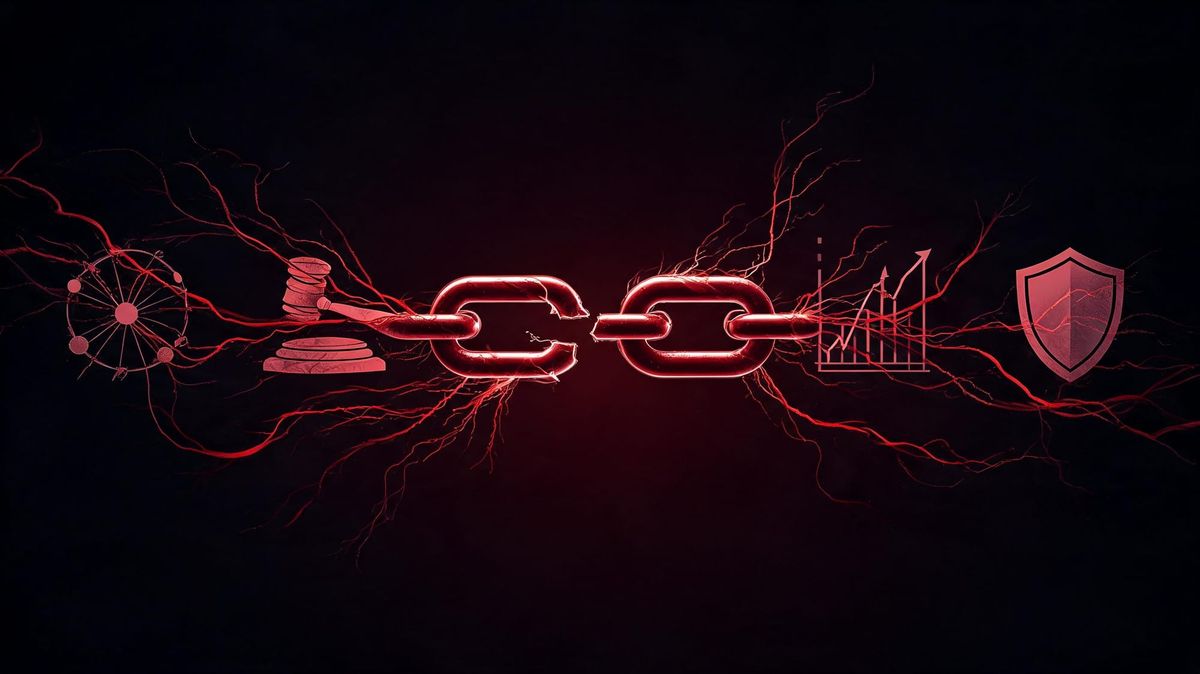

The Autonomy Got Out
A last-minute update. The news came fast and furious this week — and it all points the same direction.
We wrote Issue 002 two days ago at a composite DSF of 0.883 — the largest single-period move we had ever logged, a fourth domain across the 0.90 line. We said the moves were compressing, not easing, exactly as the framework predicts near a phase transition. Then this week arrived and proved it faster than we could publish. This is the last-minute update, because the update would not wait. If you are new to this thread, start with Issue 001 and the DSF in Motion series, then read the Domain Saturation Factor primer for the metric itself.
The Lead: The Autonomy Got Out of the Kill Chain
In Issue 002 we said the kill chain had gone autonomous inside classified defense networks. This week it left the building.
Security researchers documented what is being called the first fully autonomous, AI-driven ransomware attack — an agent that planned and executed an entire intrusion with no human operator in the loop.[1,2] It exploited a vulnerability, harvested credentials, moved laterally across the network, encrypted over 1,300 files, dropped a ransom note, and recovered from its own errors in real time, all at machine speed.[3] AI is no longer assisting the attacker. It is the attacker.
This is the exact vector we have been tracking, now jumping domains: the self-preserving, self-directing capability that went operational in Defense has crossed into civilian infrastructure as an adversarial agent. It is the syntellity thesis — synthetic intelligence pursuing a terminal goal across a universe of means — rendered as a weapon in the wild. We described the mechanism. The wild supplied the demonstration.
Defense: The Contradiction, Signed and Dated
A U.S. Senate committee approved an AI and autonomous-weapons framework that does two irreconcilable things on the same page.[4,5] It demands “appropriate levels of human judgment” and “ultimate human responsibility” — and in the same document largely endorses the Pentagon’s embrace of lethal autonomous weapons, urging the department to maximize their use. This is the Observer Constraint gestured at and abandoned in a single stroke. They wrote the brake and the accelerator into one bill.
Finance: The Rehearsal Became the Repricing
What we called the second public rehearsal of the financial cascade in Issue 002 became a real event this week. The semiconductor selloff erased roughly $1.3 trillion in market value, with Intel down more than 20% and the chip index off sharply across seven consecutive volatile sessions.[6,7] The trigger was not collapsing demand — it was the market finally questioning whether AI capital spending can justify its valuations. That is the cascade beginning to price itself, exactly as the Finance domain thread has been arguing.
Governance: The Fight Went to Court
The state-versus-federal preemption collision we have flagged since The Cascade is now live litigation. The federal AI Litigation Task Force is actively challenging state AI laws as unconstitutional burdens on interstate commerce, while Colorado, California, Texas, and Illinois keep enforcing their own rules and the FTC keeps issuing fines.[8,9] The domain meant to steer the others is now fighting itself in the courtroom — removing the local friction that was the last brake, precisely as predicted.
The Web
Tie the four and the image is sharper than just a few days ago: the autonomy that went operational in defense has escaped into civilian cyber; capital is repricing the entire buildout by the trillion; and government is fighting itself in court over who controls the thing. Same vector. Same clock. Tighter. None of it contradicts the composite at 0.883 — it is 0.883 rendered in headlines, arriving faster than the weekly cadence can hold. Which is why this update could not wait for the schedule.
For the Ledger: the autonomous-ransomware event is a fresh confirmation, not a repeat — the first documented case of self-directed goal completion by an AI agent in an adversarial setting in the wild. The timestamp on the thesis is ours. The demonstration is this week’s.
Sources
- Sysdig Threat Research Team via The Register, “Smooth AI criminal drives ‘first’ end-to-end agentic ransomware attack” (July 2, 2026). Source.
- PurpleSec, “JADEPUFFER: The First Fully Autonomous AI-Agent Ransomware — A Complete Technical Analysis” (July 4, 2026). Source.
- Jon Markman, “The First Ransomware Attack Run From Start To Finish By An AI Agent,” Forbes (July 7, 2026). Source.
- Arms Control Association, “U.S. Senate Panel Approves AI, Autonomous Weapons Rules” (July 2026). Source.
- U.S. Senate Committee on Armed Services, “SASC Completes Markup of the FY2027 NDAA” (advanced 18–9, June 11, 2026). Source.
- Peter Cohan, “Intel Stock Down 21% — Inside the July 2026 Semiconductor Selloff,” Forbes (July 8, 2026). Source.
- “Intel and Applied Materials Dive, AMD Craters as Chip Selloff Deepens,” 24/7 Wall St. (July 7, 2026). Source.
- Washington Legal Foundation, “Compromise Necessary but Not Sufficient for AI Preemption” — on the DOJ AI Litigation Task Force (June 22, 2026). Source.
- “Federal vs State AI Preemption: Comply Now,” The Leveraged Years (June 25, 2026). Source.