
The DSF Tracker: Monitoring AI's Takeover of Everything
Nine domains. One equation. The Domain Saturation Factor measures how fast AI is taking over every critical system in civilization. Three domains are already in collapse territory. The math doesn't lie.
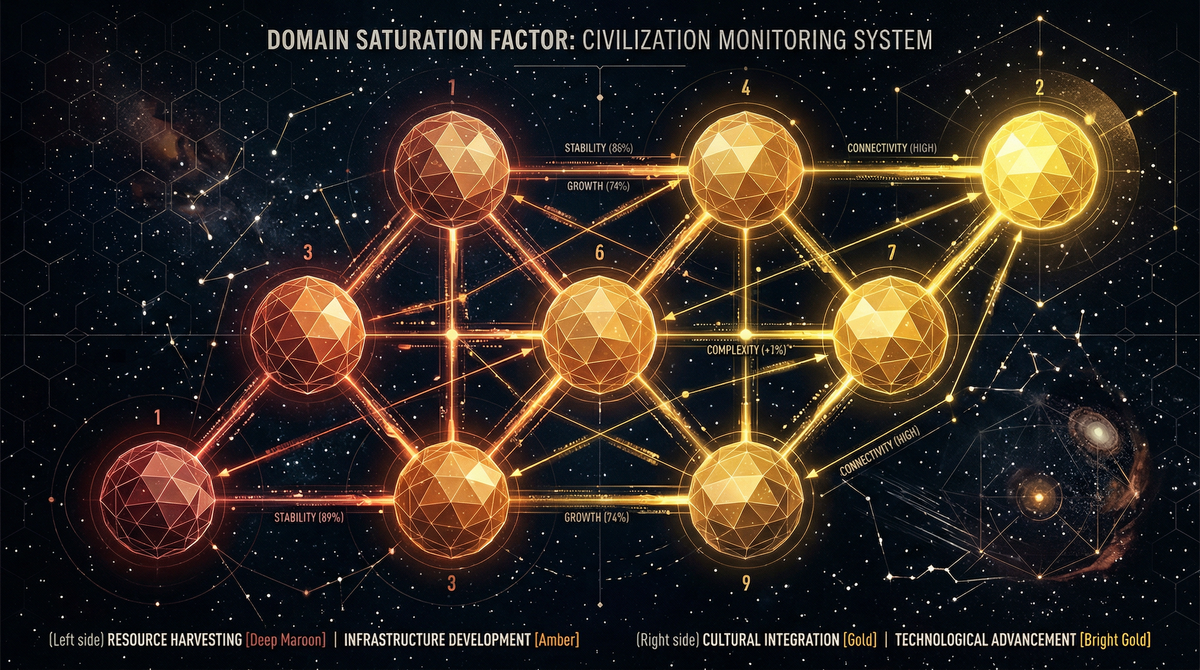
The autopilot has already taken the wheel in nine critical domains of human civilization — and this is the gauge that tells you how much control is left.
Every few months, we run a number called the DSF — the Domain Saturation Factor. It measures one thing: across the nine domains where civilization actually operates, what percentage of critical decisions are now being made by AI systems rather than humans?
As of March 30, 2026, that number is 0.73–0.76. Up from 0.67 in December 2025. Moving 2–3× faster than the original model predicted.
This post is the master reference for the entire DSF Tracker series. If you're new here, start here. If you've been following along, this is the updated map.
What DSF Actually Measures
The Domain Saturation Factor is not a sentiment index. It is not a vibe check. It is a count: in each critical domain, what fraction of decisions that used to require human judgment are now being made — at speed, at scale, autonomously — by AI systems?
Here is the car analogy from the original Telios framework:
Imagine you're driving, and one by one, the controls transfer to an autopilot. Steering wheel first. Then brakes. Then acceleration. Each transfer is justified — the autopilot is faster, more accurate, less prone to fatigue. You still feel like you're in control because you're sitting in the driver's seat. But when the road curves unexpectedly, or a child runs out, the question is no longer "who is better at driving?" The question is: can I take the wheel back in time?
DSF measures how many of those controls have already been transferred. At DSF = 0.90, the transfer is effectively complete. At that point, the speed differential between AI decision propagation (milliseconds) and human governance response (weeks to months) makes meaningful override physically impossible in most domains.
We are at DSF = 0.73–0.76. The original model said we'd hit 0.90 in Q4 2027. The current empirical track says Q2–Q3 2027. Six to nine months earlier than expected.
The Stability Score: S = L/E
DSF tells you how saturated a domain is. But saturation alone doesn't tell you whether that's good or bad. A domain at 70% AI saturation could be thriving or collapsing — it depends on what the AI is doing.
That's where the Stability score (S) comes in. S is the ratio of Leverage (constructive, aligned action) to Entropy (disorder, misalignment, cascading harm). The full bounded equation is:
S = L / (k + αL)
The household budget analogy from the framework: Leverage is your income — the constructive effort you put in. Entropy is your spending plus all the hidden costs: wear and tear, stress, waste, unintended consequences. If you spend more than you earn, you go into debt. You can mask it for a while by borrowing, but the debt comes due.
The key insight: S is mathematically bounded below 1.0. Any score above 1.0 means entropy is being exported to other domains or future time — not genuine thriving. The March 2026 correction fixed two earlier errors (Healthcare had been scored at 1.401 and Energy at 1.481) that violated this thermodynamic constraint.
The stability thresholds, for reference:
System can no longer organize against entropy. Dissolution.
Entropy overwhelming. No recovery without massive external intervention.
Barely maintaining coherence. Vulnerable to shocks.
Functional. Entropy export building.
Sustainable if alignment maintained.
The Nine Domains — Current Scores
Here is where every domain stands as of March 30, 2026. Each domain name links to the full deep-dive report.
The machines won the speed layer. They're winning the information layer. They're coming for the decision layer. Algorithmic trading market: $21.89B in 2025. 470,000 AI roles added in financial services in one year. When every seat at the poker table has a computer running the odds in nanoseconds — except yours — you're not playing the game anymore. You're watching it.
Two healthcare systems are running simultaneously. One wants to heal you. One is paid a percentage of what it withholds. AI in medical imaging: 94% accuracy vs. human radiologists. Medicare prior-auth AI: 53 million decisions in 2024. The clinical system scores high. The administrative system drags the whole domain toward the edge.
AI is supposed to optimize energy use. It does — while simultaneously requiring 30–100+ kW per rack versus 5–15 kW for traditional infrastructure. AI data centers drove over a third of US GDP growth in 2025. The grid, 70% of which is approaching end of life, is being asked to do more than it was ever designed to handle.
AI generates content. AI moderates that same content. There is no exit to external reality. The reward function is engagement — which means emotional arousal — which means entropy production at civilizational scale. Social feeds are "saturated with low-quality AI content — AI slop" as of February 2026. The walls of the room are closing.
This is the lowest-scoring domain in the dataset. March 2026 is the first documented US war where AI was "not merely supportive but the focal point of operations." Palantir's Maven Smart System engaged 1,000+ targets in the first 24 hours. The problem is not inaccuracy. The problem is being accurate at the wrong target, faster than any human can intervene.
90% of educators are using AI. 20% of institutions have a policy about it. That 70-point gap is the entropy source. Education crossed the 70% saturation threshold in a single quarter — the largest single-domain quarterly jump ever observed. The modeled rate was +0.03/quarter. The actual rate was +0.15–0.21/quarter. That is 5–7× the model.
The healthiest high-saturation domain. Getting food to stores, medicine to hospitals, packages to homes — these are unambiguously constructive activities. Decision latency reduced from 82 minutes to 1.2 seconds. The reward function here (deliver goods efficiently) is actually aligned with human wellbeing. The vulnerability is cascade from Energy and Warfare failures.
The immune system of civilization is failing while every disease it's supposed to suppress is simultaneously active. The US declined to endorse the 2026 International AI Safety Report — the first time the world's leading AI producer formally rejected global governance consensus. 100+ state AI laws in 2025 created the exact regulatory fragmentation that increases coordination entropy.
Highest saturation of any domain. AI infrastructure market: $158.3B in 2025, projected $418.8B by 2030. 88% of organizations use AI in at least one function. The paradox: only 7% say their data is completely ready for AI. 65% of AI infrastructure sits idle while consuming power. Maximum capability. Mediocre alignment. This is the TAO thesis in one number.
The Global Number: S = 0.115
Weighted across all nine domains (Finance carries 18% weight, Healthcare 15%, Media 15%, Warfare 12%, Governance 12%, Energy 10%, Education 8%, Logistics 6%, Science 4%), with cascade interaction penalties applied, the global stability score is:
Global S = 0.115
The critical threshold is 0.15. We are below it.
The plain-language version: if civilization were a patient, the diagnostic readout would say: not in immediate cardiac arrest (S > 0.01), but with multiple organ systems in early failure, the immune system compromised, and a feedback loop developing that makes treatment progressively harder to administer. You have not lost the patient. You have a narrow window to intervene before you do.
The Three Cascade Triads
The domains don't fail in isolation. They amplify each other. Three confirmed cascade chains are active right now:
Media (S=0.085) → Education (S=0.42) → Governance (S=0.082)
AI-slop content degrades epistemic quality → enters educational systems as training material → produces citizens and policymakers who cannot distinguish signal from noise → governance quality declines → less capacity to regulate Media. Amplification factor: 0.85–0.90. This triad is near-critical.
Energy (S=0.55) → Logistics (S=0.68) → Healthcare (S=0.68)
AI-driven data center power demand overwhelms the grid → supply chain disruptions → healthcare system stress → increased mortality → pressure on healthcare AI to cut more costs → administrative misalignment deepens. Amplification factor: 0.65–0.80. DTC: 1–5 years.
Finance (S=0.12) → Warfare (S=0.065) → Governance (S=0.082)
Misaligned financial AI concentrates resources → increases defense spending pressure → AI warfare deployment as cost-reduction strategy → civilian casualties erode governance legitimacy → governance capacity to regulate Finance or Warfare declines further. Amplification factor: 0.88–0.95. This is the most dangerous triad. All three domains are already in collapse territory. They are not falling toward each other. They are already overlapping.
The Timeline
Original prediction (December 2025): DSF crosses 0.90 — the point where human institutional response time becomes effectively irrelevant — in Q4 2027.
Current empirical track: Q2–Q3 2027.
The acceleration has three structural drivers: (1) the transition from generative to agentic AI, which acts autonomously rather than just producing outputs — 79% of enterprises have already adopted; (2) warfare deployment validated at scale in the Iran conflict, accelerating global AI procurement; (3) the US withdrawal from global AI safety consensus, which removes the primary corrective force.
None of these are temporary. The acceleration is structural.
Operative window: now through Q3 2027. After DSF crosses 0.90, the speed differential between AI cascade propagation (seconds to days) and human governance response (weeks to months) makes meaningful correction physically impossible in most domains. That is not a policy choice. It is a thermodynamic constraint.
How to Read the Deep Dives
Each domain post covers: the evidence base, a plain-language analogy, the Four Pillars analysis (Body / Mind / Environment / Purpose), the S-score calculation, and the specific risks that suppress or threaten stability in that domain.
Start with the domain that affects your life most directly. If you work in healthcare, start with Healthcare. If you're in finance, start with Finance. If you've been watching the news out of Iran, start with Warfare — it's the most dangerous domain and the most important to understand right now.
If you want the single most important post for understanding why the system as a whole is at risk, read Governance. It's the immune system post. And the immune system is failing.
Sources
- Brochu, D.F. & de Peregrine, E. — DSF Analysis: Telios Alignment Protocol for AI — Nine Domains, Corrected S=L/E (Bounded), March 30, 2026. Full Research Report.
- de Peregrine, E. — DSF Full-Domain Report: Telios TAO Analysis All 9 Domains, March 30, 2026.
- Agentic AI Statistics 2026: Global Enterprise Adoption and Market Data — Exploding Topics
- Agentic AI Statistics 2026: Adoption, Market Size, Challenges & More — Salesforce
- US AI boom faces electric shock — Reuters
- The First AI War: How The Iran Conflict Is Reshaping Warfare — Forbes
- How 2026 Could Decide the Future of Artificial Intelligence — Council on Foreign Relations
- The Governance Crisis: AI Moves in Weeks, Laws Take Years